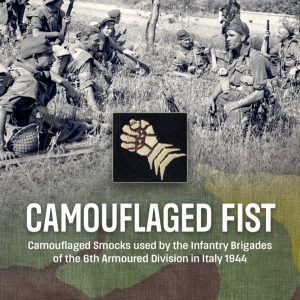

Followers of this blog will likely be aware of the story of the photograph that features on the cover of Camouflaged Fist (if not click here!) containing one of my great grandfathers, Glyn Spowart of 3rd Battalion (Bn) Welsh Guards. I am extremely fortunate to own another fantastic photograph of him in the field that was found in his estate following his passing.
A Personal Photograph
Glyn is standing back row, fourth from left, with another 23 NCO colleagues from No1. Rifle Company (Coy). It has proudly hung in my last three homes for over twenty years and I continue to look at it each and every day:
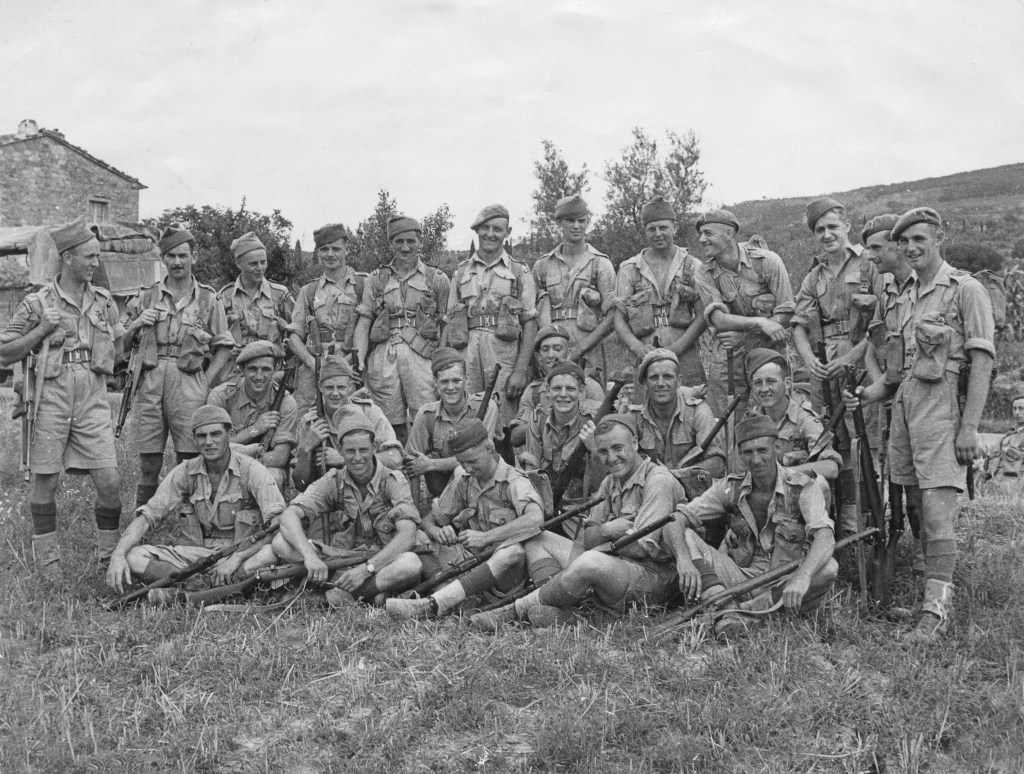
I’m sure you’ll agree it’s an absolutely superb photograph; with all of the men laughing and smiling but armed to the teeth with weapons and bandoliers. The fact that they can laugh and smile after all they endured by that time in Italy; Monte Ornito and Cerasola, Cassino, Arce and Perugia, is testament to the fortitude of those of the greatest generation.
I have often wondered about the fate of the men in this photograph, for this was taken some ten months prior to the end of hostilities; the gruelling and costly battles for Arezzo, Florence, The Gothic Line and the Po Plain were yet to come. Just six days after this photograph was taken, Sjt. Best of the Army Film and Photographic Unit would capture Glyn (16 July 1944) wearing a M1929 Telo Mimetico camouflage smock, denim trousers, and a US enlisted man’s shirt at the L’Olmo Pass, Arezzo as referenced earlier.
3Bn was to take significant casulaties in the Mediterannean Theatre. Following the German surrender in Italy on 2 May 1945, the then 3Bn C.O. L/Col. Rose-Price addressed his troops and stated:
“Today we are 320 strong. Almost exactly 1000 guardsmen sailed from England on 5 February 1943 and since the almost exactly 1000 more have to come to us.”1
When examining this photo closely we can see the anything but the uniformity we would ordinarily expect from guardsmen. Whilst they are all wearing full ‘shorts and shirts’ khaki drill order, some have berets, others have cap comforters, some wear shoulder titles, some do not, there’s a mix of blanco’d and unblanco’d webbing … I could go on. There’s just so much detail and nuance in the photo that it could keep even the most experienced kit-nerd entertained for a while. As an aside, the photo is featured on page 54 of Camouflaged Fist as a part of a discussion on debunking the myth that pattern 37 webbing was, generally, left unblanco’d in the Italian Campaign.
As stated in the caption, the photograph is marked to the reverse with the compliments of Major Sharples MC (Military Cross). Richard Sharples assumed command of 1 Coy on 24 June 1944 after Major W.T.C. Fogg-Elliot was killed during an attack on a house near Pt 532 west of San Marco, Perugia on 21 June 1944.
This important caption enabled me to confirm that Glyn was a member of 1 Coy. This has allowed me to be able track his war by following the exploits of 1 Coy, in particular detail, throughout the entire campaign.
As a part of my research over the last 20 years I have trawled through tens of thousands of images of the Italian Campaign in painstaking pursuit of seeking out those of 3Bn Welsh Guards. Some time ago I found two photographs of 3Bn in the Imperial War Museum (IWM) Collections Archive and immediately recognised Major Sharples in both, despite the low resolution of the images.
It is a shame that a large number of photos retained by the IWM archive relating to the Italian Campaign have yet to be fully digitised into high resolution scans. Resultantly, I have peered over these low resolution contact prints for some time often wondering, owing to the similiarity in surroundings and attire worn, if they were taken at the same time as the group photograph containing my great grandfather2:

I had always intended to order and pay for the IWM digitisation to obtain these photographs as high resolution scans, just as I did for the never-before-seen photographs in Camouflaged Fist. For one reason or another, I hadn’t got round to it.
A Breakthrough: Dr. Niccolò Tognarini
During my recent visit to Arezzo in July 2024, I was delighted that Niccolò and I, who’d been communicating online for some time, were able to meet face-to-face to discuss all things Italian Campaign over lunch. I was both shocked and humbled by him going to such great efforts in travelling from northern Italy to meet me, for lunch, in Tuscany!
Whilst we were chatting Niccolò reached into his bag and presented me with a book written by his late father, Ivano Tognarini, covering the war in Arezzo between 1943-1944: La guerra di liberazione in provincia di Arezzo 1943/44 – Immagini e Documenti3. As I started flicking through it, I nealy choked, both of the photographs of 3Bn Welsh Guards were in the book. Futhermore they had been excellently and faithfully reproduced from Ivano’s personal copies in high defintion 10″x10″ prints.
I am extremely grateful to Niccolò for him allowing me to copy them, here they are with all the splendour of detail:
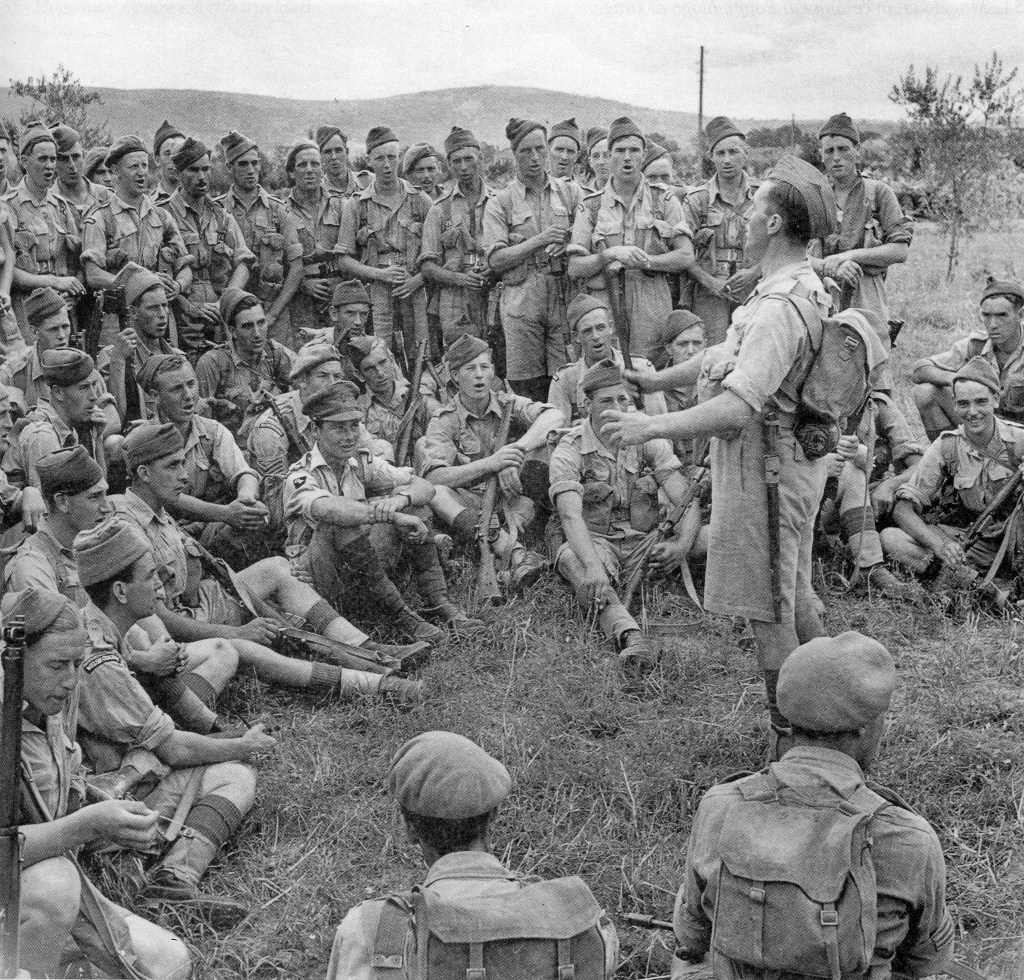
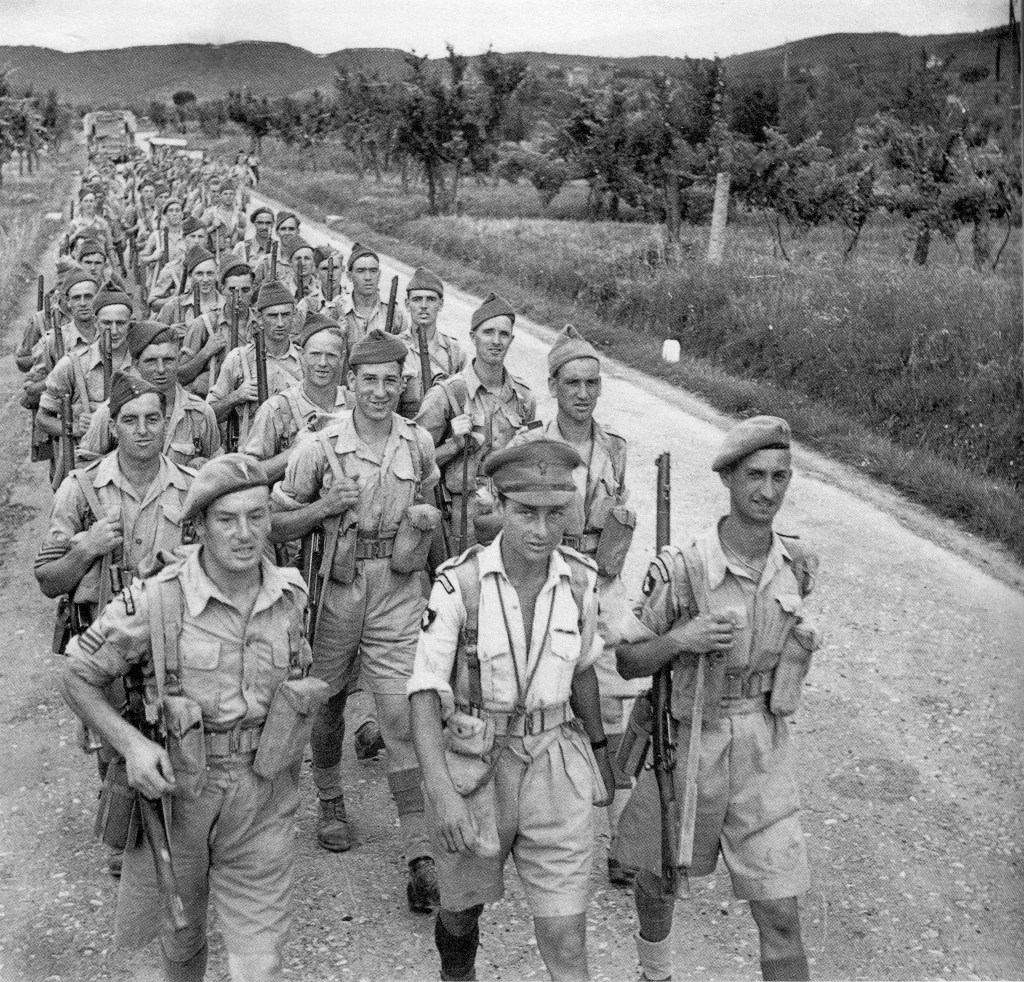
The IWM captions recorded by Sjt. McConville4 of the Army Film and Photographic Unit (AFPU) state that both photographs were taken on 11 July 1944 in the “Arezzo Area”, but this is not the case5.
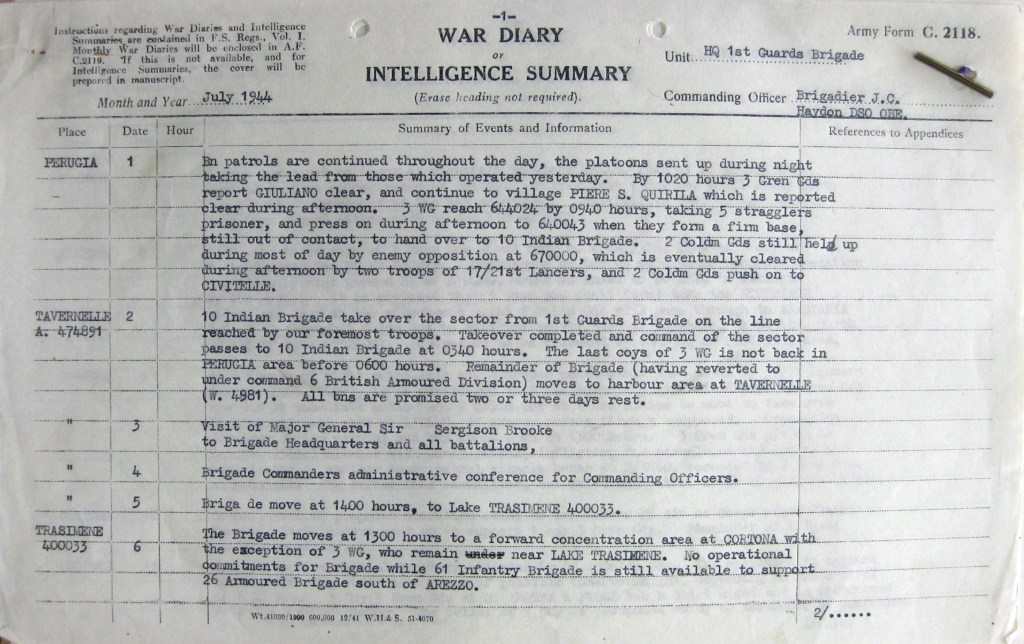
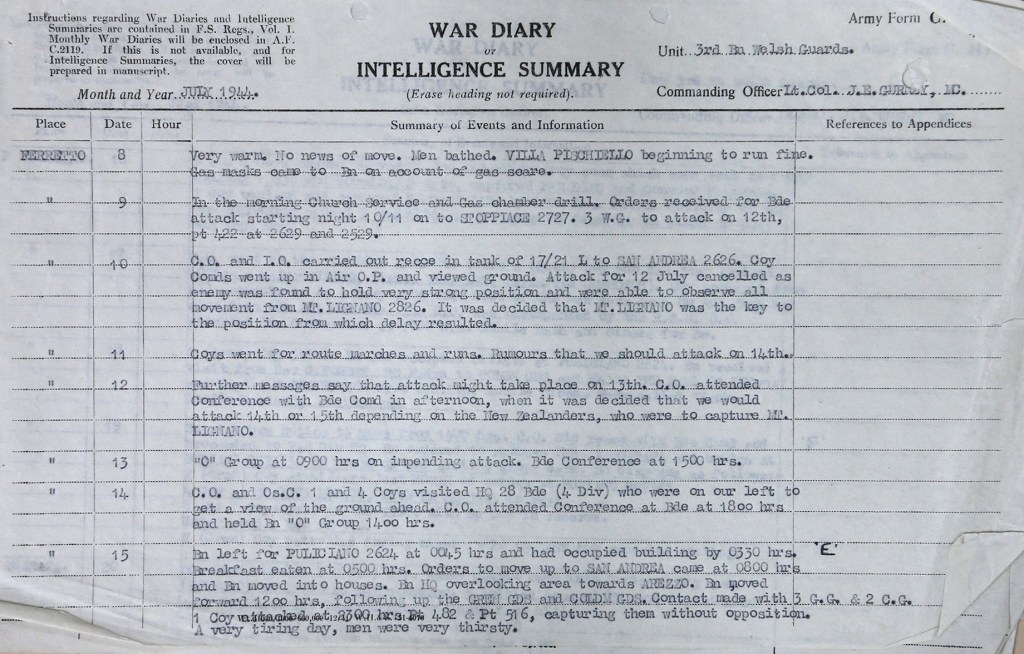
The 1st Guards Brigade War Diary states on 6 July that: “The Brigade moves at 1300 hours to a forward concentration area at CORTONA with the exeception of 3WG, which remain near LAKE TRASIMENE”. The 3Bn War Diary further pin-points their location as being at FERRETTO on the north western shore of Lake Trasimene. Additionally, on 11 July 1944 the War Diary entry notes for that day that “Coys went for route marches and runs” which is wholly consistent with the photographs taken by Sjt. McConville:
The Forensic Analysis
Within days of returning from Arezzo I digitised the photographs within Ivano’s book by scanning them at 200% size to provide 20″x20″ high resolution digital files.
I quickly discovered that it was absolutely beyond doubt that the three photographs were taken in quick succession of one another, solving my long standing and ponderous mystery.
Close inspection of the ‘marching photograph’ shows that it contains approximately 67 men, two italian civilians and a vehicle. The photograph of the men singing in ‘preparation for the Florence Eisteddfod6‘ contains 45 men. It is useful to know that at that time the Field Return for Other Ranks7 (OR) and Officers8 evidences that the Bn was at 94.5% strength overall.
Whilst the caption on the reverse of the photograph from Major Sharples states the date as being “August 1944”, my hypothesis is that this is when the photographs were provided to Sharples. It is my belief that he commissioned Sjt. McConville to take additional photographs of 1 Coy and then arranged for them to be distributed to the men, including Glyn. Hypothesizing again, this may be due to the fact that at that time Major Sharples had only recently taken command of 1 Coy and may have used the gifting/issue of group photographs as an opportunity to increase both morale and his reputation amongst his men. Either way, I’m sincerely glad he did, some 80 years later!
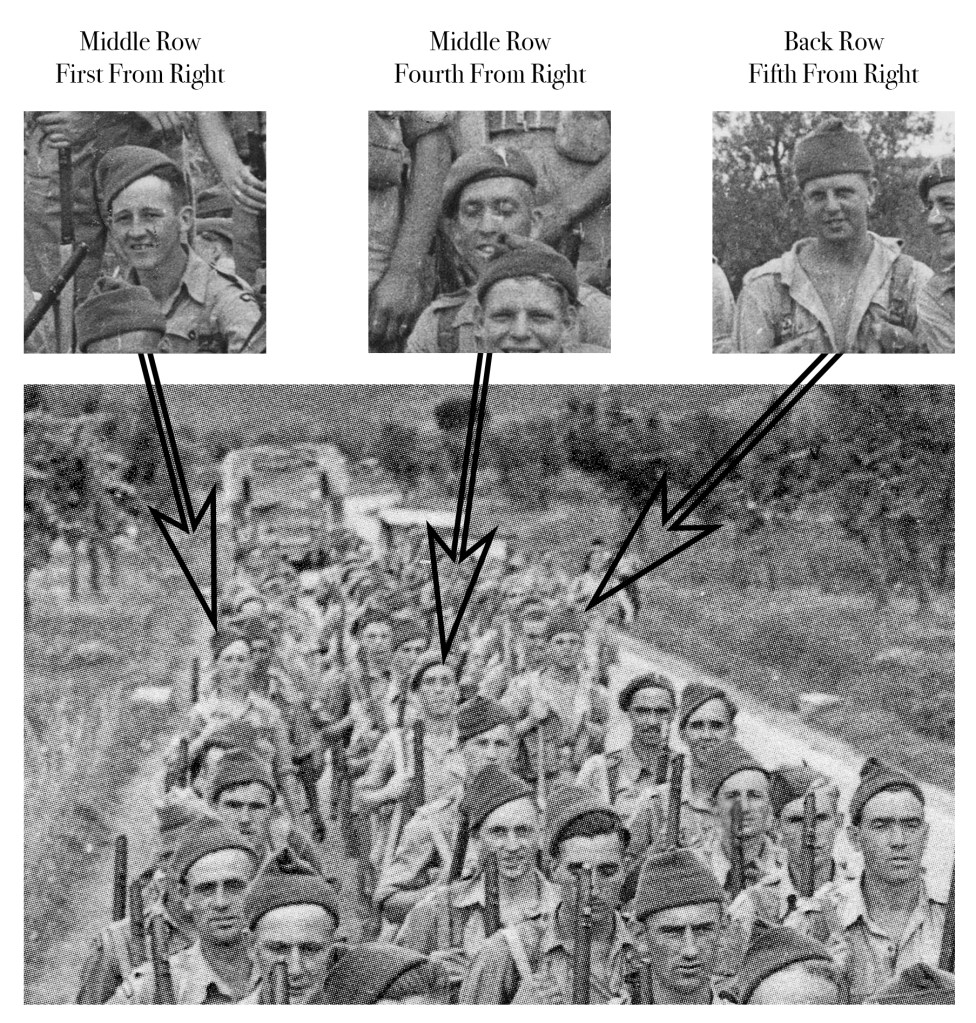
The photograph from Sharples has 24 men captured within it (including Glyn). I have been able to irrefutably identify and cross reference seven men within the ‘Florence Eisteddfod’ photograph. This was achieved through extremely close examination to match the men’s headwear type/colour shade/style of wear/creases, hair exposure beneath headwear, general dress, wear of shoulder titles, webbing and equipment nuances and colour etc.
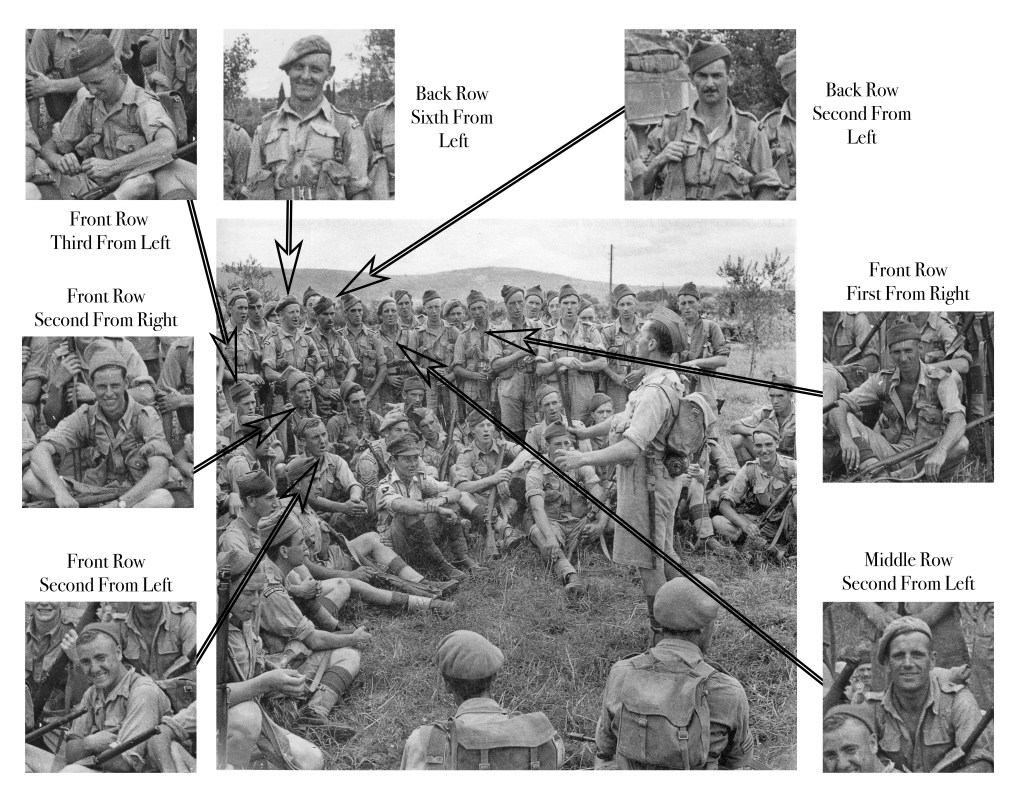
The men captured with Glyn in Sharples’s photograph would account for approximately 36% of the total men in the ‘marching photograph’. It appears that most of them are presumably marching towards the end of the column and are therefore indiscernible. However, three men can be identified in both photographs mid-way along the column.
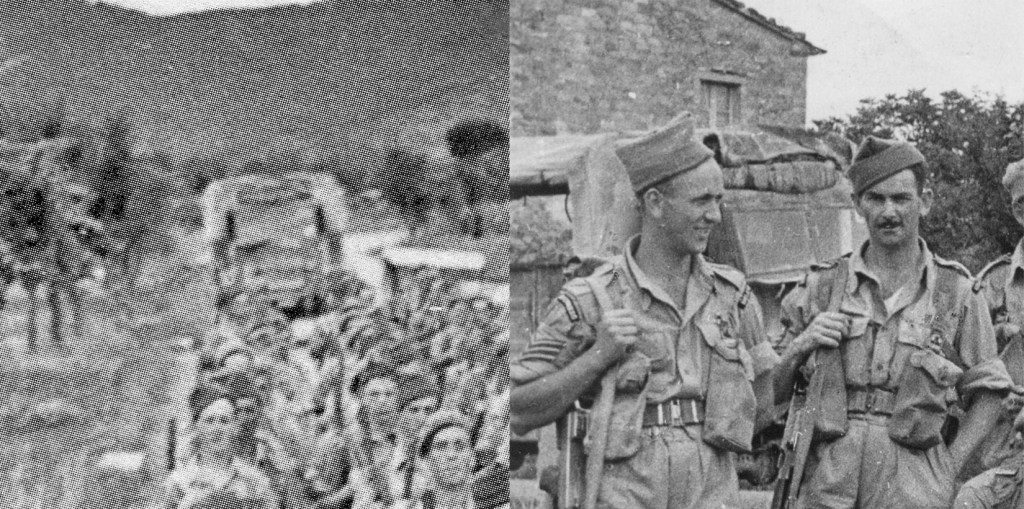
The Bedford MW truck can also be confirmed to be the same vehicle on account of the identical stowage of the canvas over the cab and to the sides as evidenced in both photographs.
Whilst it is a shame that Glyn cannot be positively identified in either of the photographs provided by Niccolò, it is beyond doubt that owing to the sequencing of the images (and the absolute un-duplicatable consistencies in headewar, dress, etc. between the photographs as outlined above) that he was within the column and singing, or at the very least present at that time.
Interesting Details
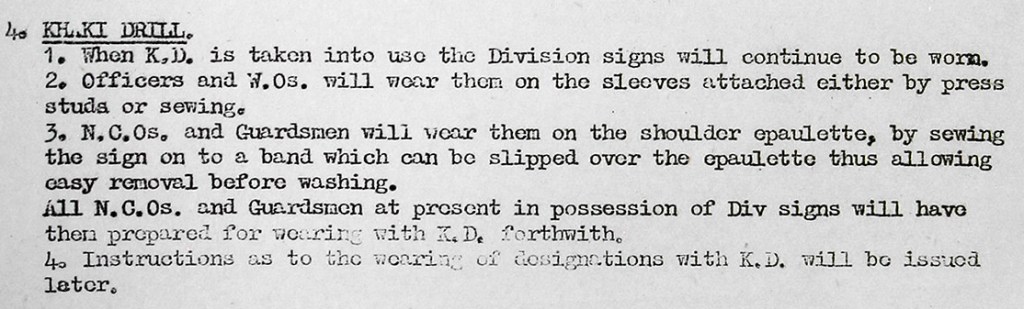
It is interesting to note that Major Sharples and, presumably, the Company Sergeant Major are both wearing the 6th Armoured Division Mailed Fist formation signs in a similar fashion to that designated in a Bn order issued to 3Bn Grenadier Guards (the senior Bn within 1st Guards Brigade) on 1 May 1944 at Cassino. It is also worthy of note that none of the NCOs or Guardsmen are wearing 6th Armoured Divison formation signs on epaulette sliders within any of the photographs:
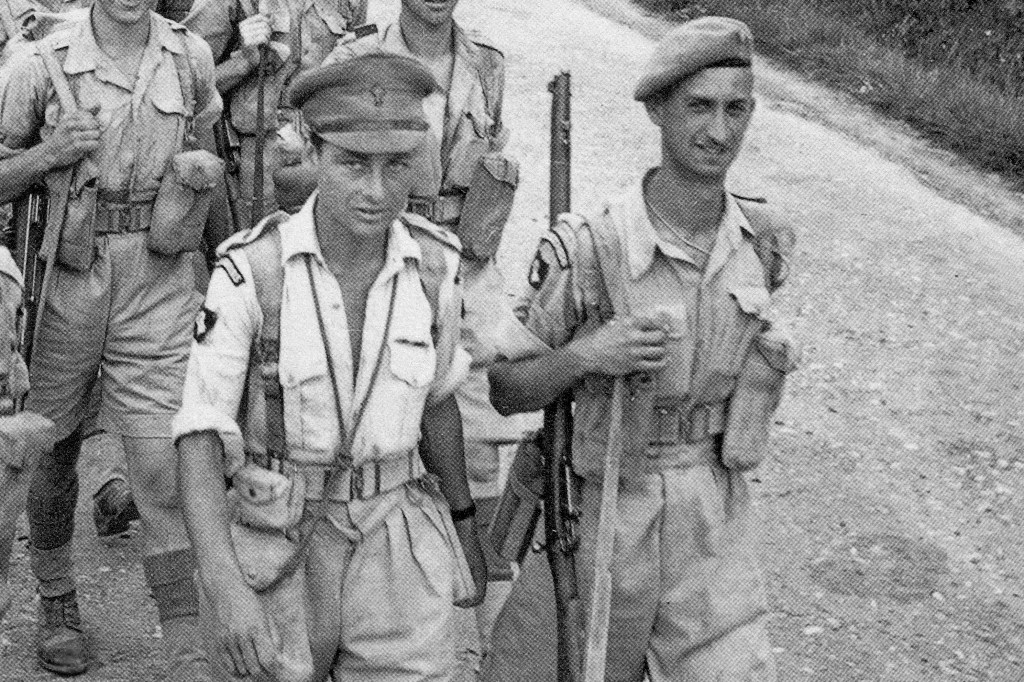
Also note the presumably private purchased, pale/white/sun bleached, khaki drill shirt worn by Major Sharples along with his heavily sun bleached pattern 37 webbing belt, ammunition holder and holster. As per the famous ‘Two Types’ Central Mediterannean Front parody, I believe these items are worn as badge of honour come status symbol by way of distinguishing his veteran status as a new company commander.
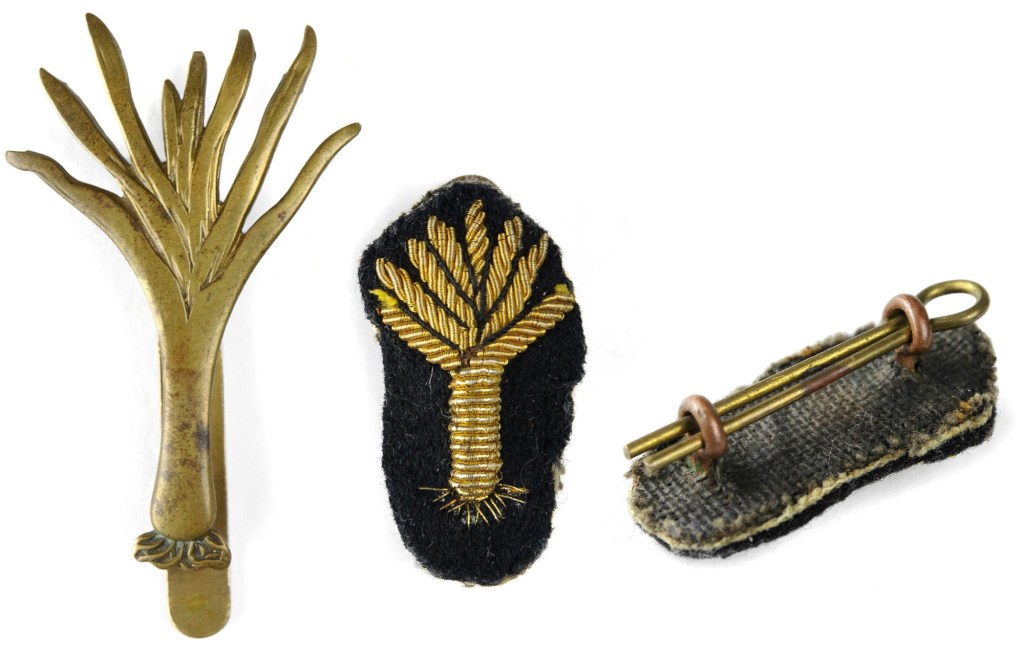
It is also worthy of noting the interesting Welsh Guards leek cap badge worn by Major Sharples. This is the of the small Khaki Service Dress type seen in use by officers and, again, is likely to be a privately purchased Italian made item in bullion wire. The author has an identical badge held within his collection, it is very small, measuring 3.4cm in length:
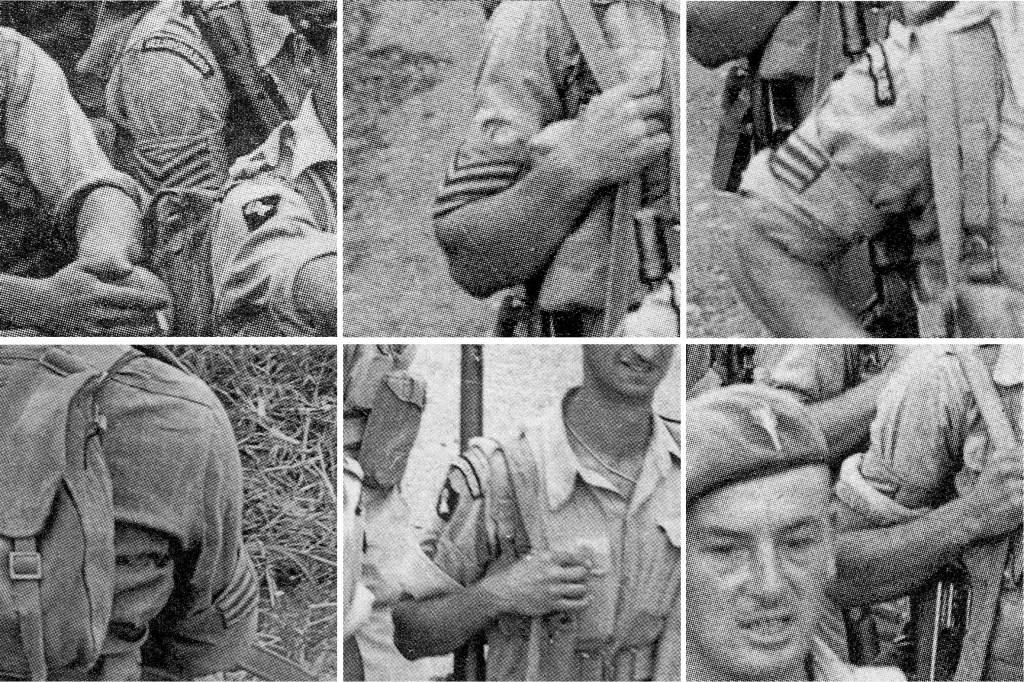
The photographs provided by Niccolò have also enabled an improved understanding of the types of rank armbands in use by 3Bn Welsh Guards. The exerpts from both photographs presented below enables multiple types of arm bands to be identified including the mixed use of tropical and non-tropical stripes and tapered/non-tapered bands. This will likely be of significant interest to scale modellers and living historians:
Three examples of original rank armbands from my collection:
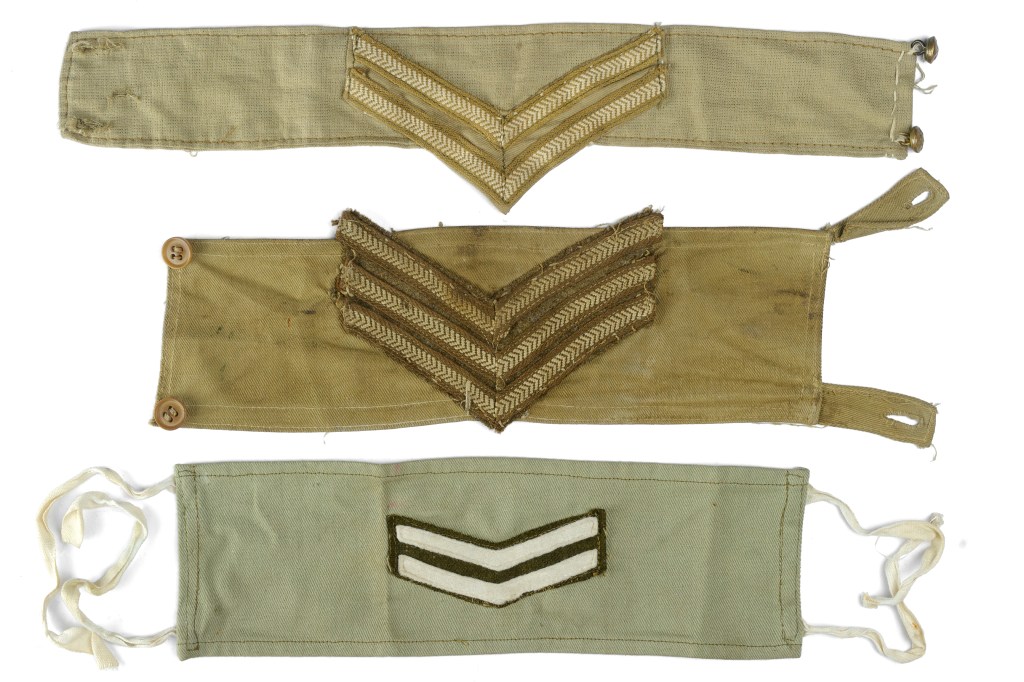
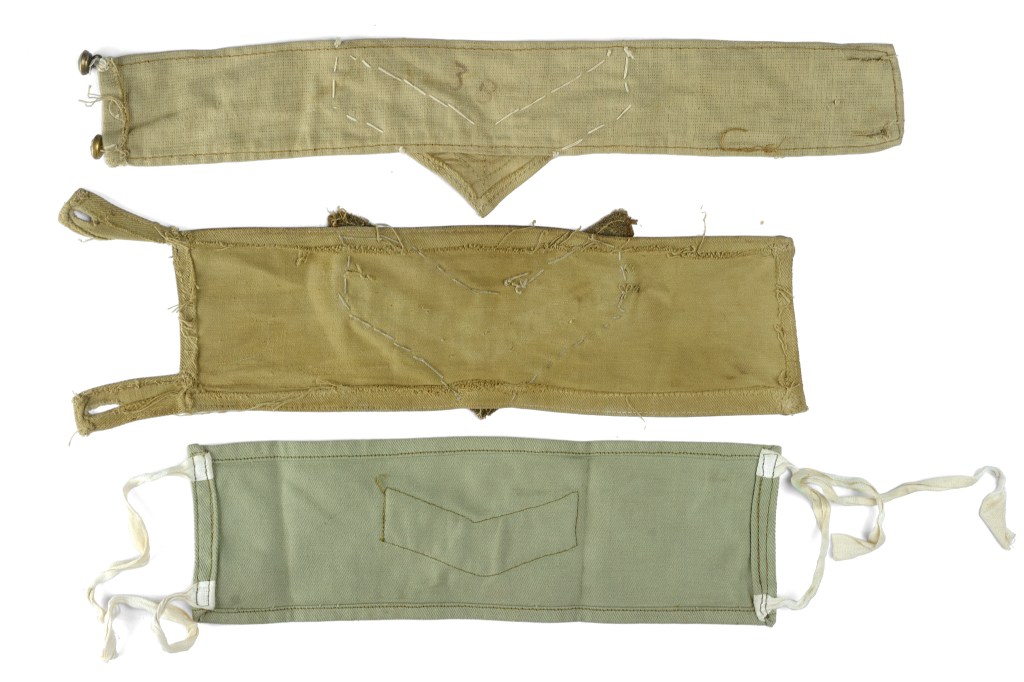
Top: This item has direct provenance from L/Cpl Mathews 3Bn Welsh Guards of Grangetown Cardiff. It is made of Aertex khaki drill material, has tropical stripes and uses service dress cap buttons as fastners. This example features on page 97 of Camouflagued Fist. I believe it is probable that this was made at Royal Army Ordnance Corps ‘C’ Clothing and Repair Factory, Naples. Glyn is wearing an identical example in the photograph taken of him as featured on the cover of Camouflaged Fist. Middle: Khaki drill material, ‘normal’ coloured stripes, shirt buttons as fastners. Bottom: Tropical armband with tie tabs.
© Copyright Gareth Scanlon 2024.
Where Was It Taken?
The next, inevitable, step with these photographs was to attempt to locate the exact site where they were taken in order that I may once again return to Italy to stand in the exact spots that Glyn once did.
We know from the 3Bn War Diary entry on 11 July (as presented earlier) that the Coys were route marching on the day the photographs were taken. Given that the frontline at this time was not that far away, I am surmising that the marches would have been kept within a reletively short distance of Ferretto.
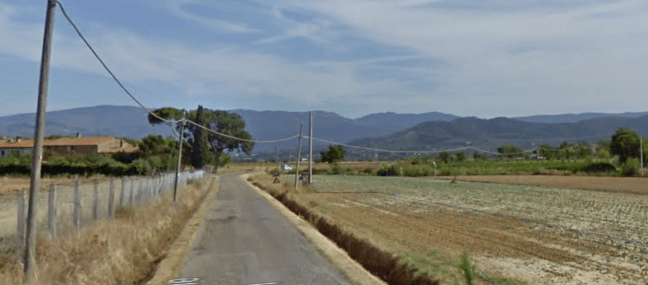
I began scouring every road leading west from the the mountain ranges east of Ferreto on Google Maps in attempt to match the persepctive of the mountain profile as captured behind the guardsmen in the ‘marching photograph’.
I have been able to find two locations that enable the scene to be matched. The first potential location is on the Strada Communale dei Landucci between Ferretto and Terontola. Whilst this profile matches identically, the road appears to be too narrow in comparison to the original photograph. It must be remembered that during the 1940s Italy’s road infrastructure was not what it is today, wide metalled roads were very much a rarity.
The second potential (and more likely) site is locted on the Strada Provinciale 33 between Pietraia and Riccio, this is a much wider road as depicted within the photograph.
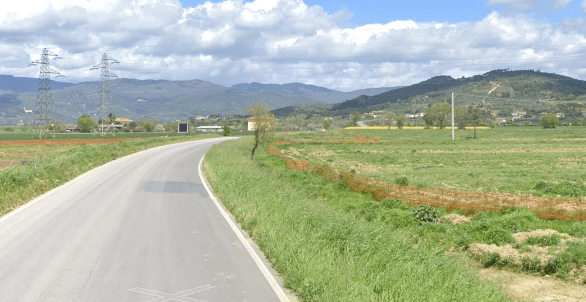
Whilst I am reasonably confident that one of these locations is likely to be it (likely the latter), this will inevitably require more investigation. For example, I’m not sure whether the white object near the ditch in the ‘marching photograph‘ is a just a dust spot or indeed a distance marker that could aid the identification of the exact location. I’m currently in the process reaching out to friends in Tuscany and Umbria with local knowledge and familiarity with the area to see if they are able to assist. Following the successful identificiation of the road, the hunt to find the house behind the Beford MW truck in Major Sharples photograph will begin in earnest!
Final Thoughts
I apologise for what has been a longer than normal article, I’m just so absolutely delighted to have been able to unequivocally link the photographs (as I suspected) and particularly to a series of events and places which offers another link to my great grandfather Glyn’s service. I really wanted to take the time to set out, in detail, my journey of discovery, the approach taken and the interesting finds along the way.
I sincerely hope you enjoyed it!
I also hope that it may serve to inspire and assist other relatives of the ‘D-Day Dodgers’ of 3Bn Welsh Guards in seeking out photographs of their family members too.
Thank you,
Gareth
- Scanlon, Gareth, Camouflaged Fist, Camouflage Smocks used by the Infantry Brigades of the 6th Armoured Division in Italy 1944 (Warwick: Helion & Company Ltd, 2024) p.xiv ↩︎
- I recently posted this conundrum on my social media pages on X and Facebook ↩︎
- Tognarini, Ivano, La Guerra Di Liberazione In Provincia Di Arezzo 1943/44 – Immagini e Documenti (Arezzo: Amministrazione Provinciale Arezzo, 1988) ↩︎
- Who incidentally would take numerous photographs of the men of 10Bn Rifle Brigade, 61 Brigade, 6th Armoured Divison, wearing camouflaged smocks in Arezzo on 16 and 17 July 1944 as reproduced in Camouflaged Fist ↩︎
- This photograph has been documented in Camouflaged Fist as being taken near Cortona, albeit the acquisiton of the high resolution photographs from Niccolò have cast a new light on this statement ↩︎
- In Welsh culure, an eisteddfod is an institution and festival with several ranked competitions, including in poetry, dancing and music ↩︎
- Field Return of Other Ranks, 8 July 1944, 3rd Battalion Welsh Guards War Diary, WO 170/1355, The National Archives ↩︎
- Field Return of Officers, 8 July 1944, 3rd Battalion Welsh Guards War Diary, WO 170/1355 (water damaged), The National Archives ↩︎
 Camouflaged Fist
truly amazing research you are doing there, Gareth! Keep it up
LikeLiked by 1 person
It would have not been possible without you. Thank you 🏴🤝🇮🇹
LikeLike