
Introduction
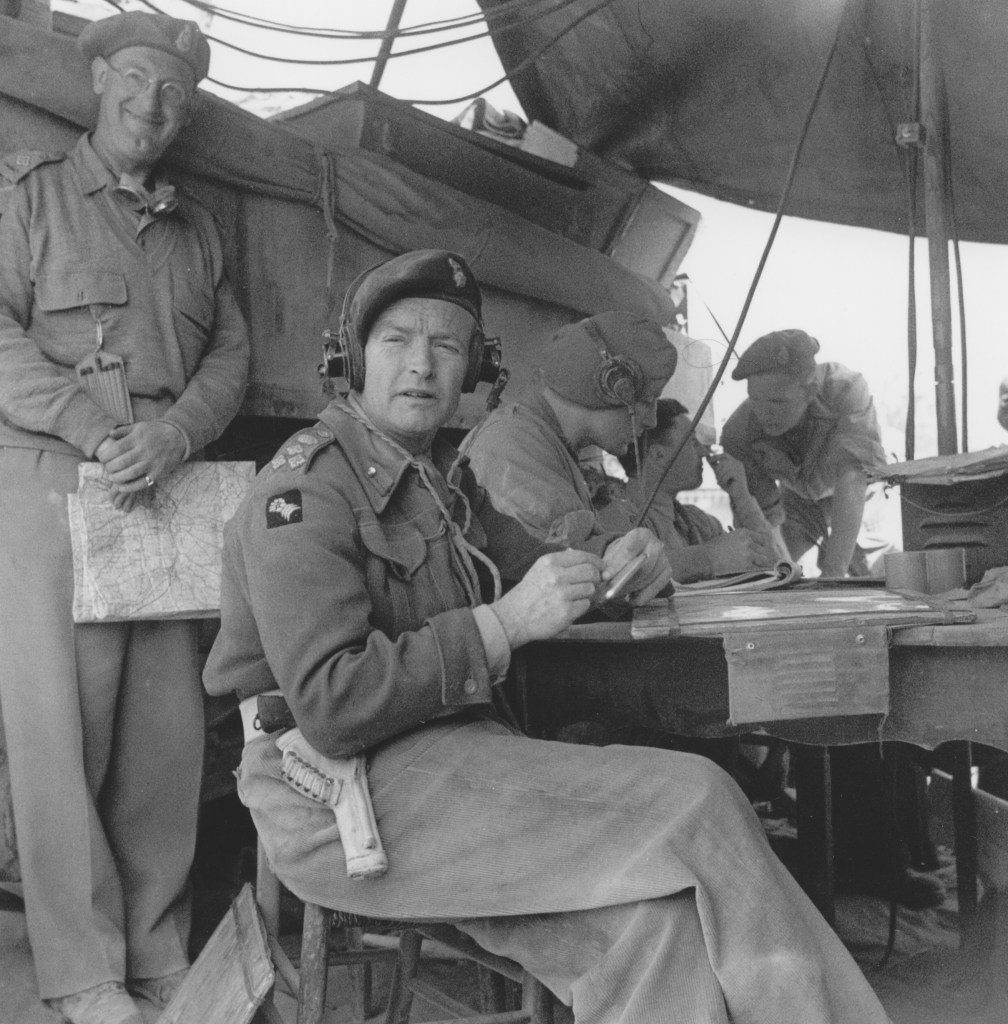
The British 6th Armoured Division was raised in September 1940 by Maj Gen John Crocker. For its divisional sign it chose a clenched mailed gauntlet in white on a square black background – a symbol that was to earn it the name of the ‘Mailed Fist Division‘.
Armoured Divisions were uncommon formations in the WW2 British Army. Ken Ford in his opening page of Mailed Fist – 6th Armoured Division at War 1940-45 states:
“There were of course many reasons why so few armoured divisions were raised and deployed, some of which had nothing to do with strategy or the tactics of how they were employed. The fact was that, apart from North Africa, there was rarely a battlefield on which British forces were engaged that was suitable for them to act as armoured divisions. Most of the time they went into action not as divisions, but as a collection of armoured regiments in support as the infantry1“.
6th Armoured was to opperate in both circumstances that described by Ford during its active service in Tunisia and Italy from 1943-1945.
Following the end of WW2, the 6th was the only British armoured division which remained in service in a theatre outside north-west Europe. The other four survivors were the Guards, 7th, 11th and 79th Armoured Divisions. In July 1946 the division was redesignated as the 1st Armoured Division and retained its Mailed Fist divisional sign. Thereafter the division was moved from Trieste in Italy to Palestine and was subsequently disbanded in September 1947.
Unlike most other British Divisions, there was no history of 6th produced after the Second World War. Aside from Ken Ford’s book referenced above, and a few personal accounts, there has been comparatively little written regarding the exploits of the division, with those fighting within the 8th Army in North Africa (6th Armoured was a part of the 1st Army) and in 21st Army Group in North West Europe attracting more attention. Consequently, little has been written about the Mailed Fist divisional formation signs too. Aside from a few isolated social media posts, there is no definitive guide to enable historians and collectors to identify original war-time period examples.
As an aside, and to avoid any confusion, two 6th Armoured Divisions were operating simultaneously in Italy during 1944-45; the British Division subject to this article and an entirely separate formation, the 6th South African Armoured Division. To distinguish one from another, they are often abbreviated in contemporary documents as 6th BR Armoured and 6th SA Armoured Divisions respectively.
To frustrate matters for collectors a little further, the division was reformed in May 1951 and assigned to British Army of the Rhine (BAOR) in Germany. Its key combat elements consisted of the 20th Armoured and 61st Lorried Infantry Brigades (a nod to its Italian Campaign history). It was finally disbanded seven years later June 1958. During this period the Mailed Fists were produced again, albeit in a differing style to their WW2 counterparts.
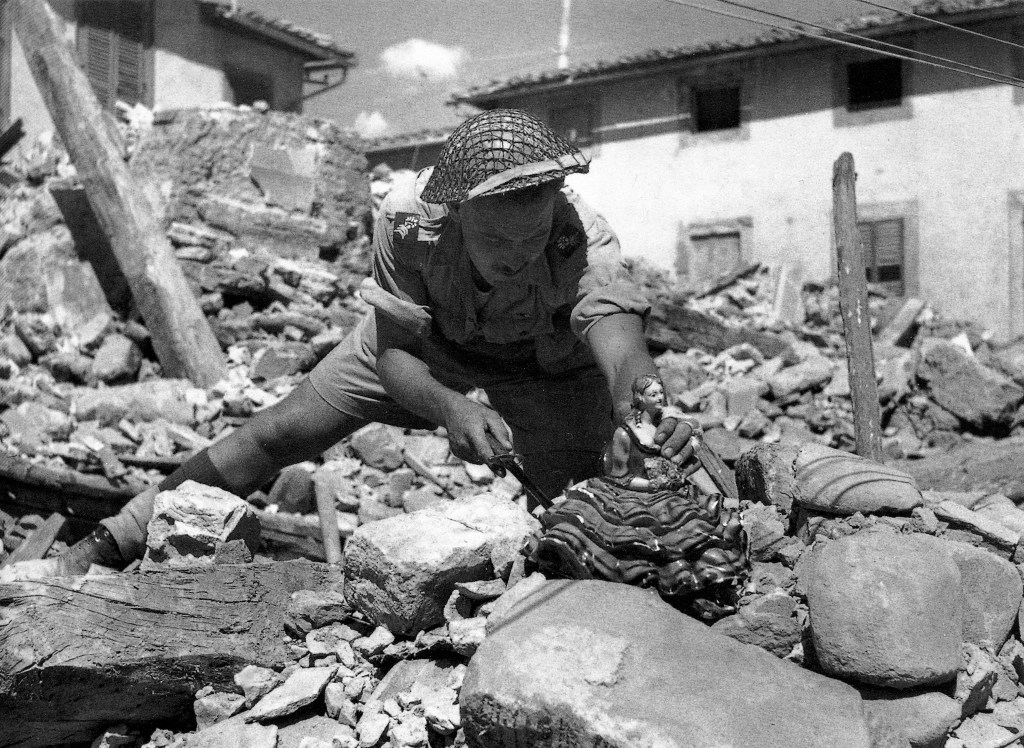
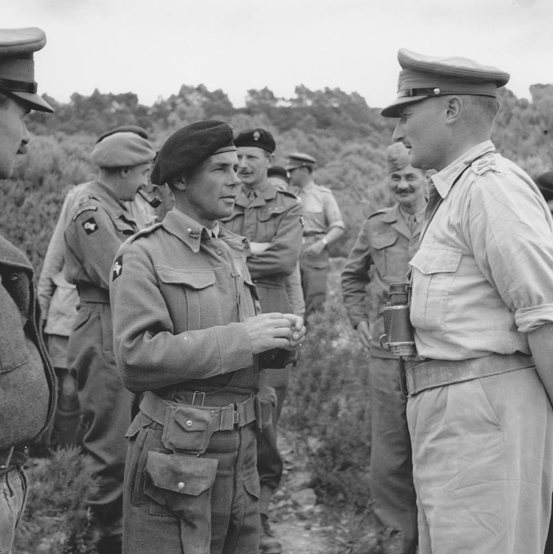
During WW2, the division was one of the more badged up units and thankfully numerous photographs exist of vehicles and men proudly sporting the Mailed Fist formation sign.
This article will focus on the badges worn on the clothing of the divisions men as per the below examples:

The Mailed Fist: Three Principle War Time ‘Types‘
Note: it is intended that this article will become a ‘living document’ which will be subject to regular updates as and when new and interesting information and badge variations come to light.
An armoured division was a large fighting formation comprising approximately 15’000 men. Furthermore, 6th Armoured Division was operational from 1940-1947 and during its life numerous units were rotated in and out of the division. It also inevitably received significant numbers of reinforcements to replenish casualties. It is likely that tens of thousands of Mailed Fist badges were manufactured and consequently they are common items on the collectors market today.
I have been researching the division, on and off, for over 20 years. As I continue to deepen my research I hope to uncover some contemporary documentation regarding the decision making around how the sign was chosen and designed and where and by whom it was made.
Over the years I have obtained numerous original war-time examples of the Mailed Fists worn by the men of 6th Armoured. From this I have identified common variations that I have categorised into three principle types; A, B and C:
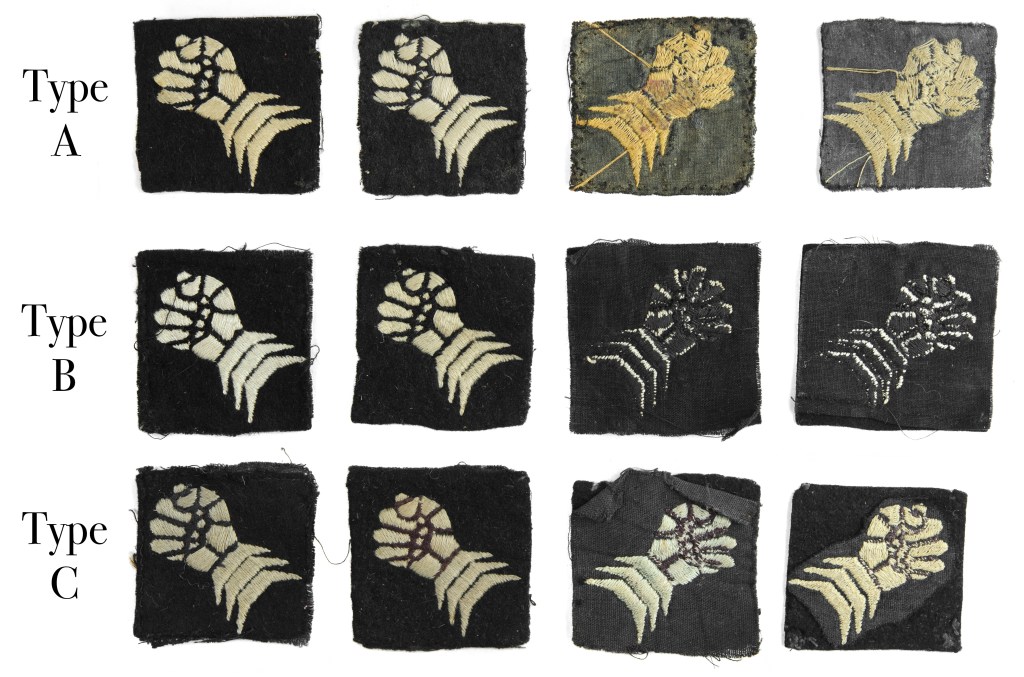
All types share several similar characteristics namely that they all measure approximately 4.5 cm by 5 cm and that the fists are formed of white thread embroidered over black felt which is reinforced by a backing material to hold the stitching. The most obvious differences between the three types concern the method of embroidery (as observed on the rear of each badge), the backing material used and any inlay embroidery of the fist itself. It is not clear at this time whether all three types were made by the same factory and that each type could denote batch differences, manufacturing expediencies, economy measures (etc.) or not.
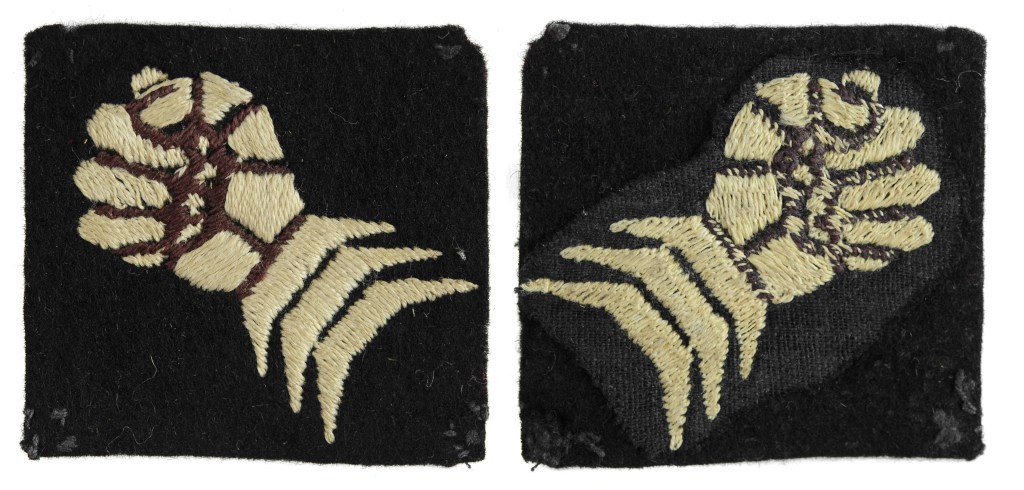
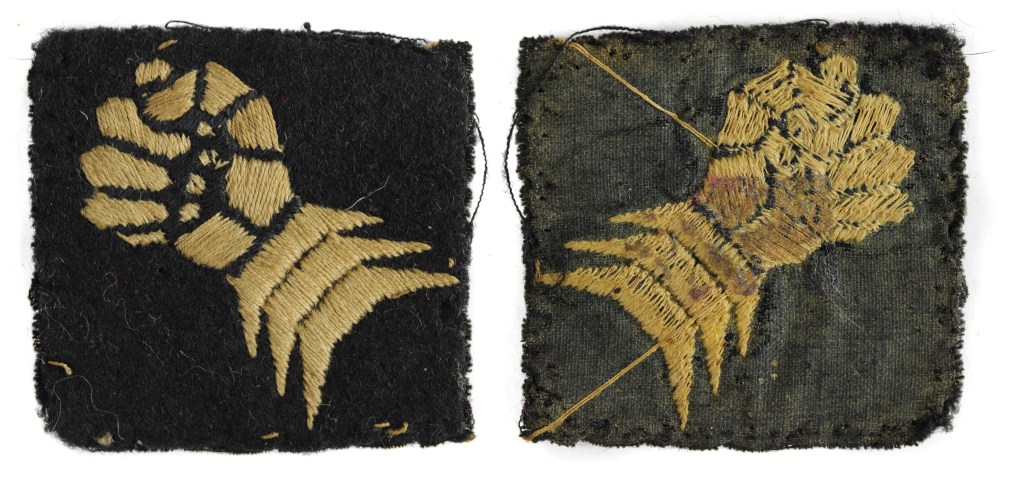
Without an opportunity to examine the reverse of any badge (to enable the backing material to be viewed), Type A fists can be easily identified by the larger clenched forefinger behind the thumb as illustrated in the photograph below:
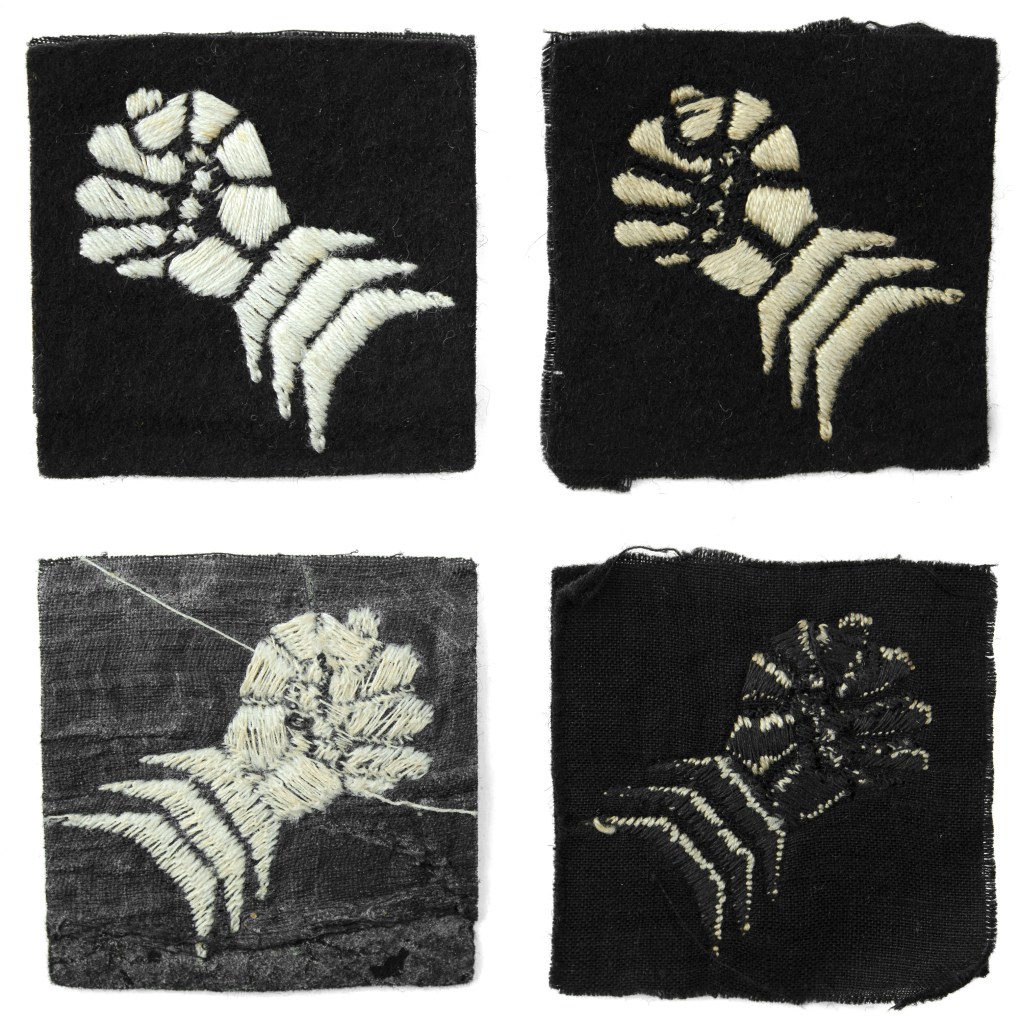
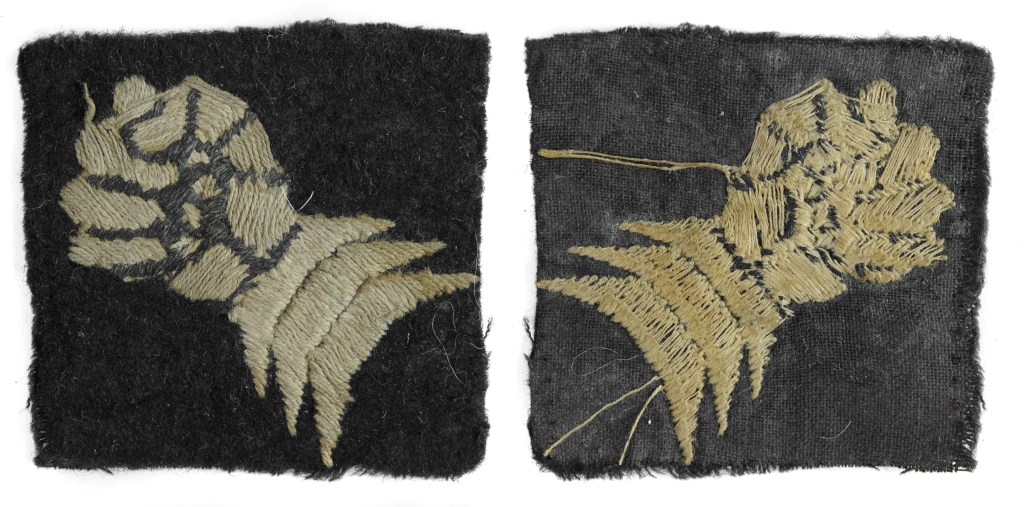
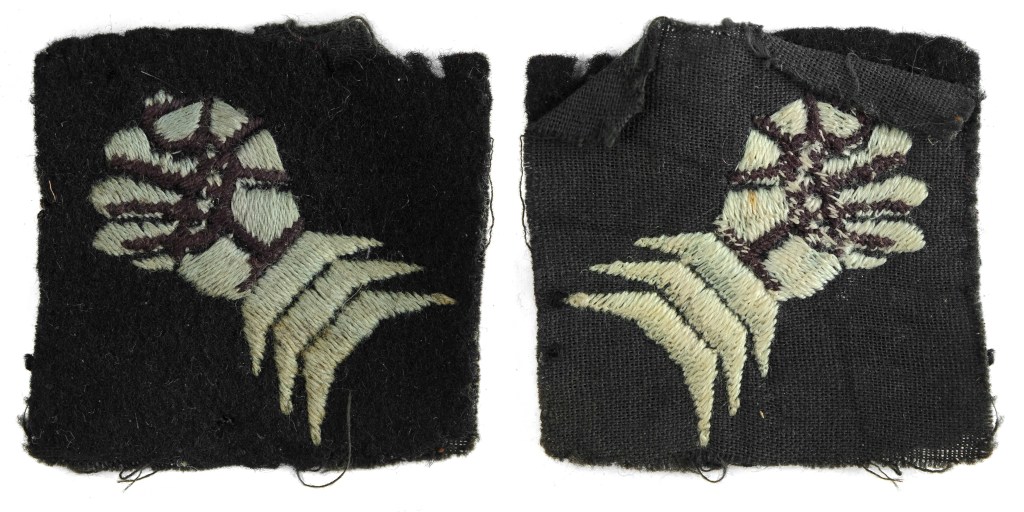
Type B and C fists both share the smaller clenched forefinger. Again without an opportunity to examine the backing material, Type B and C fists can be distinguished from each other by the colour of the inlay embroidery between the white features of the fist. Type B fists are always black whereas Type C are often in a brown, purple or grey cotton. Type A badges sometimes contain a grey cotton inlay, but never brown or purple, so close attention must be paid to the forefinger size as outlined earlier to ensure accurate identification (where the rear of the badge cannot be examined).
Provenanced Examples
I own a number of estate groupings from former soldiers of the division, many of which contain the formation signs, amongst other items, retained from their wartime service.
L/Cpl (later Sjt) White, 3Bn Welsh Guards, 1st Guards Brigade
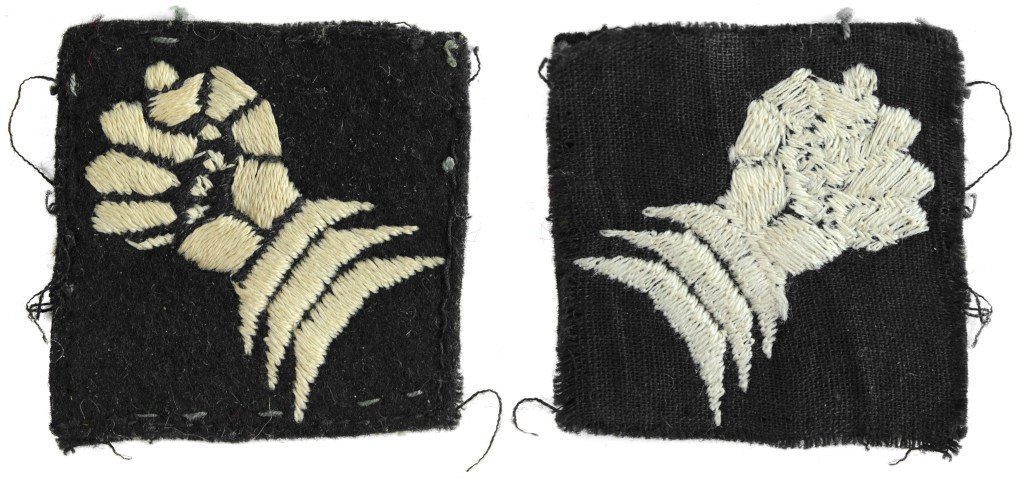
L/Cpl White served in Italy with the Welsh Guards. Following 3Bn’s disbandment in Austria, July 1945, he was transferred to 1Bn Welsh Guards in Germany. His estate contained an extensive amount of documents and paper items including his boarding passes for the Ville d’Oran (the ship that conveyed him to Italy), battalion and army commander messages, service cards, newspaper and magazine clippings, a pair of Welsh Guards cloth shoulder titles, his cap badge and numerous post-war Welsh Guards event and reunion memorabilia. It also included his fathers WW1 service paperwork. The badge has clearly been removed from his uniform and is of the Type A variety.
Derrick Manning, 3Bn Grenadier Guards, 1st Guards Brigade
His uniform removed Type C fist was obtained alongside his medals, a Grenadier Guards cloth shoulder title, his 1934 dated Guards Squad Photograph (taken at Caterham Barracks), post-war civilian portraits and a kings crown post-war Grenadier Guards Veteran Association badge (seen worn in his post-war civilian portraits). Interestingly, his grouping also contained a tunic removed German Wehrmacht enlisted mans breast eagle and a tunic removed Afrika Korps title band, assumingly liberated during service in Tunisia (or perhaps in Italy from an Afrika Korps veteran). After the war he ran a small hotel in Ipswich the address of which is documented on his service medal box.
L/Cpl Mathews, 3Bn Welsh Guards, 1st Guards Brigade
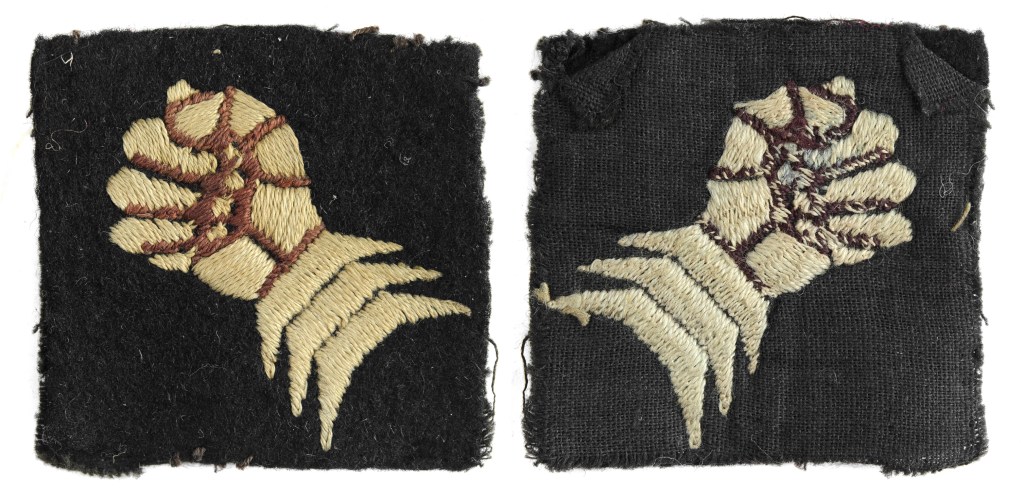
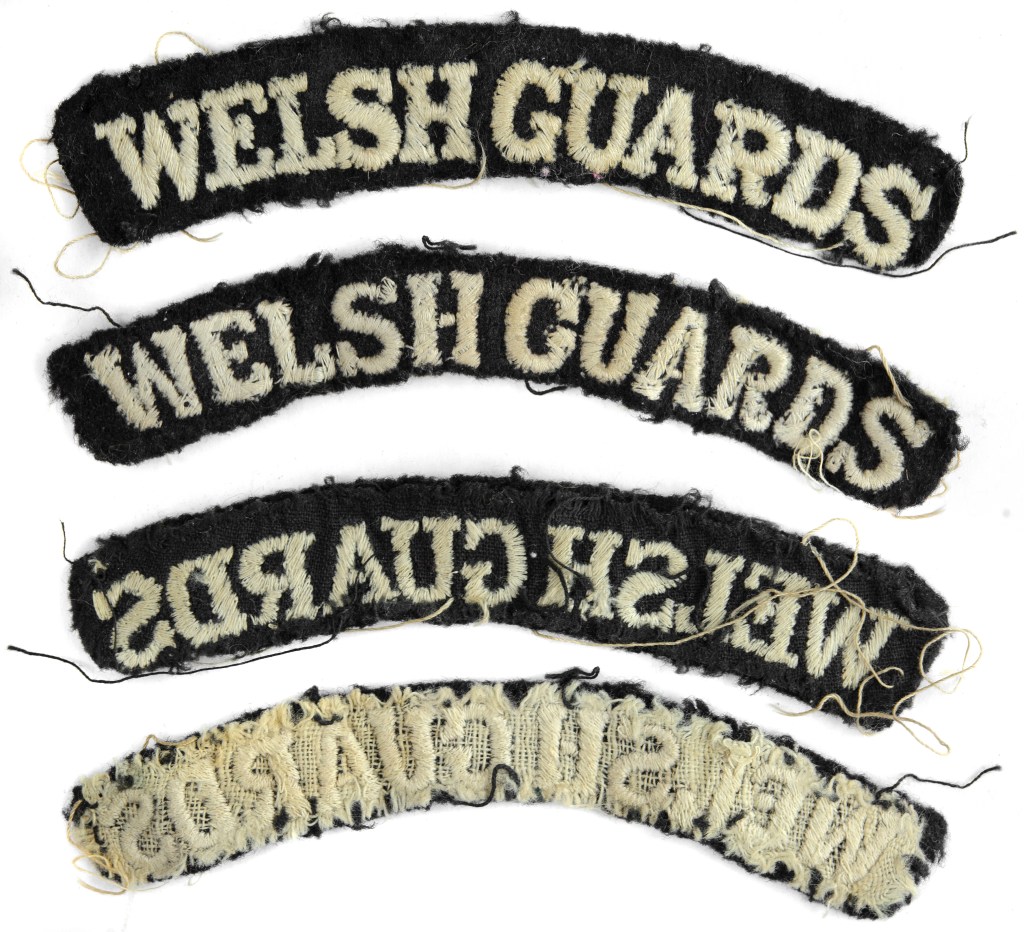
The estate of L/Cpl Mathews came complete with his brass pattern 37 belt buckle, brass Welsh Guards shoulder title, medal ribbon bar (1939-45 star, Africa star with 1st Army device and Italy star), Welsh Guards cap badge, four cloth Welsh Guards shoulder titles and an aertex khaki drill L/Cpl Rank Armband.
Both of his uniform removed fists are of the Type C variety. Both were, without doubt, worn together as evidenced by the conformity of the wear and the remnants of the stitching. It is interesting to note that both fists have different inlay features (brown and grey). Despite collectors wishing to match like badges it appears that these heavily worn examples were worn by him for a considerable part of his service and may have been issued together. Two of his unmatched Welsh Guards cloth shoulder titles again show considerable and uniform service wear and again were irrefutably worn together. He lived in Grangetown, Cardiff after the war.

Wear Orders: Press Studs & Epaulettes
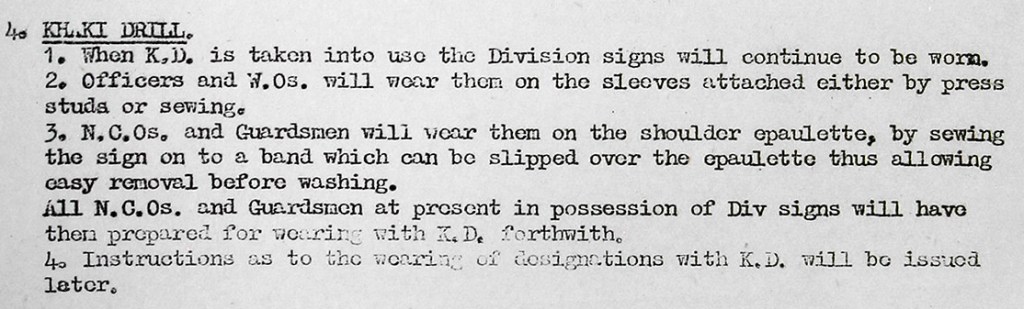
During my research for Camouflaged Fist I discovered a battalion order within the 3Bn Grenadier Guards war diary (dated 1 May 1944 whilst 1st Guards Brigade were at Cassino) stipulating how the Mailed Fist formation signs were to be worn by Officers, Warrant Officers and other ranks in conjunction with khaki drill (tropical) clothing. With the exception of the use of epaulette sliders, this likely extends in practise to how they were worn on serge battledress too:
I have a number of examples of Mailed Fists which use press studs to afix them to uniform garments. I believe that they were most likely worn by officers given the order above. The press stud method of attachment enabled the badges to be removed during laundering and ensured the same badges could be worn on other uniform garments.
The most interesting of these were located separately. In the photograph below, the left example was located at a militaria fair in Brecon, Wales whilst the right example came from a friend, Adrian Stevenson. Both badges feature four press studs to the rear around a fashioned piece of celluloid (akin to that used in British G.S. map cases) that has been cut to size and stitched to the rear. This has presumably been done to make the badge rigid. The fact that both examples were sourced separately gives credence to the fact that this practise, whilst uncommon, may have been widespread.
On the left badge, white cotton has been used to attach the celluloid and consequently the owner has painted or dyed the face of the badge around the fist itself black to disguise the white thread used. Both badges are of the Type A variety.
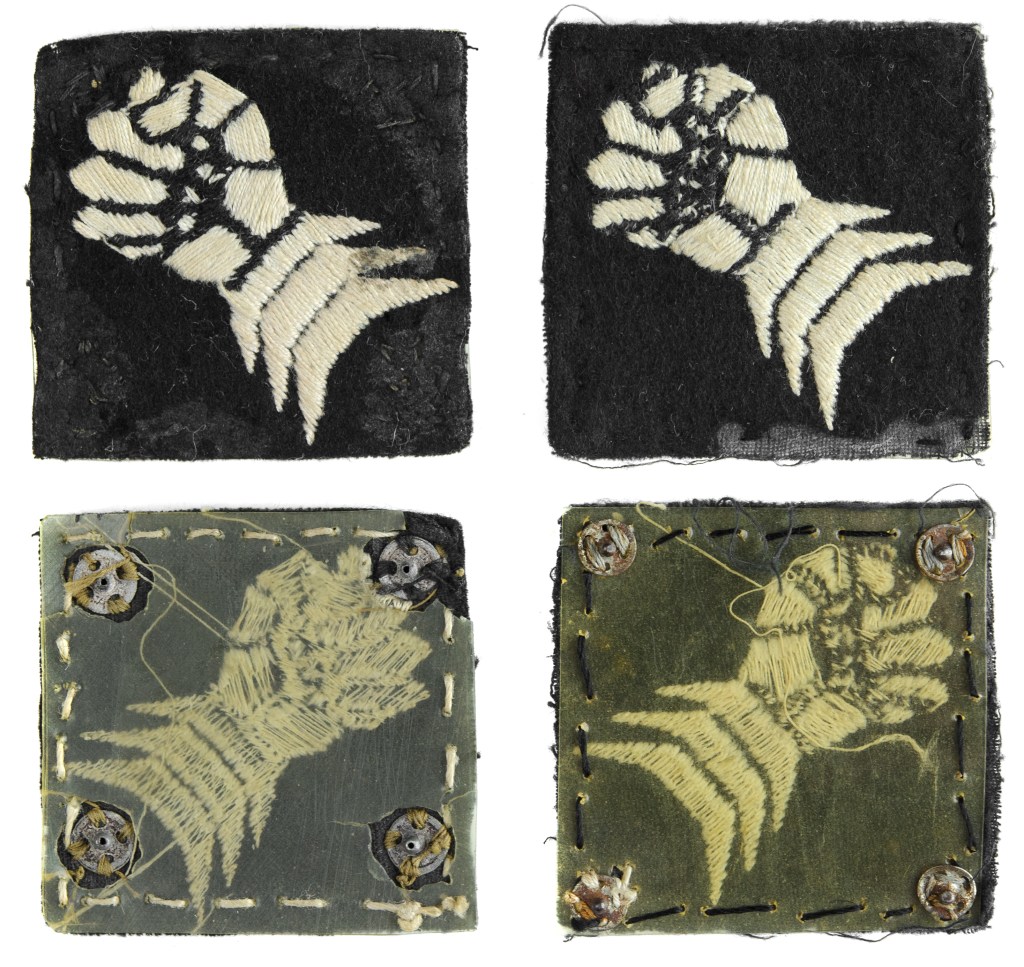
Another pair of matched Type A examples featuring the press stud attachment method:
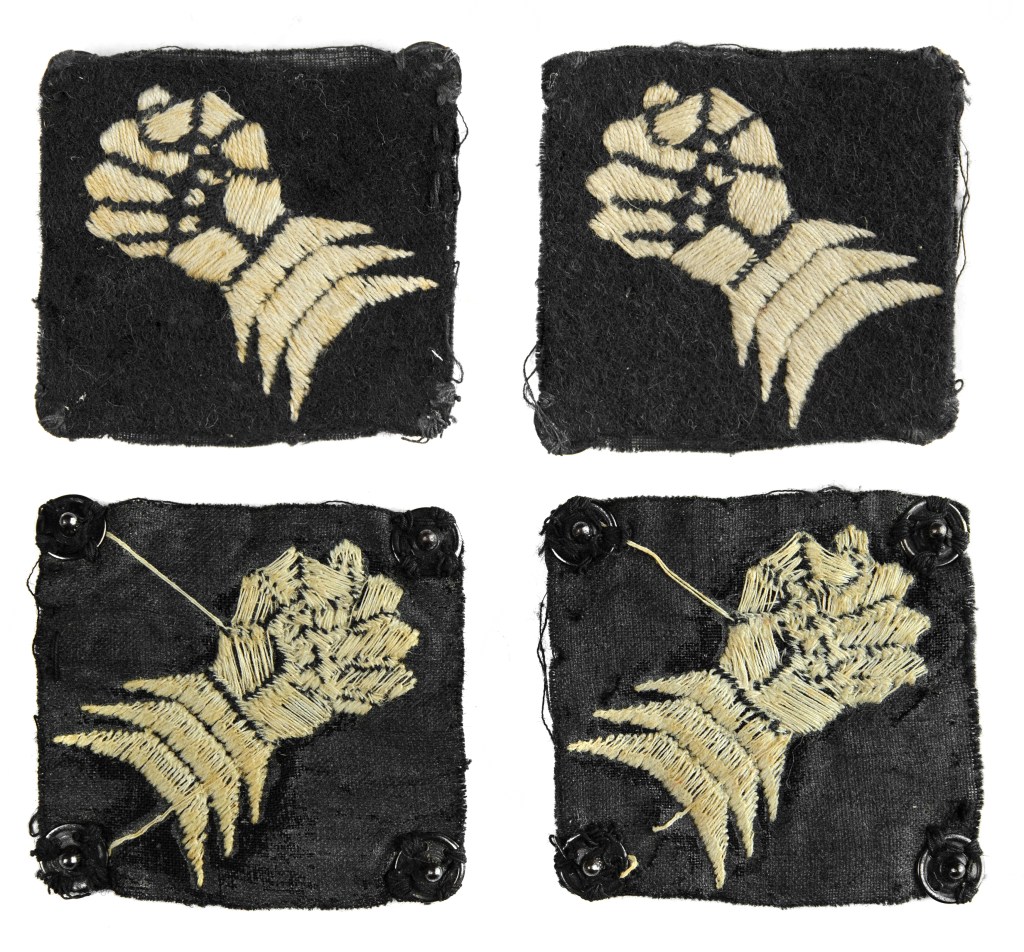
The below Type C example is featured on the cover of Camouflaged Fist. Remnants of stitches used to attach press studs can be seen in the four corners.
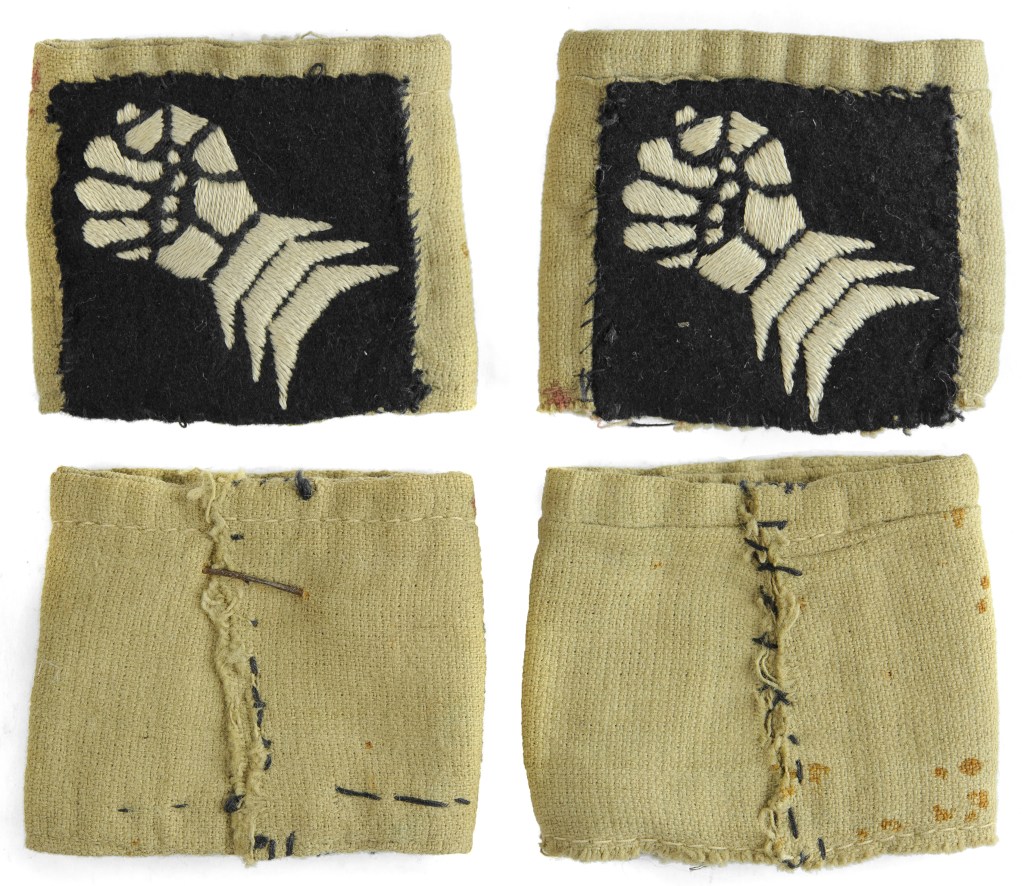
The epaulette sliders, which conform to the order (above) for other ranks, are field-made examples fashioned from what appears to be an Aertex khaki drill belt. These have been looped to make a band with black cotton thread and pins. The Type A fists have then been stitched to the band in the same black cotton thread to make the sliders.
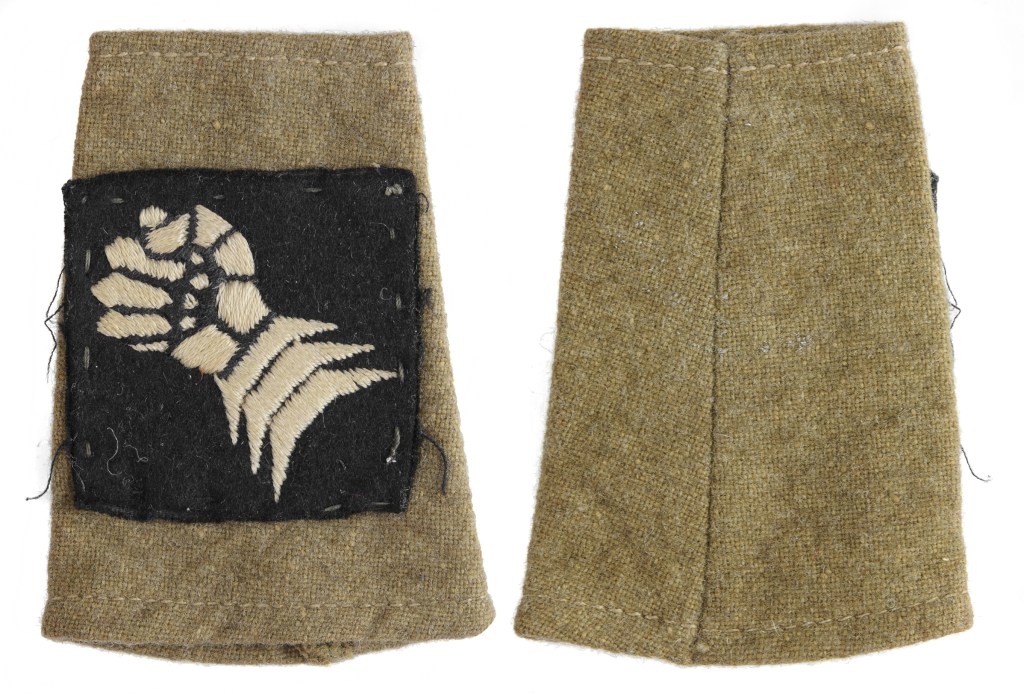
This type of epaulette slider is frequently seen being worn, in private photographs, by members of 2Bn Lothians and Border Horse, 26 Armoured Brigade both with and without the red and yellow arm of service strips (AoS) of armoured regiments (photographs to follow – awaiting use permissions). The fist again can be identified as a Type A from the forefinger.
Interesting Examples
The following photographs seek to outline some interesting examples and variations from my collection that may help / be of useful to those with an interest in this topic.
A heavily yellowed Type A uniform removed example:
A uniform removed Type A example with grey fist inlay as referenced earlier:
A heavily tarnished Type C uniform removed example. The white embroidering has significantly faded / dirtied to a subdued grey colour.
A heavily sun bleached Type B uniform removed example. Note that the backing material has been trimmed around the fist embroidery:
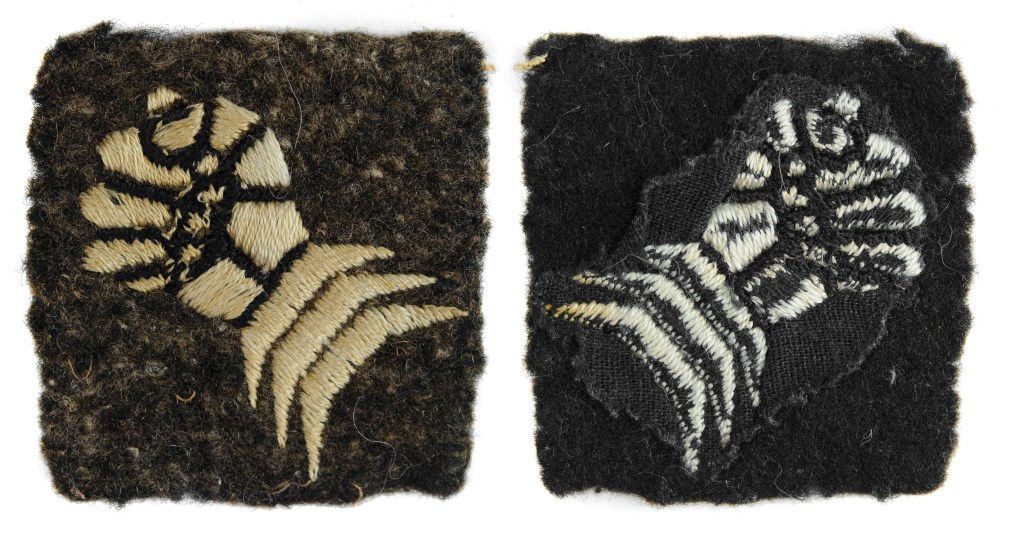
A pair of matching Type A fists which were worn together. Note that the fists have been picked out in thick white blanco. This presumable has been done to disguise fading and dirt to make the fist more recognisable. This is practise has been observed in other (predominantly white) embroidered British and Commonwealth formation badges in other theatres of WW2.
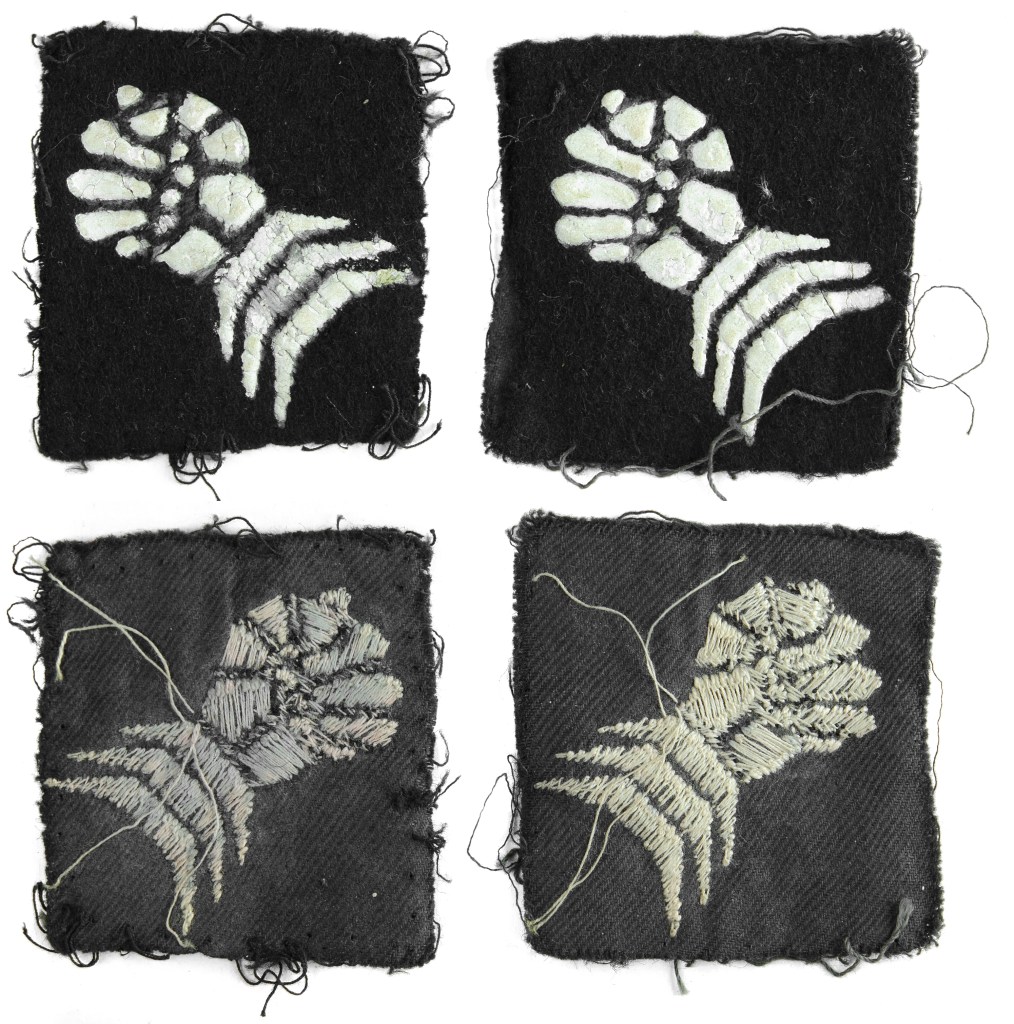
Another Type A uniform removed example that has been picked out in white blanco:
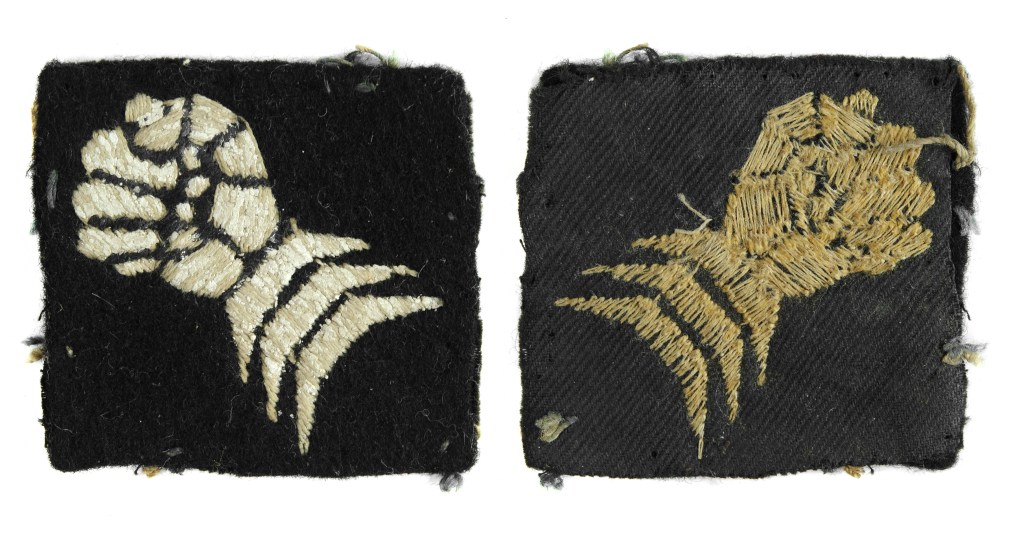
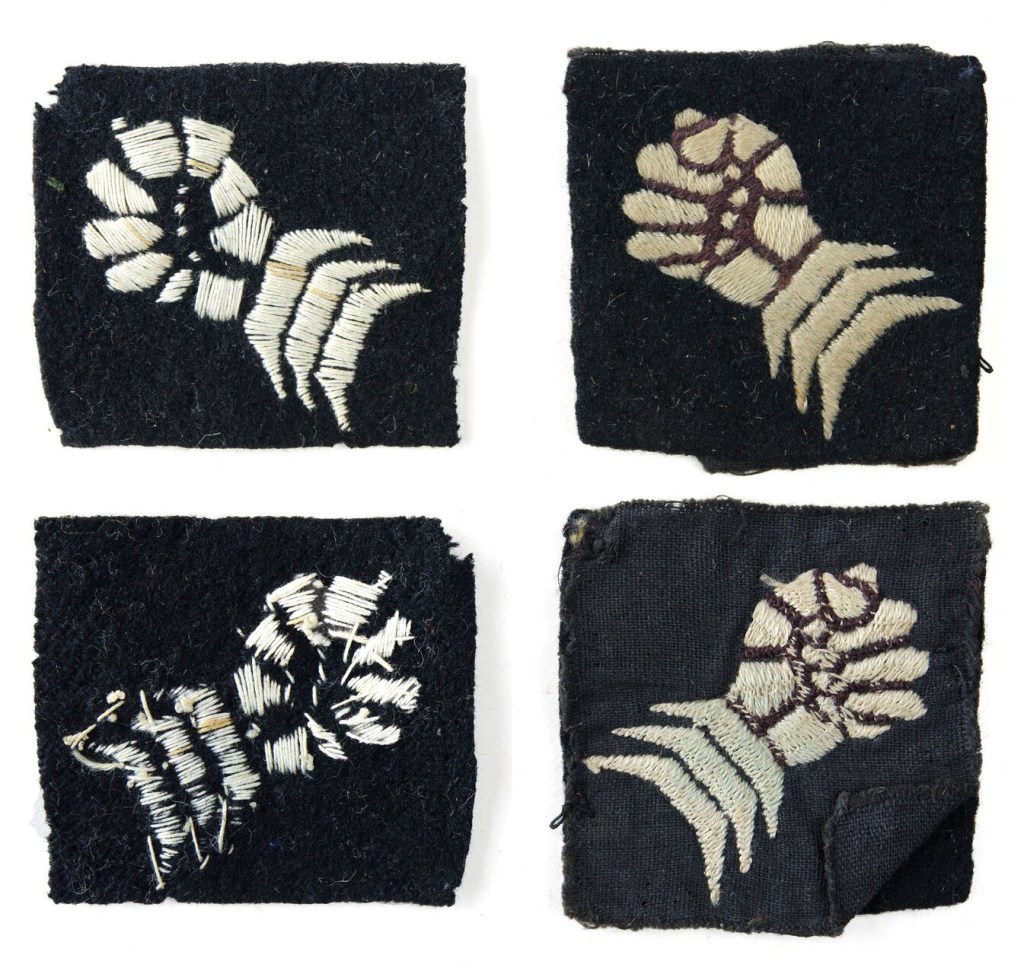
An interesting Italian made example which is slightly smaller than the usual 5 cm x 4.5 cm. There was a thriving badge making industry in Italy both during and after war. The backing material conforms to that observed in other Italian made items including a Welsh Guards bullion cap badge, an example of which has been identified in contemporary photographs of 3Bn Welsh Guards officers.
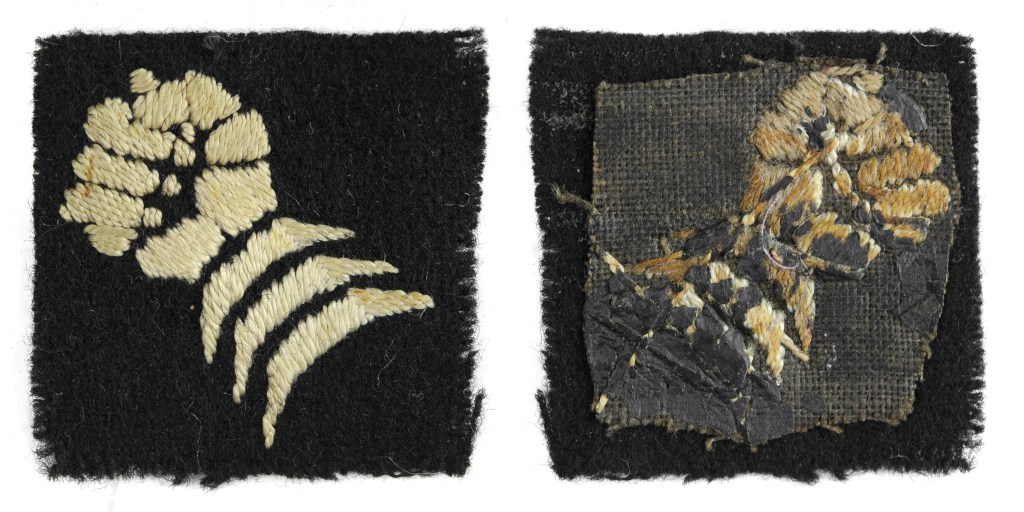
Another interesting variation, again possibly Italian made. As per the last example, it again is a little smaller than a standard Type A/B/C patch. This is currently subject to further research.
Unissued Examples
A matched and untouched pair of unissued Type A. Again not the trimming of the backing material around the fists.

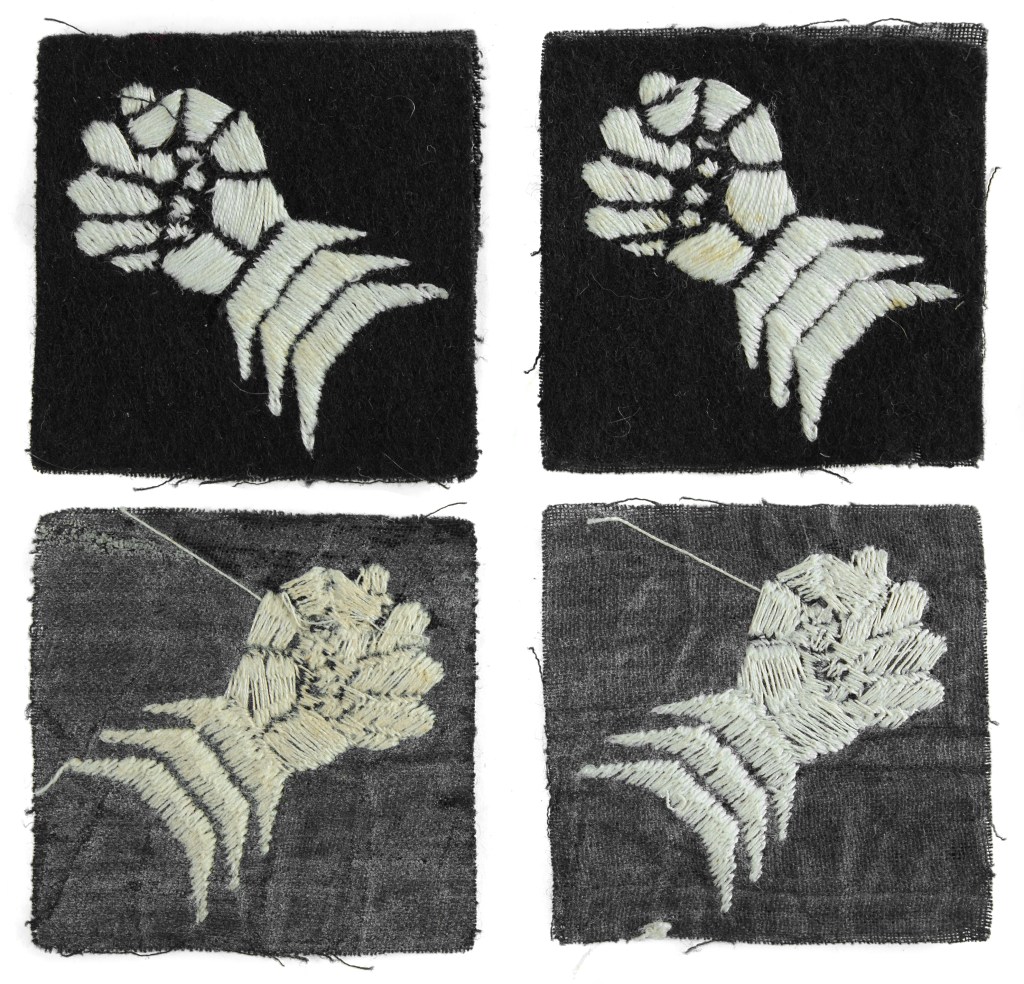
Another pair of unissued Type A fists:
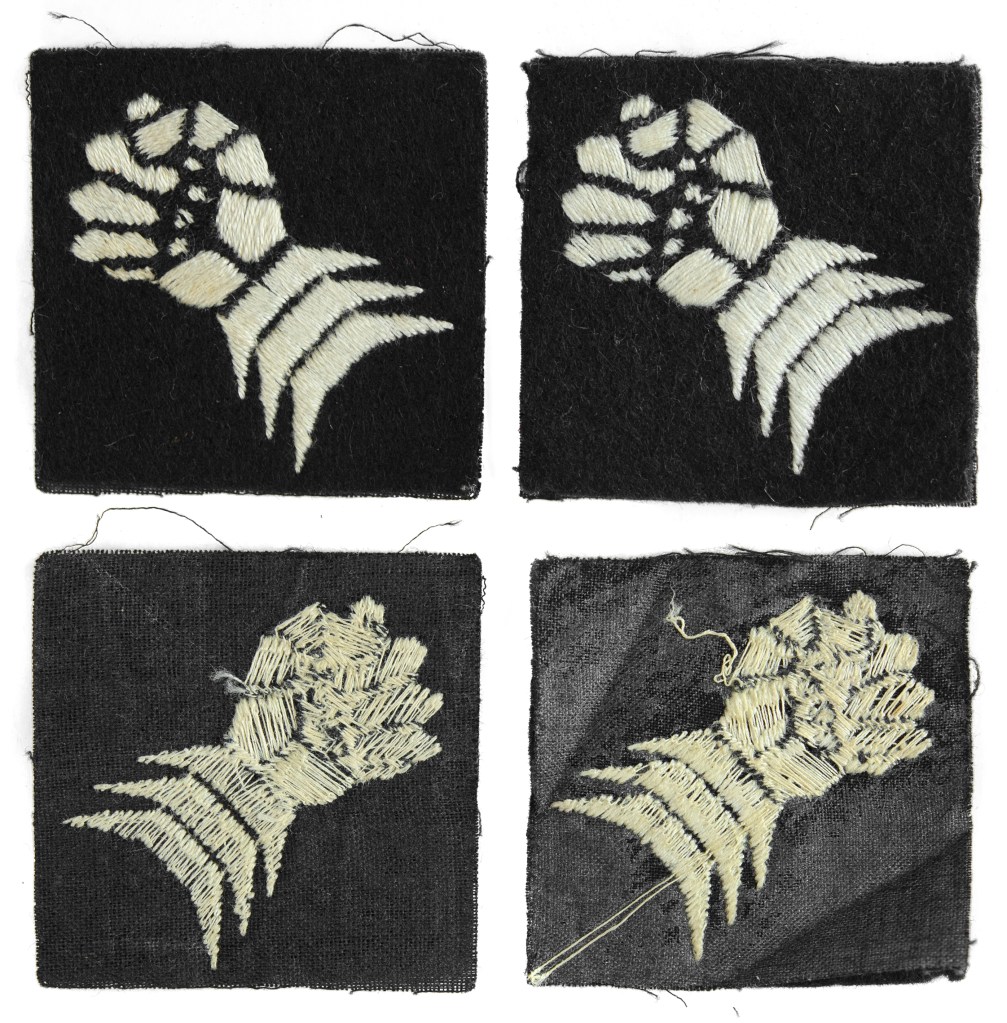
A further example of unissued Type A fists with some storage marks:
Post War Examples
Note: This section will soon be expanded.
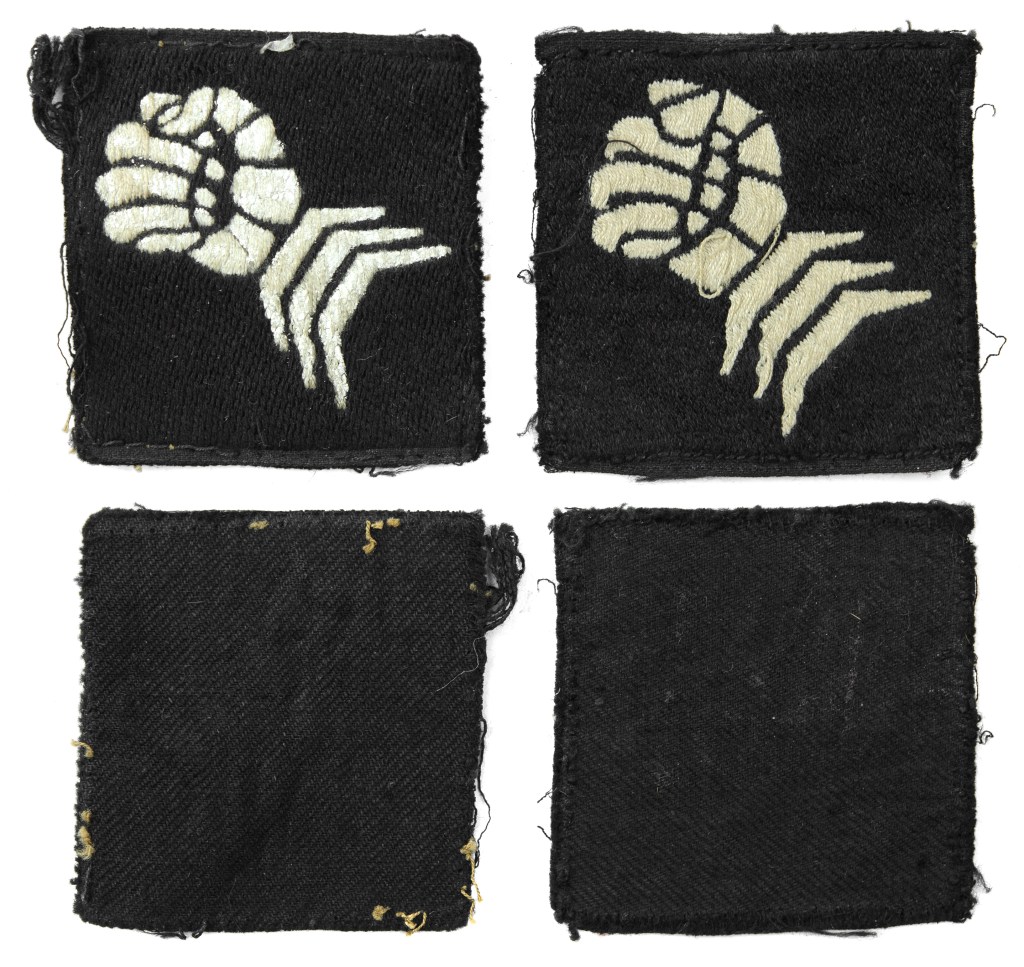
A pair of post-war woven fists made following the reformation of 6th Armoured Division in May 1951. These are considerably larger and feature a number of significant differences to their war-time counterparts. The example to left has a pronounced thumb nail and has again been highlighted in white blanco. Note that the fist embroidery cannot be seen on the rear of the badges.
- Ford, Ken, Mailed Fist – 6th Armoured Division at War 1940-45 (Stroud, Sutton Publishing, 2005) p.1 ↩︎
 Camouflaged Fist
This was a most informative and interesting read as I have my Fathers Fists Flashes and Medals from his time with the 6th Armoured Division and this adds a little bit more history to what I have gathered other the years.
LikeLiked by 1 person
Thank you David I’m extremely pleased you enjoyed it. What element of 6AD did your father serve in ?
LikeLike
Hi Gareth My Father was a Gunner in the Artillery so his army records say, he was in Tunisia, Libya, Egypt and Italy…
Sent from Sky Yahoo Mail on Android
LikeLike
I can forward a picture of his flashes , medals if you would like.
Dave
LikeLike
Yes please ! I’d love to see them Dave ! If you can’t post here please send them to on by email / social media messengers (contacts are below on the bottom of the page).
Thank you !
LikeLiked by 1 person
My Dad, Ken Lewis, was a tank driver in 6th armoured division. I have a photo taken at the time with him wearing the mailed fist flashes, I have them, they are the “looped” variety so would have been kept in place by shoulder button down straps passing through the loop, so they are in great condition as they were not sewn and didn’t have to be ripped off.
He fought through North Africa and up into Italy. At the end of the war he stayed in Italy for another 18-24 months – there was so much equipment littered all over Africa and Italy, if it was deemed valuable it was shipped up to northern Italy and onwards from there. He and a co-driver would pick up whatever it was from southern Italy and were given a number of days to take it up to the northern depot. What actually happened was that he and his co-driver would drive like crazy taking it in turns, until they got to Rome where they would go and party! then they would leg it up north to arrive on time. Same on the way down…repeat!
In later life my Dad used to have a large “hot toddy” or two each day… (whisky, sugar, hot water), bacon and eggs for breakfast, and some smoked salmon – when someone commented that this was perhaps not the healthiest of foods he said “I saw so many friends and colleagues blown up on the battlefield, that every day is borrowed time”.
LikeLiked by 1 person
Thank you Paul, I would love to see Ken’s formation badges if you could send me a pic. Thank you for sharing his story, Gareth
LikeLike