
Happy New Year !
2024 was quite a year and I’m very much looking forward to 2025.
As Camouflaged Fist was nearing completion, I had already resigned myself to documenting a full account of the Welsh Guards in Italy. To that end I have been working on my forthcoming title that will also be available from Helion in due course; “The Forgotten Fighting Third – The Welsh Guards in Italy 1944-45”.
Those of you who follow my social media channels will be aware that I have been very busy seeking out as much primary information as possible in order to pay due diligence in telling the story correctly. As a result of this, I have somewhat neglected this blog since August 2024 – something I intend to change during 2025!

Progress To Date
I’m pleased to report that whilst I’m still gathering information, I am well underway in writing the book, albeit starting somewhat backwards with the appendices and supporting information before really getting into the guts of the narrative. I have found this method has been useful as the appendices prove a useful reference to keep the content on track.
A key part of my time and research has been spent in building up as comprehensive a nominal roll as possible. To that end I’m delighted to announce that I have been able to trace c.1000 men who served in Italy (approximately 2000 served in 3rd Battalion Welsh Guards [3WG] during the Tunisian and Italian Campaigns between 1943-45). As a result I have amassed a great deal of detail about the individuals who served in the battalion.
As a part of the initial compilation of the roll, I checked every page of every Casualty List from 1 January 1944 to 30 June 1945 to build up as complete a picture of possible as those who not only were killed in action, died of wounds, illness or as a result of accident, but also those who were wounded too. This was quite an undertaking to say the least as each Casualty List covers roughly a three week period and runs between 500-700 pages covering all theaters where British troops were deployed (including home).
This was painstaking but definitely worth it and is proving to be the backbone of the book. This has then been augmented by details obtained from personal diaries, documents from archives, accounts, photographs, books, newspapers etc.
As a consequence, this database has enabled me to assist several families of those who served in 3WG over the last few months in tracing their relatives service through the Italian Campaign. I intend to start documenting these mini research projects here going forward. Inevitably, all of my material and the roll will also be shared with the the WG regiment and collection once the book has gone to print.
2738461 L/Cpl Dewi West
This mini-project will serve as an example of how I’m using the database, alongside other resources, to hone in on the service of an individual. Whilst the information presented below is given chronologically, it was not found in that manner. Irrespective, I feel it gives a flavour of the richness of information that the book is being built on.
Dewi has been known to me for several years on account of many a conversation about him with his great nephew Oliver whilst we worked together some ten years ago.
Oliver knew that Dewi was with the Welsh Guards and believed he was killed in action at Cassino. His grave stone at the Commonwealth War Graves Commission Cemetery at Naples bears his date of death as 5 June 1944. His headstone is inscribed with “His duty done for his country with love his light went out to shine above.”
Aside from that, Oliver and his family had no further information and no photographs of Dewi whatsoever. His parents Edward and Hannah West who lived at 77 Pleasant Street, Morriston, Swansea, South Wales, were inevitably and understandably deeply affected by the loss of their son.
Given that the focus of The Forgotten Fighting Third is around the Welsh Guard in Italy specifically, most of my research has been on the period immediately following the cessation of hostilities in North Africa.
I know that Dewi served with 3WG in Tunisia, and he first appears in my research as being mentioned in the Herald of Wales Newspaper in Tunisia on 15 January 19441. An interesting point of note is the tongue in cheek comment which nods to the devastation of Swansea through bombing, principally during the Swansea Blitz between 19 to 21 February 1941:
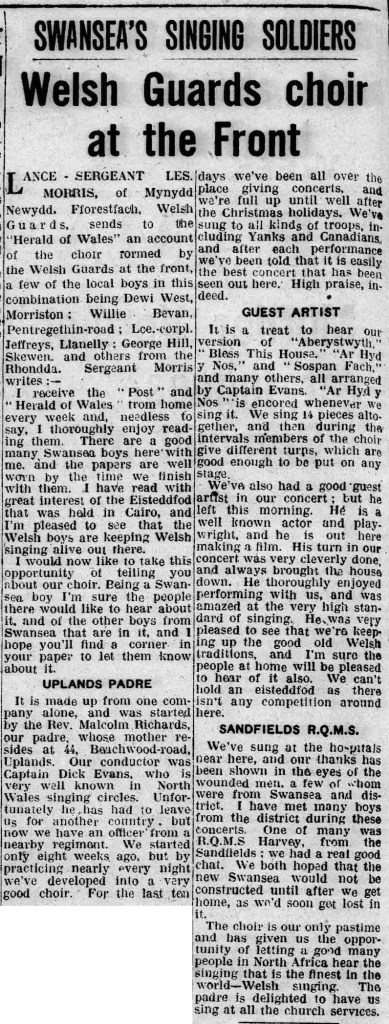
As an aside, fellow Swansea boy Rev. Malcolm Richards later becomes the Padre for 3WG. I have been extremely lucky to be able to photograph a number of his personal effects from the war including his theater worn battledress, cap, personal trunk, map cases and maps amongst other items held by the Welsh Guards Collection in Oswestry, Shropshire. I also have an 8th Army Thanksgiving Service booklet signed by Richards within my own collection; this also features in the book.
Dewi must have been quite the singer as a later newspaper clipping states that he was also a member of a schoolboy’s choir and later the Orpheus Male Voice Party.
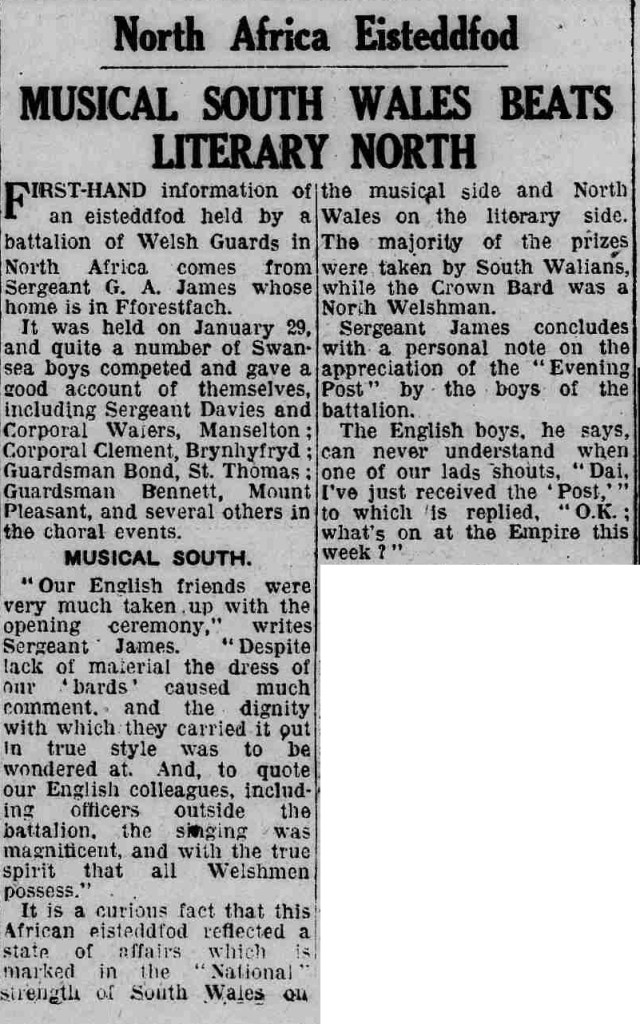
Another article about the North Africa Eisteddfod appears in the South Wales Evening Post on Monday 14 February 19442, albeit it does not mention Dewi specifically but does mention other Swansea Guardsmen:
‘W’ Coy
At around about the time the first newspaper article was going to print, Dewi was likely already on his way to the Guards Infantry Training & Reinforcement Depot (I.R.T.D.) at Rotondi, north of Naples, Italy, as a part of the composite ‘W’ Coy (‘W’ for Welsh). Most of 3WG was to follow with the bulk of the battalion arriving on Italian soil on 5 February 1944, however, ‘W’ Coy was an advance party and arrived in mid-January 1944.
At that time, 24 Guards Brigade was about to land at Anzio and 201 Guards Brigade had sustained heavy casualties from continued action from their landing at Salerno in September 1943 and their engagement during the winter at Monte Camino. As I discussed in Chapter Two of Camouflaged Fist, it became customary for a company from one guard regiment to be attached to another guards regiment to replace lost company’s. I stated that this was initially trialled with ‘S’ Coy (‘S’ for Scots) being attached to 2Bn Coldstream Guards (CG) and becoming their fourth rifle company following severe losses at Monte Ornito. This was reported as fact being consistent with a number of accounts. This will now need some redress, as I have since discovered that ‘W’ Coy was attached to 2Bn Scots Guards, 201 Guards Brigade, 5th Infantry Division, in the Minturno sector from 26 January 1944 to 4 February 1944 – this was the true first experiment of this kind as referred to in Camouflaged Fist, and pre-dates ‘S’ Coy being attached to 2CG.
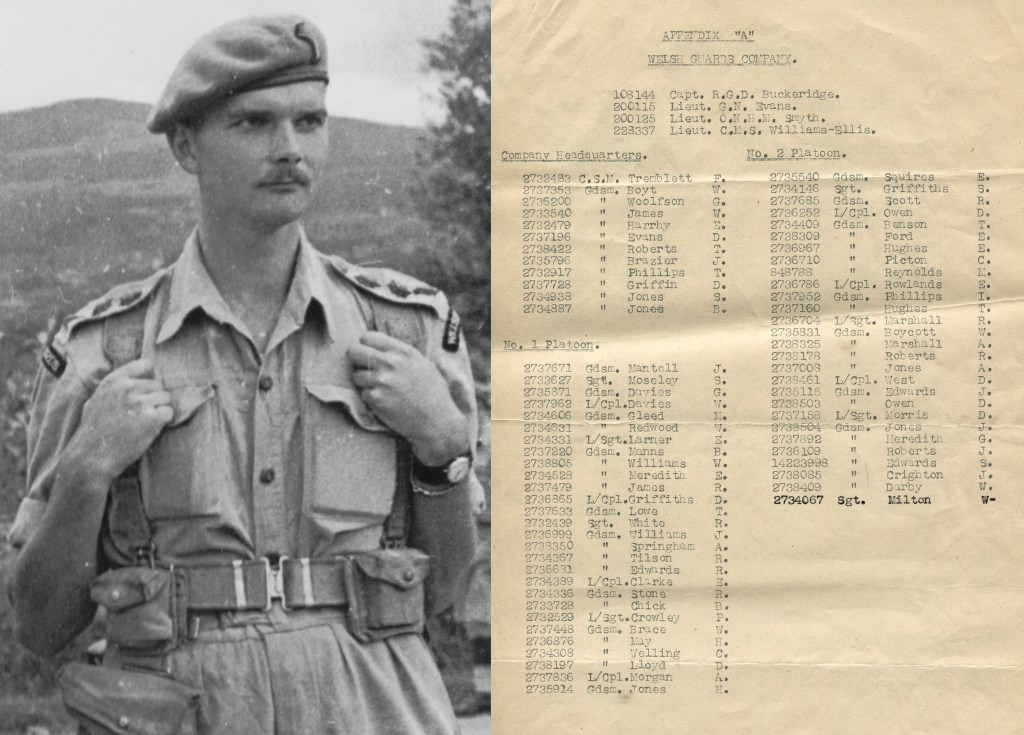
Whilst I have already written the chapter covering ‘W’ Coy for The Forgotten Fighting Third, I don’t want to let the cat out of the bag too early about their exploits. What I will say is that the unofficial War Diary kept for this period by Captain Raymond Buckeridge, Officer Commanding ‘W’ Coy, includes a complete roll for the company; Dewi is shown as being a L/Cpl in No.2 Platoon (there were 3 Platoons including self-sufficient ‘Echelons’).
The men of ‘W’ Coy returned to the I.R.T.D. after their attachment to 2Bn Scots Guards in early February 1944. Consequently, they did not see action at Monte Cerasola with the rest of 3Bn.
They were however released from the I.R.T.D. in time to see action at Monte Purgatorio (near Cerasola) in March 1944. It is fair to assume that Dewi, having been left out of battle (L.O.B.) for Cerasola, would have seen action at Purgatorio and Cassino Town.
Wounded
The next document mentioning Dewi is the booklet containing Casualty Lists 1460-1478 covering the period 31 May 1944 to 22 June 19443. Dewi is mentioned as being wounded on 26 May 1944 alongside eleven other guardsmen (page 11 to right in below image) and two others who were killed in action (page 8 to left in below image).
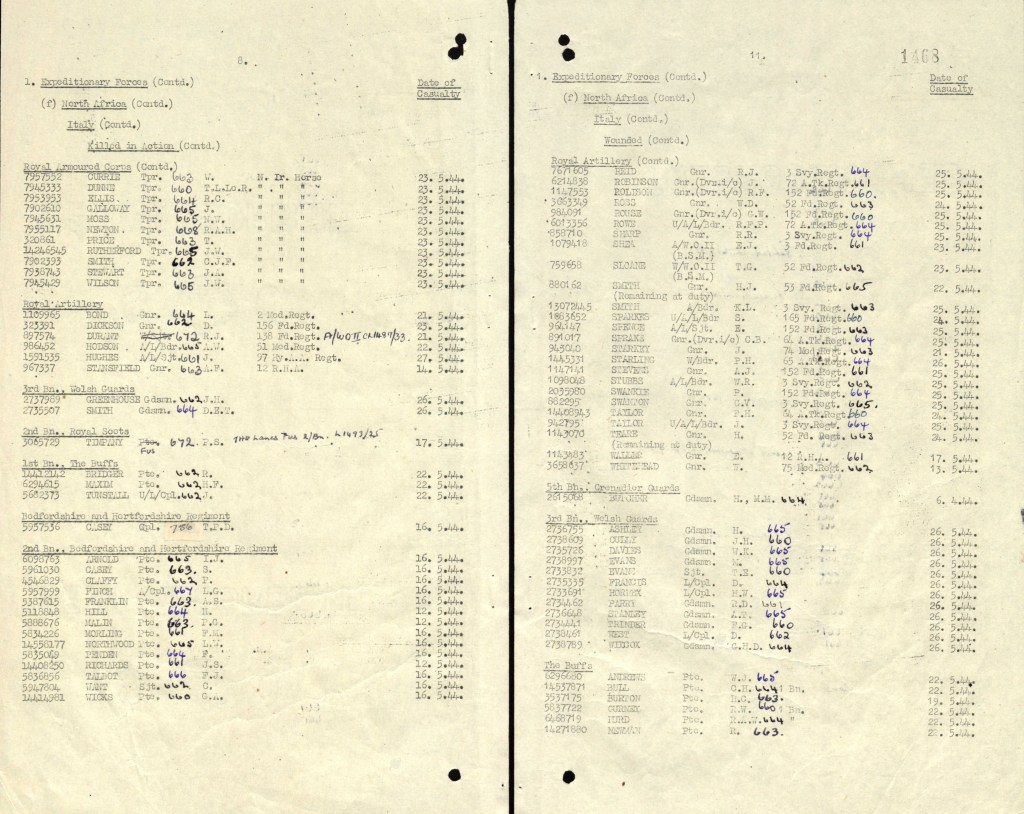
The entry within the 3WG War Diary for 26 May 19444 states:
“PONTECORVO 26 (May 1944): Bombed by enemy aircraft. At 0100 hrs. 2 ORs (Other Ranks) killed and 12 wounded. Fires in tpt areas under control. Bn on move throughout day. Lt-Col D.G. DAVIES-SCOURFIELD, M.C. wounded but remained at duty.”[ii]
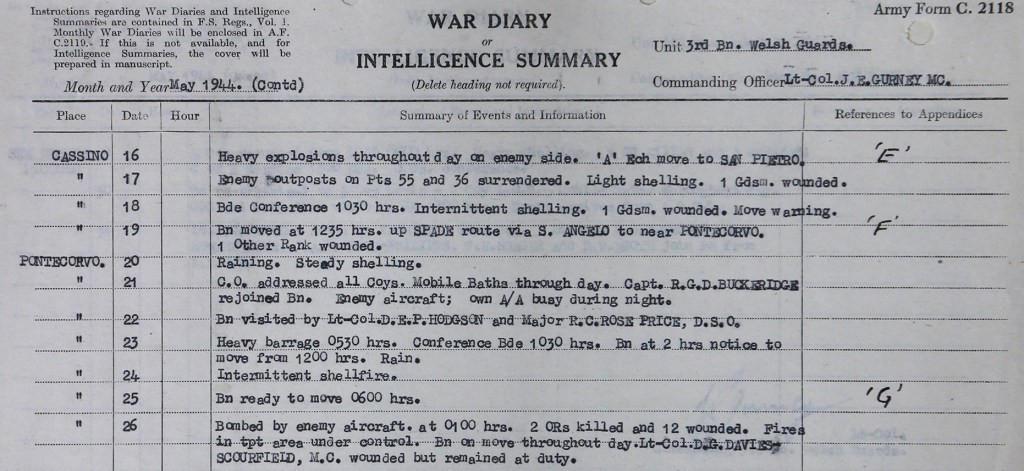
The attack happened the day before 1st Guards Brigade became committed in the battles for the hills south of Arce that straddled Route 6, namely Monte Grande, Piccolo and Providero. Here 3WG would sustain heavy casualties and lose their No.2 Rifle Company.
Phil Brutton in his account Ensign In Italy gives extra context to what happened that night, including the circumstances of how Dewi became wounded. He leans on his own contemporaneous personal diary to tell his story throughout his book:
“Thursday 25 May: ‘Spend whole day travelling in a jeep’. We travelled, I believe, thirteen miles in eighteen hours. ‘Convoy takes over long time to reach new harbour area. Dive-bombed during the night. Very light casualties considering.’
(Captain) Tim Bolton wished to hold an ‘O’ (Orders) Group. My attention was, however, distracted by the German aircraft overhead, engine noise being something to which all of us were attuned. Either on the Chinese principle that if you pay no attention the nuisance will go away, or on the British that nuisance is to be ignored with disdain, the ‘O’ group, like the plane overhead, droned on. I had noted that the carrier platoon, a short distance from us, had incautiously started to brew up and the flames from their petrol cookers were, presumably, engaging the attention of the lone anger above. Furthermore, our ‘O’ group was being held in a signals vehicle.
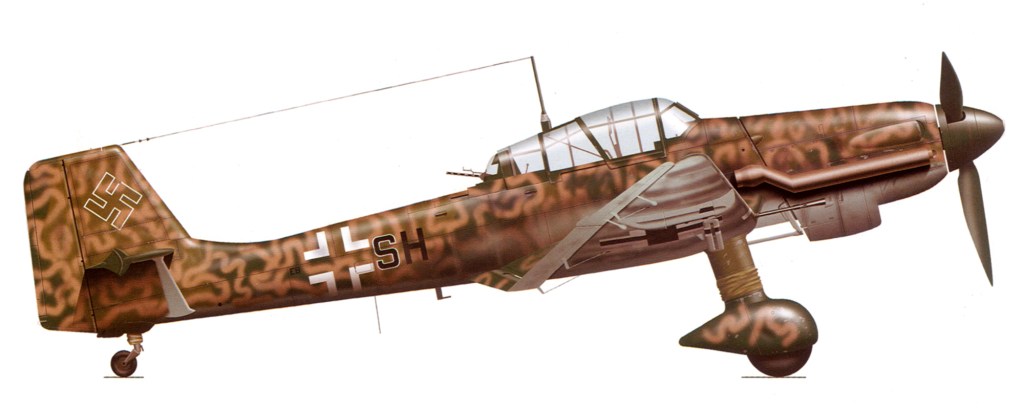
I thought it better to say nothing and do nothing. I was attending this important conference about the state of 8th Army as it affected 3 Company, 3rd Battalion, Welsh Guards, and there was someone in charge of the carrier platoon who had, it appeared, thought fit to allow petrol cookers to be lit. I was, however, after five minutes, dismissed and, on emerging, sought the safety of a slit trench and awaited the whistle of bombs, or the woosh. I was wrong. It was a Stuka and its pilot, having taken note of the light from the petrol cookers, he improved his view by dropping flares and then dive-bombed with an increasingly menacing whine while preparing to release both incendiary and high-explosive bombs. He returned for several encores. If dive-bombing at night was a tricky business for the pilot, it was a singularly unpleasant one for the target. The unit harbouring next to us was also hit, some of their ammunition trucks went up; two 17-pounder anti-tank guns were destroyed as well as some Welsh Guards vehicles. Three guardsmen were killed and twenty wounded.
Needless to say, the ‘O’ group was abruptly adjourned and the participants hurled themselves out of the vehicle and piled on top of me in the slit trench. The ‘O’ Group then reassembled, the dead were buried and the wounded were tended. The incident was closed with the Battalion minus twenty-three men and letters would be written to the bereaved. The wounded would write that they had had a narrow escape and, presumably, no one mentioned the petrol cookers.”5
Whilst Brutton recalls that 23 men were killed or wounded in the incident, the entries within the Casualty Lists are consistent with the figure provided in the War Diary (this is not often the case!). Brutton’s account is, however, instrumental in enabling us to know exactly what happened and understand that 3WG were attacked, at night, by Stuka ground-attack aircraft.
Incidentally, Guardsman James Howard Greenhouse who was killed in the attack was another Swansea boy from the Hafod, he was 23 years old. Guardsman David Edward Thomas Smith who was also killed was 24 years of age. Guardsman Ashley, who was also wounded, served alongside Dewi in ‘W’ Coy at Minturno in January 1944, albeit in No.3 Platoon.
Died of Wounds
Sadly, Dewi later died of his wounds aged 19, eleven days after the attack (on Monday 5 June 1944). This was not recorded in the Casualty Lists until September 1944, appearing in the booklet for lists 1540-1556 covering period 1 September 1944 to 20 September 19446:
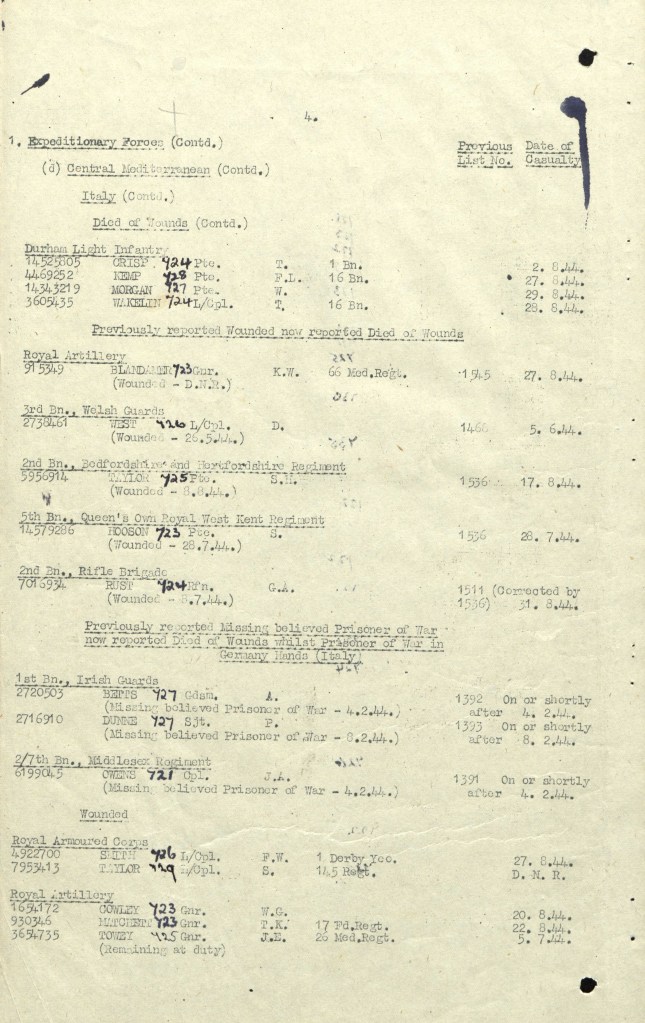
I believe that it is highly likely that Dewi died at a hospital in Naples (there were a number of modern hospital facilities within the city) as he is buried at Commonwealth War Graves Commission (CWGC) Cemetery Naples. Both Guardsman Greenhouse and Smith, who were killed outright during the attack, were buried in the field and later re-buried at CWGC Cemetery Cassino. Had Dewi been held at a hospital nearer the frontline it would be more likely that he would have been buried at CWGC Cemetery Cassino.
A Photograph !
The South Wales Evening Post for Thursday, 22 June 19447, confirms his death, months ahead of it appearing in the official Casualty List. The article incorrectly states that he had taken part in the fighting at Anzio:
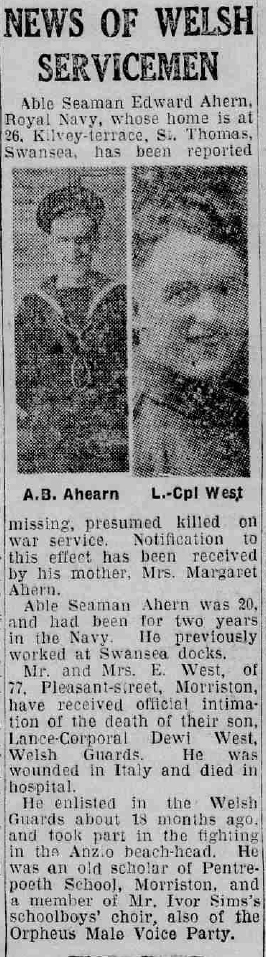
This newspaper report has proved invaluable for the family today; it has yielded the only known photograph of Dewi.
Honouring The Men & Supporting Families
I find it immensely rewarding to be able to fill in the blanks for the families of those who served in 3WG. Not only does it bring understanding and clarity but it also honours the memory of the men who gave so much, some their everything.
Bringing information and closure to Dewi’s family, in addition to a photograph, particularly having had many a conversation about him over the years is just so satisfying.
His date of death had always been a bit of a mystery as on 5 June 1944 the battalion were on the advance with limited enemy contact. The clarity brought by the Casualty Lists augmented by Brutton’s narrative has enabled not only the location but the cause of his death to be understood.
I’ve been able to support a number of families in a similar way over the last few months, if you think I may be able to help with anything 3WG related please do drop me a line.
In addition, with the utterly incredible help and support of Tracey Van Oeffelen, I have been able to write bios for every officer that served in 3WG, including those attached from the Royal Army Chaplain’s Department, Royal Army Medical Corps and those from 2 ‘Gren’ Coy (Grenadier Guards) who temporarily replaced the lost No.2 Rifle Coy (at Monte Piccolo) during July and August 1944.
Furthermore, I hope this article serves to whet the appetite in demonstrating the systematic approach to The Forgotten Fighting Third, the multiple sources of information I’ve gathered in addition to the level of detail to come.
I’m sincerely hoping to contribute here more often this year … hope to have another article up soon.
- British Newspaper Archive. ↩︎
- British Newspaper Archive. ↩︎
- Ancestry.com. UK, World War II Army Casualty Lists, 1939-1945 [database on-line]. Lehi, UT, USA: Ancestry.com Operations Inc, 2023. ↩︎
- The National Archives, War Diary WO 170/1355 3rd Battalion Welsh Guards, January-December 1944, War Diary Entry 26 May 1944. ↩︎
- Brutton, Philip, Ensign In Italy – A Platoon Commander’s Story, London, Leo Cooper, 1992, p.55-56. ↩︎
- Ancestry.com. UK, World War II Army Casualty Lists, 1939-1945 [database on-line]. Lehi, UT, USA: Ancestry.com Operations Inc, 2023. ↩︎
- British Newspaper Archive. ↩︎
 Camouflaged Fist
One thought on “2738461 L/Cpl Dewi West: A Story of Sacrifice and Discovery”