
Introduction
Wherever I find anything for sale that’s remotely connected to 3Bn I try and pick it up. This is for several reasons , but principally to be able to photograph or copy the items for inclusion in my database and forthcoming book. As per what a museum does, I feel that the inclusion of original items from these men, alongside the text of the book, gives additional context and adds ‘depth’ and interest to the narrative. All of this, at least in my opinion, helps tell the story of the 3Bn in one way, shape or form.
In October 2023 I purchased several items which were being sold individually at an auction that all related to a ‘lot’ from the same individual. Examining these items, I could immediately see that it related to a 3WG veteran who likely later served in 1WG in Germany. I just had to have it; they were not by any means expensive. I bid, and won, each individual item to ensure it all remained together.
Whilst I understand that selling the component parts of an estate individually returns more profit for a seller, it deeply saddens me that so many personal histories have been destroyed in this way. Aside from being delighted at being the temporary custodian of this little archive, I feel proud that I ‘saved’ it and preserved it, and the gentleman’s service, for the future.
The Archive
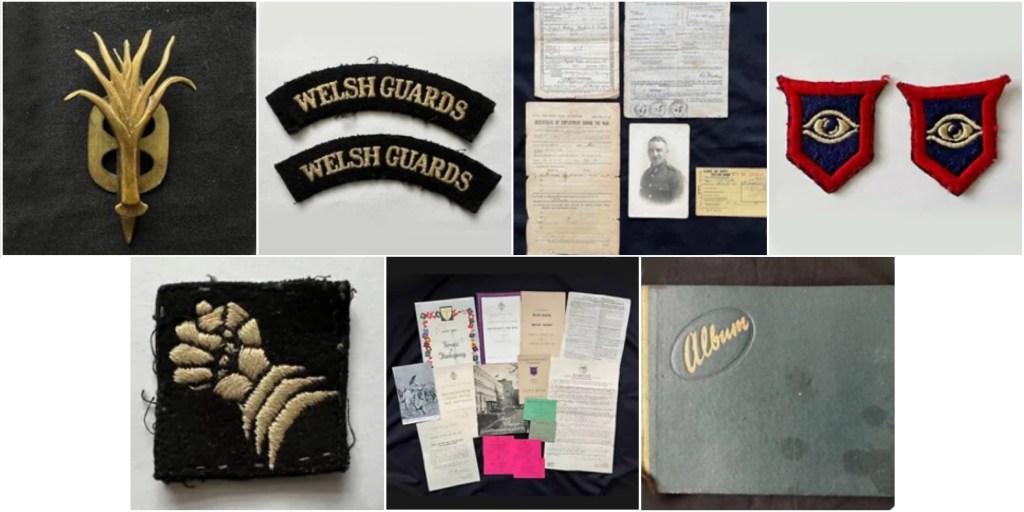
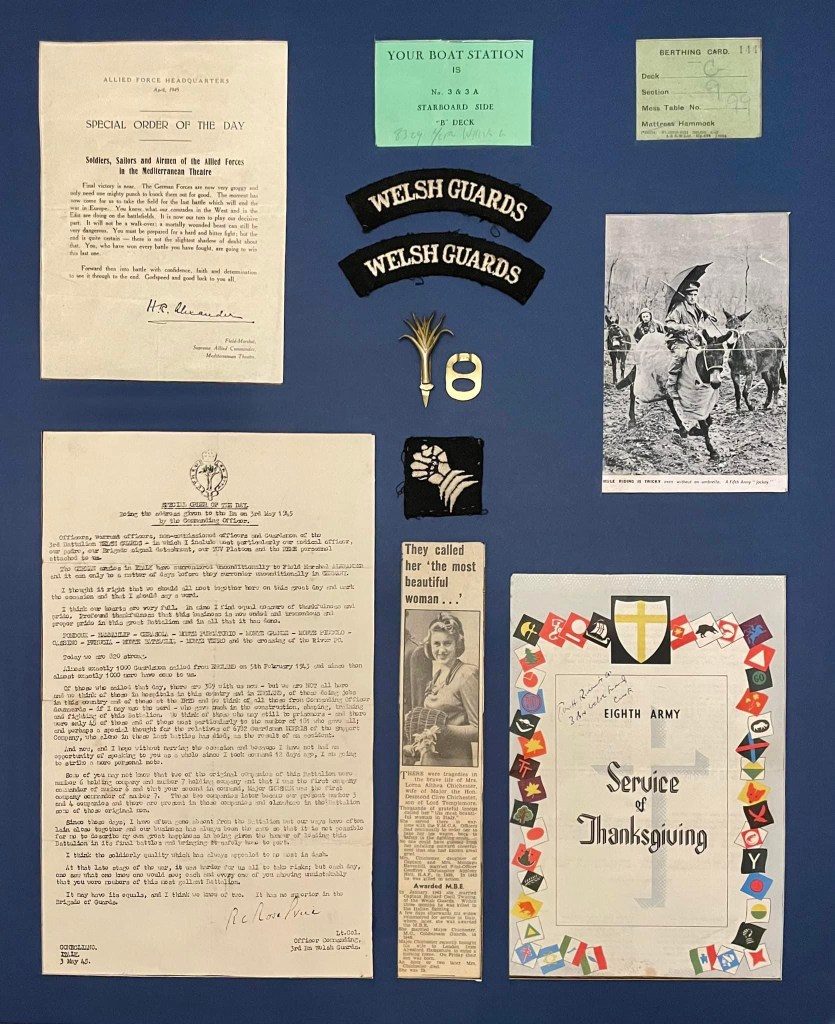
This veterans lot included:
- A well polished and repaired (soldered) Welsh Guards cap badge
- Two Welsh Guards cloth shoulder titles (uniform removed)
- 6th Armoured Division formation sign (uniform removed)
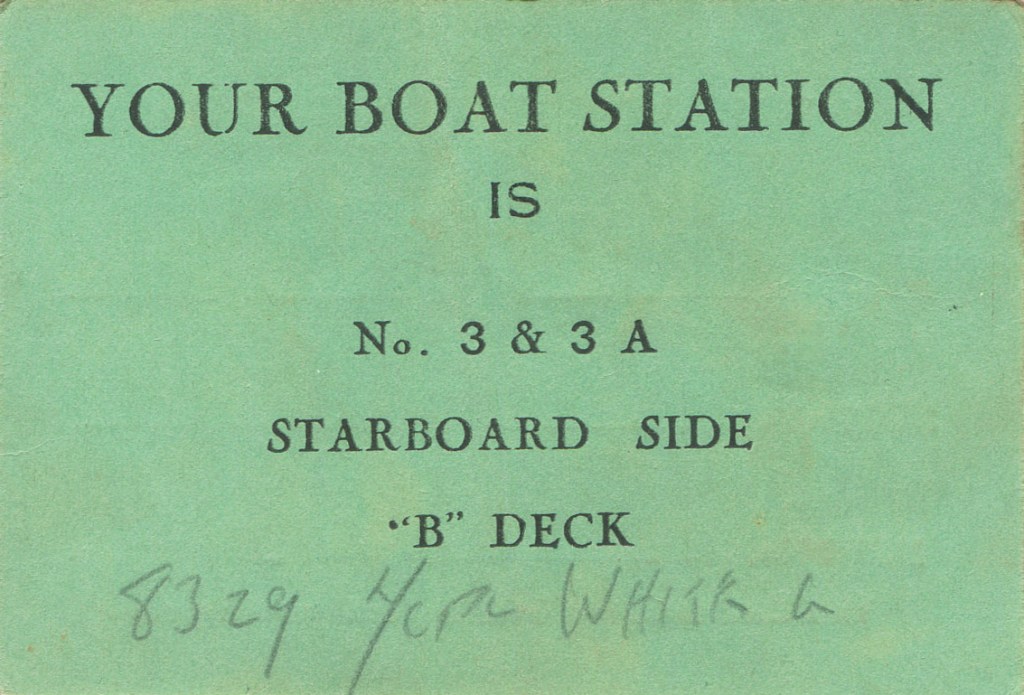
- Berthing and Boat Station Cards to a ‘8329 L/Cpl White’
- April 1945 Special Order of the Day circular from Field Marshall Alexander
- An 8th Army Service of Thanksgiving pamphlet
- Magazine clipping of a famous Italian Campaign photograph titled ‘Mule riding is tricky’ (this illustrates the importance of the role of mules to 3Bn)
- An address by Lt.Col. Robin Rose-Price (Commanding Officer 3WG) on the cessation of hostilities in Italy
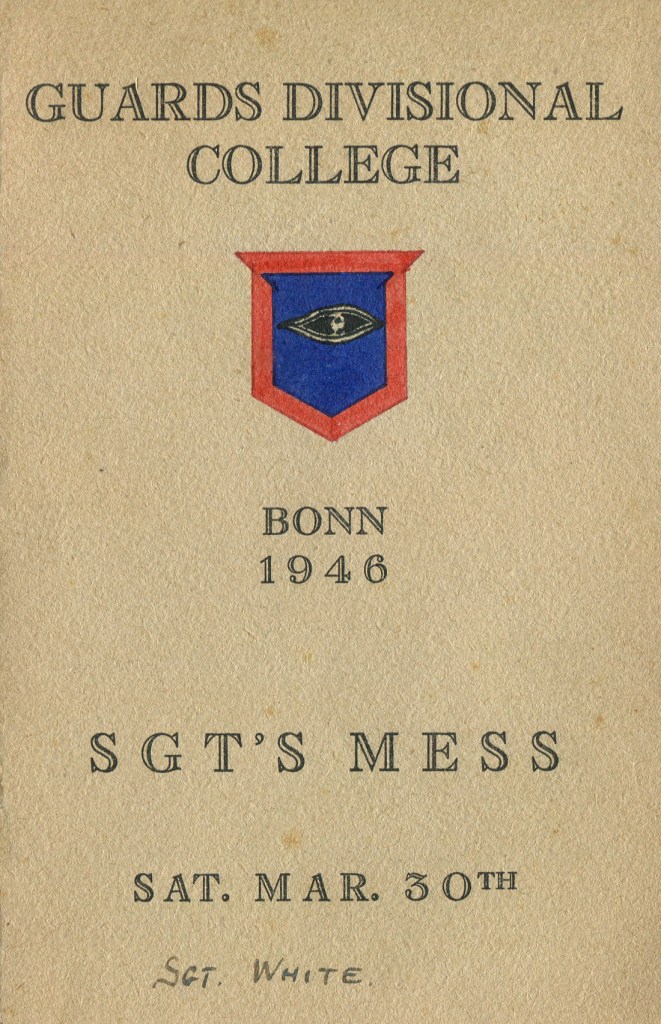
- A Guards Divisional College, Bonn (Germany) Sgt’s Mess dinner menu to a ‘Sgt White’ dated 30 March 1946
- Pair of Guards Armoured Division formation signs
- A Guards Divisional College B.A.O.R. (British Army On [the] Rhine) pamphlet
- Class A information paper covering gratuities, pay etc (no nominal information)
- Newspaper cutting of the obituary of Mrs. Lorna Twining. Her husband was Capt. ‘Dickie’ Twining who was killed in action at the battle of Fondouk, Tunisia on 9 April 1943. Following his death, she served 1st Guards Brigade with her Y.M.C.A. truck and was famous for her ‘tea and wads’. She later married an officer from 2 Coldstream Guards, and died in childbirth in 1948. More on her soon … she was loved by all in the Brigade
- Several post-war (1947-1949) Welsh Guards event programmes, tickets etc.
- A photograph album containing mainly family pics, but several men in battledress and khaki drill
- WW1 paperwork to a Thomas Samuel White who served in the Royal Army Medical Corps (R.A.M.C). This was listed as ‘the guardsman’s father’
Why Personal Archives Are So Important
I have, and continue, to enjoy the fantastic support from the regiment, museums and other institutions who support me in my endeavor to tell the story of 3Bn’s war. I have also been extremely fortunate to meet several families of those who served in the battalion. I will always be eternally grateful for their time and support in allowing me to copy or photograph items their relatives retained. Whether a lot or a little was retained, all of it is incredibly important in joining-the-dots of the people, stories and events. As a consequence, I have had the privilege to handle several thousand documents relating to the Welsh Guards in the Second World War. Alongside photographs and other files, this currently amounts to 80 gigabyte of information!
The items documented above retained by this veteran are incredibly important in themselves. For example, I have only handled two copies of Lt.Col. Rose-Price’s address, one held by the the Welsh Guards Archive at R.H.Q. and another retained by Lt.Col. Davies-Scourfield. These are rare – very rare. I have not seen another copy of the Guards Divisional College pamphlet or the menu card for the Sgt’s Mess. The 8th Army Service of Thanksgiving pamphlets are very common, however, the one retained by White is signed “T. M. H. Richards 3Bn Welsh Guards CMF”:
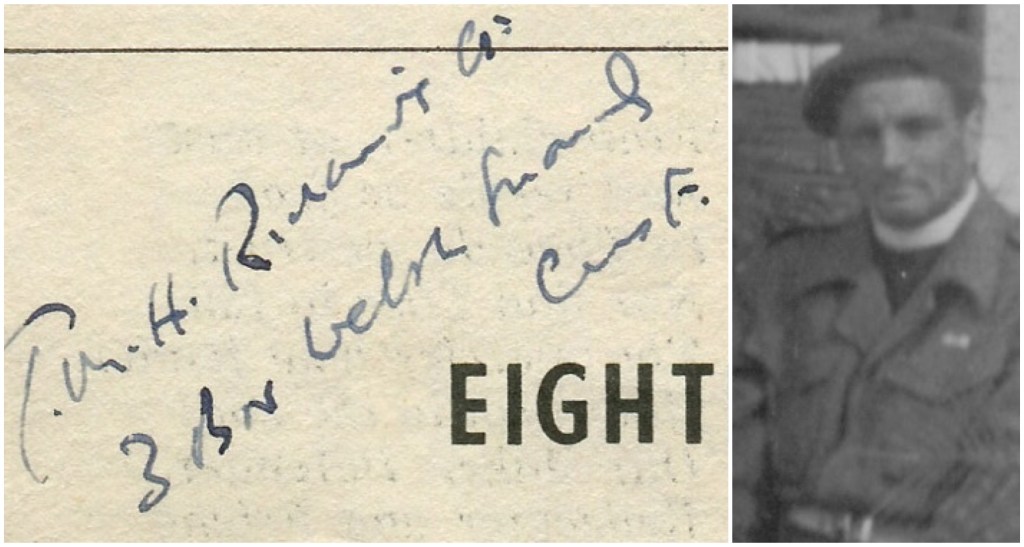
Capt. Rev. Thomas Malcolm Hart Richards, Royal Army Chaplains Department (R.A.Ch.D), became 3WG’s padre joining on 30 November 1944, joining them from 1st Guards Brigade. This document is extremely unique, and evidences the already well established importance of padre’s to the men. The padres would give advice, guidance and provide both pastoral and religious support. They were also often responsible for retrieving and burying those who fell.
As an aside, Rev. Richards also provided an interview for the Imperial War Museum that can be listened to by clicking here. He was born in Llanelli, Carmarthenshire and later lived in the Uplands, Swansea. I have also been very fortunate to handle several items that Rev. Richards retained from his war service, some are absolutely incredible, but I’ll wait to show you these in the book.
Who was 8329 White?
Since acquiring the lot I have been trying to tie it down to an individual. None of the items contained the full name or service number to be able to positively identify the veteran. Both the Boat Station and Sgt’s Mess cards were annotated to a guardsman named White. This inevitably was further corroborated by the inclusion of the WW1 documents to his ‘father’ of the same name.
The first states ‘8329 L/Cpl White’, followed by what I thought (since owning the lot) was the initial ‘G’. By 1946, whilst at the Guards Divisional College in Bonn (Germany) we can see that White became a Sgt:
Welsh Guards regimental service numbers are often abbreviated to either the last four, or last two, digits in documents and contemporary use. This tradition, I’m led to believe, continues to this day.
In his book, An Undistinguished Life, then 3Bn Lieut. Andrew Gibson-Watt (younger brother of Maj. David Gibson-Watt MC 2 Bar) explains this:
“A large proportion of them [men in the Bn] seemed to be called Jones, with Davies and Evans running second and third, and Lewis and Morgan not far behind. In fact, of course, all the Welsh names were there in the same proportions as borne by the general population in Wales. Those mentioned, in particular, occurred often enough for the men to be habitually known by the last two digits of their regimental numbers, such as ‘02 Jones’, ‘63 Morgan’ and so-on.”[i]
“I had five Jones’s in my platoon in the 3rd Battalion: after a bit one simply addressed them as ‘02’ or ‘47’ or whatever.“[ii]
Consequently, returning to White, I assumed that the 8329 would be the ‘tail end’ of his service number, preceded by the WW2 Welsh Guards army numbering convention of 237****. I therefore made the leap of faith that his service number was 2738329 – it wasn’t!
I turned to Ancestry to try and link the veteran to his the chap the seller purported to be his father, but despite finding an abundance of detail relating to his WW1 service there was no link to a ‘G’ White. I then set about messaging several other tree owners to no avail. Time moved on, and whilst I was constantly updating my 3Bn nominal roll on a daily basis, no ‘G’ White came up in any narrative, documents etc.
A Breakthrough: 14668329 Sjt Leslie Norman White!
Fast forwarding nearly two years to Friday last week, a new resource enabled me to discover that some 25 men with the surname White served in the regiment between 1930-45. There was one ‘G’ White, but he did not have a service number ending 8329. I felt stumped again.
I then manually trawled the database for every White, and there he was: 14668329 Leslie Norman White, it was an ‘L’ and not a ‘G’! Also, his number had a 1466**** prefix and not a 237****.
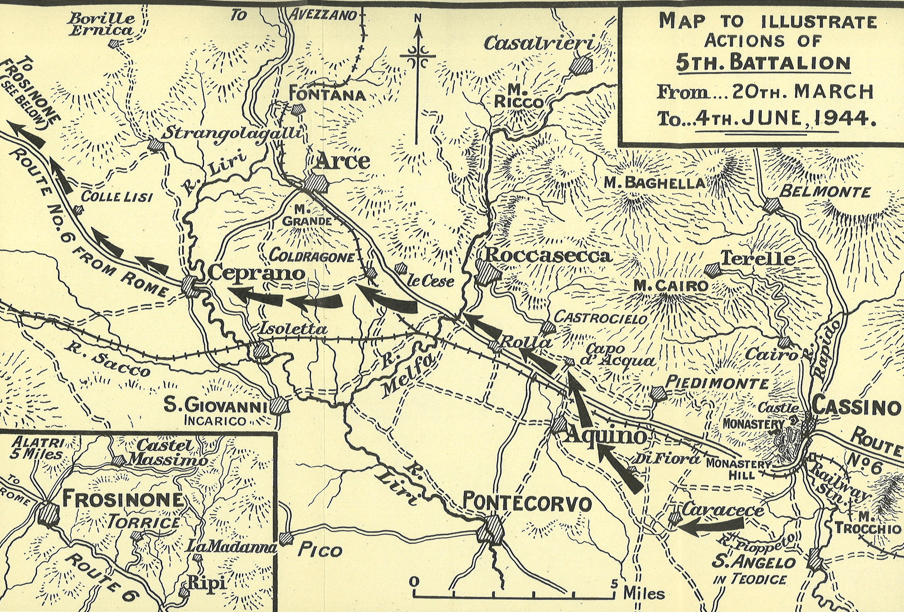
Les enlisted on 2 November 1943 aged 18, likely into the General Service Corps (hence the 1466 number) and at some point was transferred to the Buffs (Royal East Kent Regiment). The Buffs numbering convention was 628**** so he didn’t join them naively either. He later transferred to the Welsh Guards on 19 May 1944.
It is not clear whether he went through Guards Depot or joined in theatre, as 5 Buffs were operating in the same area as 3WG in Italy as a part of 36 Infantry Brigade with the ‘Battleaxe’ 78 Infantry Divison at the time of his transfer:
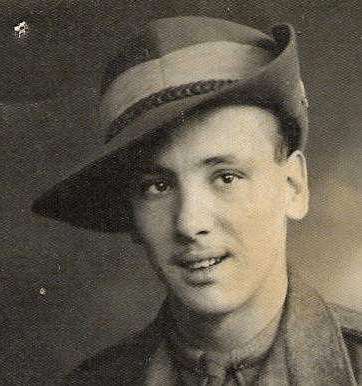
I turned again to Ancestry and now found extra information that enabled me to know that he was born on 9 November 1925 in Birmingham. I also discovered a photograph of him – in a slouch hat! I know that several photographs exist of the Buffs in Italy wearing slouch hats – so he may indeed have transferred whilst ‘in theatre’ with 5 Buffs after all – again, I’m trying in earnest to get to the bottom of this:
His ancestry record also shed light on the fact that the WW1 paperwork was not his father’s, again, I’m continuing to try and bottom this out too – I suspect it may have been an uncle’s. The next job is to now go through the photo album that came with the lot and see if I can pick him out now that I know what he looks like.
As was the case for several Guardsmen, on the disbandment of 3Bn (or just before), he was posted to 1Bn on occupation duties in Germany. Here it appears he was involved with the Guards Divisional College. He was discharged from the Welsh Guards on 30 November 1946 and passed in January 1993 in Birmingham.
Conclusion
I’m delighted to have solved this conundrum by positively identifying him. This has allowed me to inevitably include him in my 3WG roll too. I’m also glad I ‘saved’ his important archive from dispersal into smaller, inconsequential and unlinked bits. As he had not come-up in any narratives, casualty lists, rolls etc., had I have not purchased and researched this lot it’s likely his history with 3WG would never have been discovered. This inevitably underpins the importance of these personal archives and the historical and social value of keeping them together. Two documents that he retained have already been published in my last book Camouflaged Fist, with several more set to be featured in my forthcoming book.
The items he retained from his service now hang, proudly, in my study at home as pictured below. I hope that this serves to honour his contribution and cements him and his important documents into the history of 3Bn via my forthcoming book “The Forgotten Fighting Third”.
If you have items that you think may help me tell the story, please do reach out.
Diolch yn fawr iawn,
Gareth
[i] Gibson-Watt, Andrew, An Undistinguished Life (Chippenham: Antony Rowe Ltd, 1990), p.116.
[ii] Gibson-Watt, Andrew, An Undistinguished Life (Chippenham: Antony Rowe Ltd, 1990), p.116.
 Camouflaged Fist