
Introduction
The outstanding ‘Welsh Guards At War’ by Major Ellis is the de facto reference text for the history of the Welsh Guards during the Second World War. For a book of its size, and of its time, it gives an excellent account of all of the major engagements of all three service battalions. It would inevitably have been impossible for Ellis to cover ‘everything’ to the minutiae craved by today’s historians.
Throughout my studies of the Welsh Guards in the Mediterranean, I have stumbled across several events and stories which must be told to honour those who participated in them. For example, and by no means exhaustive, are varied events such as the forward deployment and attachment of a company of 3Bn Welsh Guards to 2Bn Scots Guards in January 1944, how ‘muling’ worked in practise and how they became an intrinsic part of 3Bn’s war, the integration of partisans … and … six Welsh Guards officers who served with 2nd Battalion the Royal Hampshire Regiment in Tunisia in 1942.
The attachment of Welsh Guards officers to other formations in staff positions was not uncommon. In the case of 3Bn alone for example (again not exhaustive), Lt.Col. Hodgson who commanded 3WG in Tunisia became the GSO2 of 78th Infantry Division in Italy. Jocelyn Gurney and Robin Rose-Price were Brigade Majors before they both respectively commanded 3WG as Lt.Colonels in Italy. Others became Aide de Camp’s to Generals and some were even attached to SOE. What’s most interesting in this case, is that six officers held command (not staff) positions in a non-Welsh Guards service battalion. Allied to that, and incredibly sad, all of the six were either killed, wounded or injured during the battalions first fateful action.
To that end, I feel it’s an important to tell their story that has, to date, escaped the history books.
The 2nd Battalion The Hampshire Regiment
For the first three years of the war, the 2nd Battalion The Hampshire Regiment was closely associated with the Guards. In 1940 it fought in France as a part of 1st Guards Brigade alongside the 3rd Battalion Grenadier Guards and 2nd Battalion Coldstream Guards. They were evacuated at Dunkirk, some as late as 2 June 1940, and achieved the amazing feat of managing to return to the UK with 100% of their small-arms, mortars and anti-tank rifles.
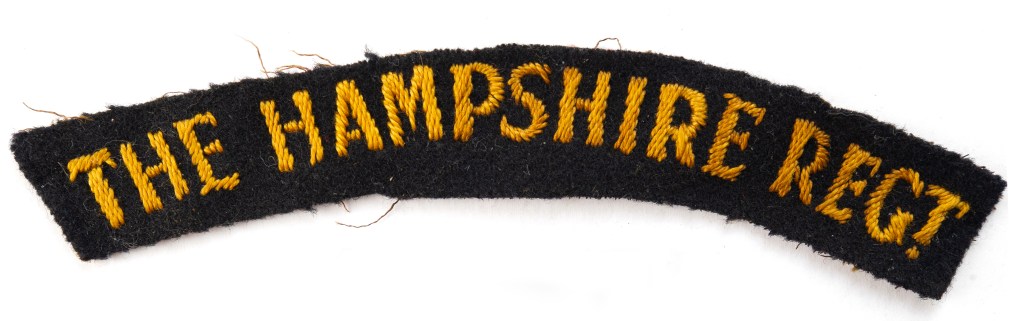
Embroidered cloth shoulder title of The Hampshire Regiment. There are several versions of shoulder titles to The Hampshire Regiments including various embroidered fonts, colourings and even calico printed versions. The exact type illustrated here feature on several surviving 2 Hampshire Service Dress tunics and Battledress blouses. There is no evidence to suggest that such a title was worn by the Welsh Guards officers at Tebourba, on the contrary they likely retained their Welsh Guards titles. © Gareth Scanlon 2025.
On 1 September 1942, the six Welsh Guards officers1 took up duties with the 2 Hampshires whilst the battalion were at Forfar, Angus undergoing intensive hardening training having been mobilised.
On 9 November 1942 the Bn evacuated their billets for embarkation on 10 November, and subsequently set sail for North Africa on 13 November landing at Algiers on 22 November. Despite being a part of 1st Guards Brigade, the Commanding Officer received orders to move the Bn straight up to the Tebourba front and to report to 11th Infantry Brigade of 78th Infantry Division. They arrived in the Tebourba area on 29 November and received immediate orders to move up and relieve the 5th Battalion The Northamptonshire Regiment near Djedeida.
The below table provides the names of those six Welsh Guards officers and their respective positions within the battalion:
| Capt. Arthur John Pearce-Seracold M.I.D. | Second In Command, X Coy |
| Lieut. Henry Arthur Evans M.I.D. | Platoon Commander, 7 Platoon, W Coy |
| 2/Lieut. Anthony ‘Tony’ Frank Quantock Shuldham | Platoon Commander, 9 Platoon, W Coy |
| 2/Lieut. Phillip Franey Mathews M.I.D. | Platoon Commander, 13 Platoon, Y Coy |
| 2/Lieut. Owen Griffiths | Platoon Commander, 16 Platoon, Z Coy |
| 2/Lieut. John ‘Jack’ C. Pugh | Second In Command, Anti Tank Platoon |
How do we know about the specific role of the Welsh Guards officers ?
Thankfully, two documents survive that specifically recount the role played by the attached Welsh Guards officers namely:
• a six page report written by Lieut. Owen Griffiths titled ‘Account of action in Tunisia with 2nd Hampshires’.
• another three page report written by Lieut. Tony Shuldham titled ‘Diary of movements of officers of Welsh Guards attached to 2nd Bn. The Hampshire Regiment’.
These are supplemented by an additional five page account dated 31 December 1942, written by Capt. M. J. Barton (Adjutant 2 Hampshires) titled ‘Account of the action of 2nd Battalion The Hampshire Regiment in the Battle of Tebourba 30th November to 3rd December 1942′. This was retained within the unit War Diary along with an incredible illustrated map plotting the exact location of the company’ deployments ‘s at that time.
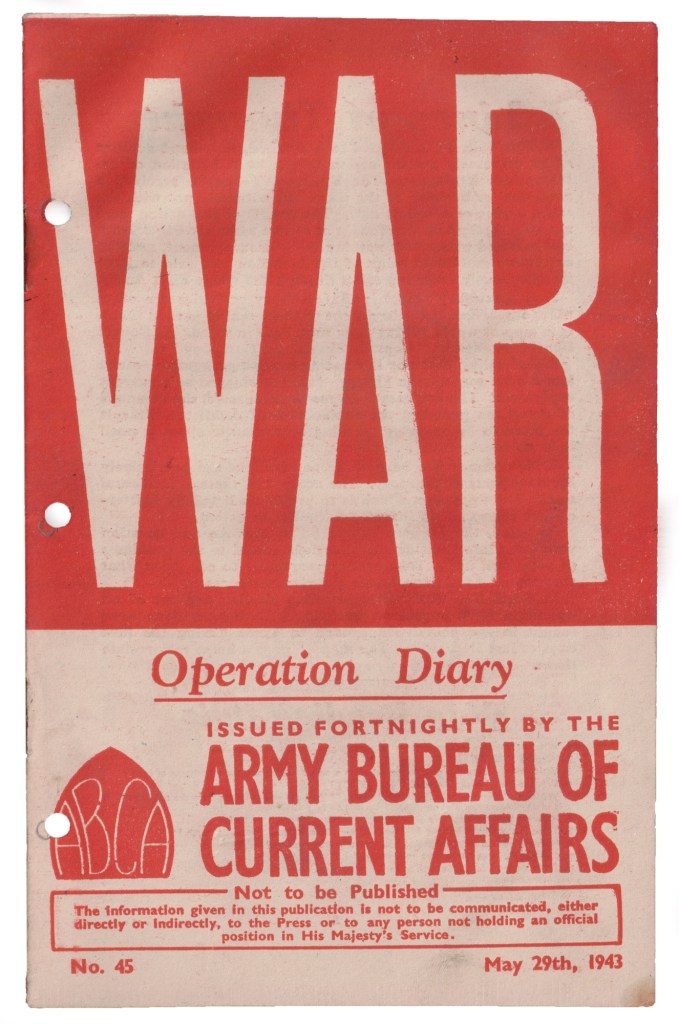
Fortuitously, Capt. Barton’s account was also used as a basis for an Army Bureau of Current Affairs (ABCA) circular on 29 May 1943. This breaks Barton’s document down into more manageable ‘chunks’ and also adds extra context over its 12 page account of the battle.
Strategic Situation Overview
The Operation Torch landings had happened just a fortnight before the Hampshires landed in Algiers. The British forces were now some ten miles from Tunis. The plan was to probe the axis defences to find a weak point and then to force a break through for Tunis. To that end General Evelegh split his forces (that is, de-concentrate them) to achieve this.
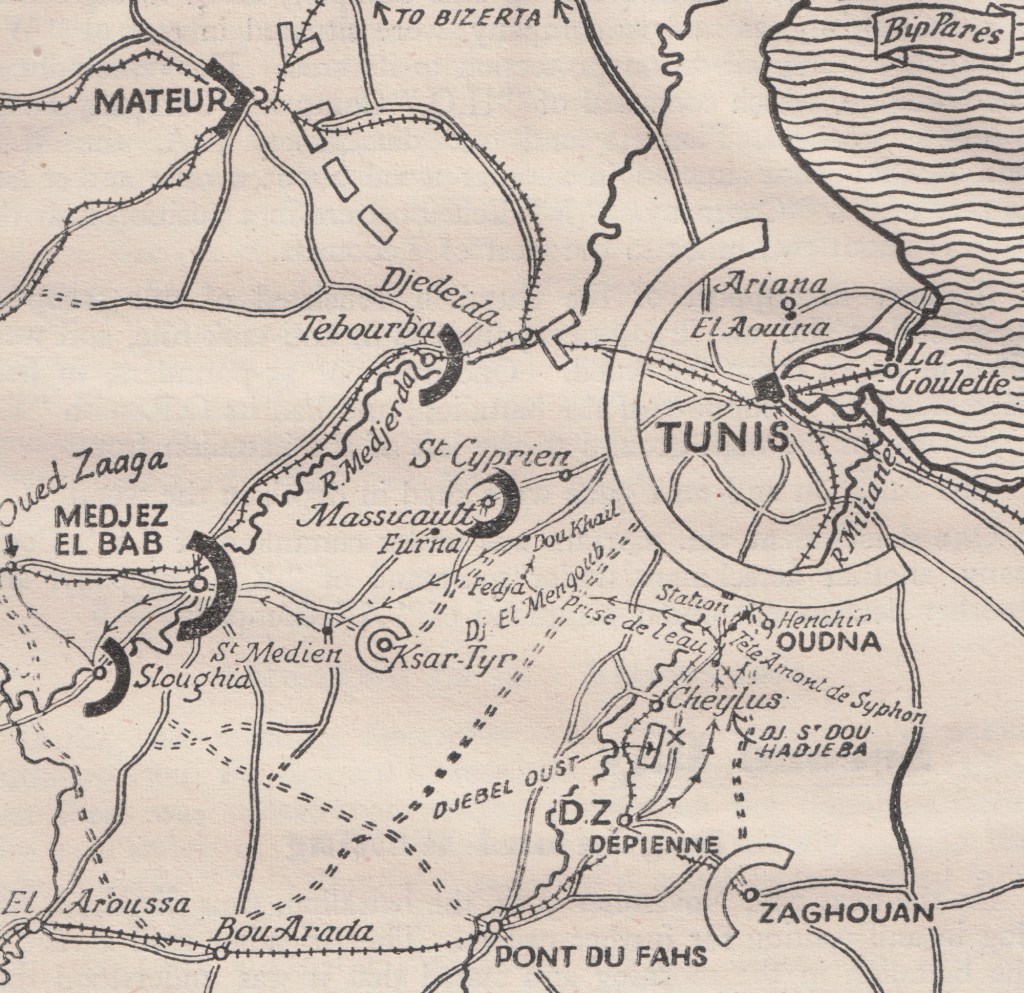
Meanwhile, the Germans were flattening their line, and in so doing gave up Medjez-El-Bab. Generalmajor Fischer split his 10th Panzer Division into four groups: Hudel, Lüder, Koch and Djedeida. The Germans had complete air superiority and the composite British Blade Force’s2 under-armed Valentine and Crusader tanks, supported by the Stuart’s of the 1st Battalion, 1st US Armoured Regiment, were now meeting the most recent Panzer VI ‘specials’ featuring the long 75mm guns.
The Northants, who they would relive, had twice tried to advance further east to Djedeida supported by a few American tanks, but each time had been beated back by Group Lüder. As already stated above, they were then relieved by the 2 Hampshires.
On their arrival, the Hampshires found the position to be totally unsuitable for defence – it being overlooked by high ground to the north and rear. The reason for this is that the Northants were tired and depleted in number and had been pinned to this position and unable to advance any further despite costly counter attacks against the enemy supported by US tanks. As you will read, this would determine the outcome of the engagement. The Hampshires, unknowingly, moved into a trap.
In setting out the events to be recounted, the ABCA pamphlet in its introduction titled Lines of Thought, states:
“This bulletin is devoted to a detailed, first-hand account of an extremely gallant action fought by a battalion of the Hampshire Regiment. The Battle of Tebourba received a good deal of acclaim at the time, but naturally not with the same degree of detail as now. The results of this action were not only tactical. It was fought at a time when the First Army had suffered practically nothing but discouragement, and the extremely gallant showing of the battalion was said to have an infectiously inspiring effect through the whole First Army”.
Before moving into the story, and as bit of a plunge down a rabbit-hole, Djedeida village was the site of an important Luftwaffe airfield. Just days before the Hampshires arrival, on the 24 November 1942 17 Stuart tanks of the 1st US Armoured Regiment stumbled across the airfield. The tanks were immediately ordered to attack and proceeded raced down the runway with all guns blazing. They destroyed or damaged more than 20 Luftwaffe Ju87 Stukas and Messerschmitt Bf-109s as they were preparing for take off, refueling and rearming. One tank even drove down a row of static aircraft shearing off their tails with its turret!
The Six: Their Story
Lieut. Owen Griffiths describes the deployment of the Bn having relieve the Northants:
“The main Bn. position was in a grove about 25 yards wide and several miles long in the middle of a narrow valley. At the far end of the valley was Djedeida which was made invisible by a large roll in the ground. On our right flank was a continuous ridge which curved round on our left front. On this ridge there was a modern looking house and two farmhouses. Running parallel to the position on the right was a river. On our left there was another ridge which took the form of two hillocks.
Y Coy. had positions on the forward and reverse slopes of the forward hillock on the left flank. X Coy was well forward in the wood with the remaining platoon of W Coy, behind them (Shuldham’s platoon had had an accident the previous night). Then came Bn. H.Q. Then Z Coy, and lastly H.Q. Coy in rear. All these were in the wood. Also in the wood were a troop of 25 pdrs attached to the Bn. We had no tanks.”
As referenced by Lieut. Griffiths, as the Bn were moving up during the very dark night of 29 November, 9 Platoon, W Coy had been involved in an accident in which the Platoon Commander (Lieut. Shuldam) and several O.R.s had been seriously injured. He became the first of the Welsh Guards casualties. The mention of having no tank support will also be critical in defining the outcome of the battle.
The below map (purchased complete with the map board) was scanned to focus on the area concerned in this article. I have also juxtaposed it with a 1:25k illustrated map that was retained within the War Diary of 2 Hamps. This gives visual context to the description given by Lieut. Griffiths and will aid the reader in understanding the events:
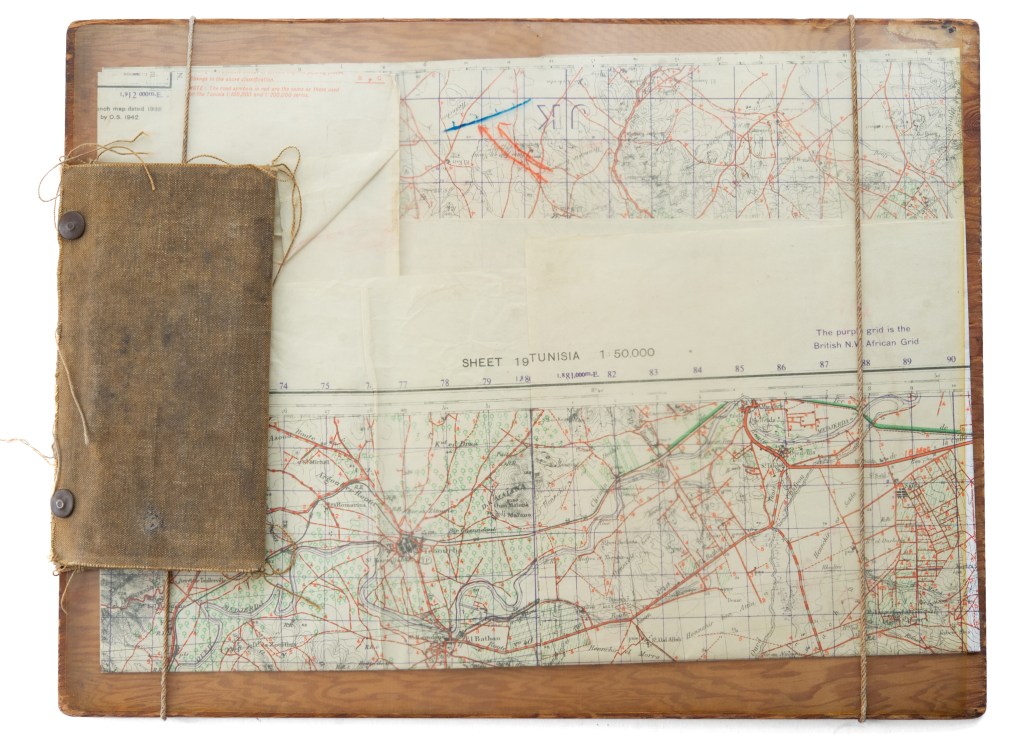
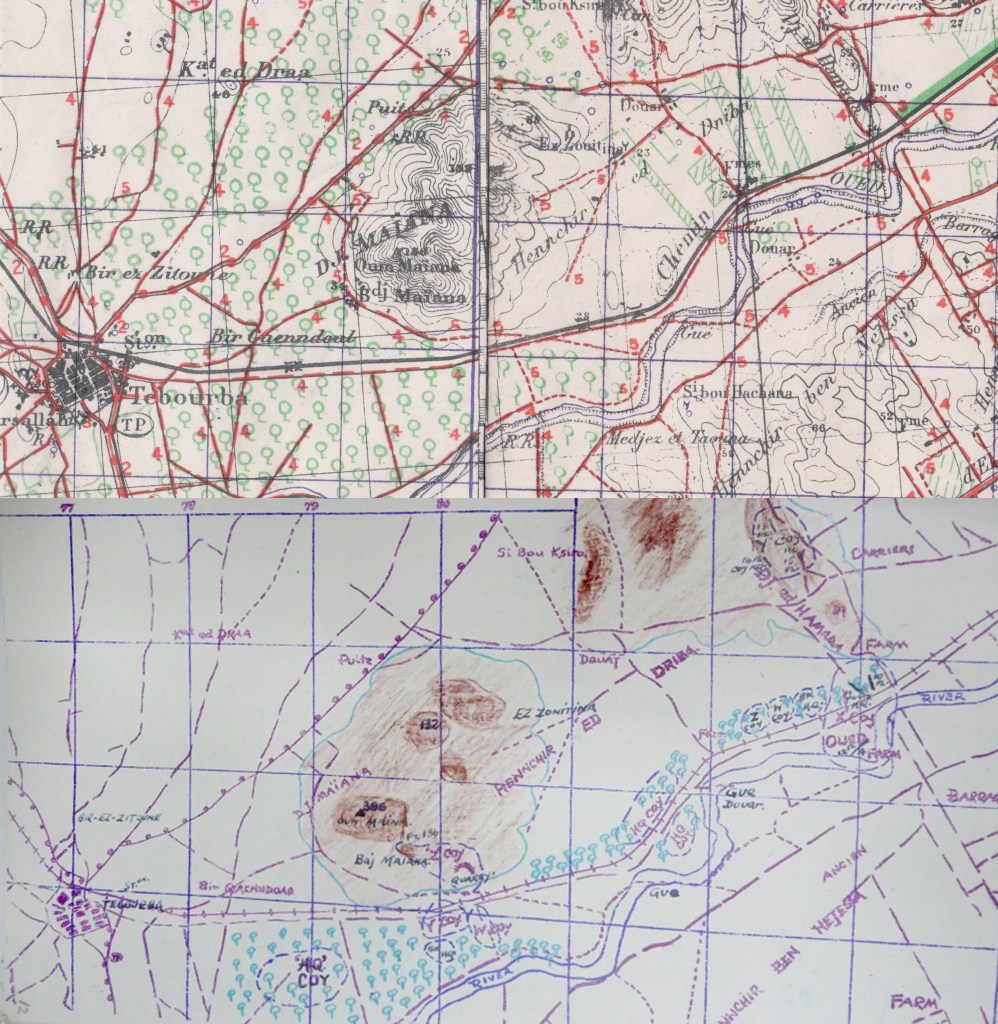
Having taken over, fighting patrols from X, Y and Z Coys were sent out on the night of 30 November/1 December, with only X Coy making contact with enemy M.G.s firing on fixed lines.
During the morning of 1 December the forward Coys and intelligence observation posts reported considerable enemy activity across the Bn’s front. In the early afternoon the Germans attacked both forward Coys with infantry supported by M.G.s and mortars.
In the evening they attempted to move M.G.s into the small farm on the right of Y Coy. 16 Platoon led by Lieut. Owen Griffiths was ordered to instigate a determined counter-attack on the farm supported by artillery and mortars. The approach to the objective was an extremely exposed forward slope and the platoon suffered heavy casualties fro M.G. and mortar fire. This farm can be seen towards the top far right in the above maps. Lieut. Owen Griffiths continues the story:
“I explained to the whole platoon what we had to do; fixed bayonets and ordered the platoon to advance up the hill. Mortar shells kept exploding but miraculously did not cause damage. I was determined to walk up the hill and charge down the other side. When we got to the top I shouted ‘double’ and ran down the hill. I did not see a single German but we were in a hail of machine-gun fire – I paused to shout on the platoon to the bottom of the slope … and I felt my leg go numb at the same time. I fell over and told my Platoon-Serjt. to go on ahead and shoot anything he saw. About seven of the platoon reached a farmhouse at the bottom of the slope and fired at the enemy from there …
… meanwhile I was in rather a quandary, to stay where I was would invite murder, and I was fifty yards from any cover. I thought of trying to get to the farmhouse but tracer bullets were going right through it so I decided to make an effort to get back to our forward position. Card (my runner) bandaged up my leg which was bleeding profusely and we set of together. I am afraid I never had much hope of getting back – as I was crawling I noticed one bullet hit the ground six inches from my head …
... (After nightfall) we set off on the way back to the R.A.P. We stopped at Battalion Headquarters and the Commanding Officer told me that I had saved the situation. How exactly he did not tell me …
… From there I went back to the R.AP. where my leg was treated by the doctor … I was carried out and put next to Jack Pugh (Welsh Guards, Lieut. Second in Command, Anti-Tank Platoon), who told me that he had two machine-gun bullets in his foot. He had been hit while he was lying behind the shield of a two pounder … Incidentally we were the first two officers to get wounded.
… (whilst at the R.A.P.) about 3 o’clock in the afternoon (2 December) a twenty-five pounder, about twenty yards behind me started firing at the enemy. The Germans replied by straddling the whole area with mortar bombs. The area unfortunately was occupied solely by wounded. We had no cover and a large proportion could not move at all. A piece of mortar shell went through my arm.”
Thus far, three Welsh Guards officers were now wounded or injured.
Capt. M. J. Barton’s report continues the narrative:
“Soon after daylight on 2nd Dec, the enemy got snipers and M.G.s on the high ground on the Bn.’s right. These M.G.s opened up on the whole front and the enemy advanced supported by about seven tanks. Tanks were observed on the right-hand Pl of Y Coy positions and one tank could plainly be seen from Bn. H.Q. firing from its turret gun directly into the platoon’s positions form arrange of about 10 to 20 yards. Communication between the Coy Comd and the commander of this platoon broke down and nothing more was seen or heard of this platoon. Meanwhile, both 6pdrs and 2pdr Arty had been active in engaging tanks and two tanks and an infantry gun towed by a lorry were seen to be hit and blazing, and on further tank on the slope of Y Coy stopped and was put out of action”.
It is also possible that this was the action which led to Lieut. Jack Pugh being wounded given the engagement of the anti-tank platoon and chronology with Lieut. Griffiths’s account of him being at the R.A.P. Barton continues:
“The 2 i/c of X Coy Capt. Pearce-Serocold reported to Bn. H.Q. in person that he had been ordered by O.C. X Coy to give a situation to the Commanding Officer. X Coy it appeared, had withstood the enemy attack all morning, inflicted large losses, and with repeated counter attacks with the bayonet, most of the led by the Coy Commd himself, Capt. Thomas, had driven the enemy off and inflicted heavy losses…”
… but shortly before midday enemy infantry in large numbers together (with) two tanks had overrun the position and he (Capt. Pearce-Serocold), remained out of the Coy”.
In his report, Lieut. Tony Shuldham references that “Capt. Pearce-Serocold and Lieut. H.A. Evans are missing, Lieut. Evans after the first position, and Capt. Pearce-Serocold when the Bn. split up into small parties (more on this later)“. Given this, it is likely that Lieut. Evans was killed during the action where the position was overrun by two tanks.
Lieut. Owen Griffiths, whilst at the R.A.P states:
“During the morning the situation became very serious indeed. I was lying practically inside the Company H.Q. of H.Q. Company so I had a very good idea of what was going on. The enemy had attacked X Coy in force and I heard that only one officer and four men were left. The position of Y Coy was rather obscure … then Sjt. Edwards the Platoon-Sjt. of Phillip Matthews platoon arrived at the R.A.P. and told me that Phillip had been killed with most of his platoon counter attacking on the left flank”.
Barton uses the same language to describe the situation at that time:
“The situation on Y Coy’s front appeared to be very obscure and enemy infantry and machine guns could be plainly seen on the hills to the left and in the rear of this Coy … at about 1600 hours however, 2 runners from Y Coy … stated that casualties were very heavy, that they were out of water and ammunition”.
This enables us to understand the fate of Lieut. Mathews, and the position with X Coy having one officer and four men left. I believe that the one remaining officer was Capt. Pearce-Serocold for reasons explained below.
As the Germans proceeded to roll-up the front, Barton reports that:
“The Commanding Officer then ordered all remaining troops to form a square around Bn H.Q. …
The intention being to hold the enemy until dark, then to break out and capture Pt. 168, and hold this feature until further orders, but at 1900 hrs however, he decided that the position, short of ammunition and water and without any anti-tank weapons, was untenable and would only result in the complete annihilation or capture of the remaining of the fighting personnel of the Bn. which then consisted of approx. 10 officers and 200 men.
He therefore ordered all ranks to arm themselves with as many automatic weapons, rifles, grenades and ammunition as could be found or taken from casualties or from the dead, for bayonets to be fixed and for the Bn. to cut its way out in extended order, moving with its right on the railway west of Tebourba.
The Commanding Officer gave the order to charge and all troops charged with Brens and TSMGs firing and with bayonets fixed. Direct contact ws made with two tanks and about a company of enemy infantry and some confused fighting took place with casualties on both sides”.
Lieut. Tony Shuldham recounts that Capt. Pearce-Serocold became missing “when the Bn. split up into smaller parties”. For this reason I believe that it was during the action that he was killed.
Barton concludes his report in saying that:
“By 6th December out of the original fighting part of the Bn. (Less B Echelon) which had gone into action, only 4 officers and approximately 120 men had reported to the collecting post … and from that date until the time of writing (31 December 1942) no other officer or other rank has reported except wounded on discharge from hospital.”
| ✝ Capt. Arthur John Pearce-Seracold M.I.D. Second In Command, X Coy | Missing (presumed killed in action) when the battalion split up into small parties 02/12/1942. He has no known grave. Commemorated at the CWGC Medjez-El-Bab Memorial. Age: 24. |
| ✝ Lieut. Henry Arthur Evans M.I.D. Platoon Commander, 7 Platoon, W Coy | Missing (presumed killed in action) likely when his platoon position was overrun by two tanks 02/12/1942. He has no known grave. Commemorated at the CWGC Medjez-El-Bab Memorial. Age: 21. |
| 2/Lieut. Anthony ‘Tony’ Frank Quantock Shuldham Platoon Commander, 9 Platoon, W Coy | Injured in Accident 29/11/1942 : “Platoon Commander and 6/7* ORs were seriously hurt when a troop carrier had an accident and overturned in the “exceedingly dark night”. The remainder were treated for shock. |
| ✝ 2/Lieut. Phillip Franey Mathews M.I.D. Platoon Commander, 13 Platoon, Y Coy | Killed in Action 02/12/1942: Killed with most of his platoon counter-attacking on the left flank. He has no known grave. Commemorated at the CWGC Medjez-El-Bab Memorial. Age: 21 |
| 2/Lieut. Owen Griffiths Platoon Commander, 16 Platoon, Z Coy | Wounded 01/12/1942 whilst counter attacking farm house. Wounded 02/12/1942 whilst mortared at R.A.P. |
| 2/Lieut. John ‘Jack’ C. Pugh Second In Command, Anti Tank Platoon | Wounded 02/12/1942: two machine-gun bullets in his foot whilst lying behind the shield of a two-pounder anti-tank gun. |
Aftermath
As a consequence of the casualties sustained, some three months later, the 2nd Battalion Hampshire Regiment would be replaced within 1st Guards Brigade by 3Bn Welsh Guards.
Lieut. Shuldham rejoined 2 Hamps on 22 January 1943 on discharge from hospital. He was given command of the M.M.G. Pl, which consisted at that time of 9 Vickers .303 Medium Machine Guns. He returned to the UK as an officer “of battle experience, capable of instructing”. He later fought as a platoon commander in 2 Platoon, 1 Coy, 1 WG in North-West Europe and is noted in WGAW for his performance at Beeringen, Helchteren and Hechtel in Belgium. He was born in Neath, Glamorgan, some ten miles from where I grew-up. He left the army with the rank of Captain.
Lieut. Griffiths was miraculously evacuated to a dressing station at Medjez-El-Bab and from there to the UK.
I have not been able to secure any further information regarding Lieut. Jack Pugh.
Likewise I have only been able to source photographs of two of the six officers at this time (I am hopeful to find photographs of the other four officers):
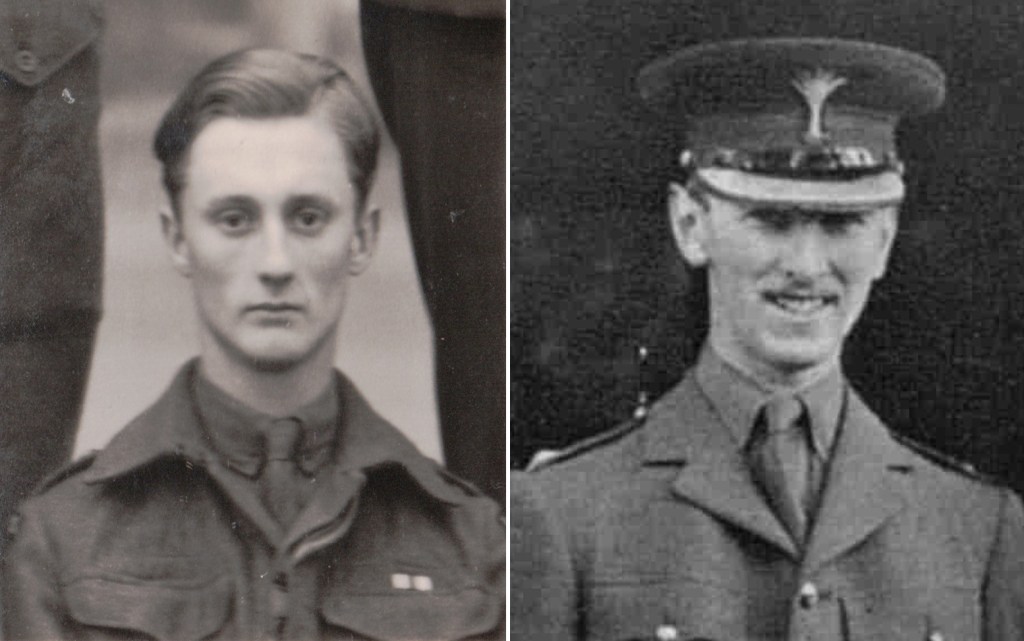
Conclusion
To my knowledge, this story has not been told, at least not from the perspective of the six Welsh Guards officers. I sincerely hope that it goes some way as to honour their service, particularly since with the exception of Shuldam’s accident, all were injured whilst leading their men. Capt. Pearce-Serocold, Lieut. Evans and Lieut. Matthews all received posthumous Mentions in Dispatches. I also hope it draws attention to the early period of the Tunsian Campaign and the challenges faced by the Allies at this time.
Finally, I’m confident the article will provide an insight into the level of detail to come within ‘The Forgotten Fighting Third’. As those of you who follow the blog, my social media accounts or have read my last book, I have mainly concentrated on the Italian Campaign, of which I have amassed some 90Gb of information thus far. Again, I hope it serves to ‘whet the appetite’ for what’s to come.
Diolch yn Fawr,
Gareth
 Camouflaged Fist
One thought on “Remembering the Six: Welsh Guards Officers & The 2nd Hampshires, Tebourba, Tunisia 1942”