
Introduction
Regular readers of my blog and social media pages will be well aware of the information I have been amassing in support of my book. I now have some 18’000 files relating to 3Bn, these include photographs, maps, documents amidst other bits. Regular readers will also know that I have travelled far and wide to gather up this information from museums, archives and families. This database has enabled me to layer information to be able, to varying degrees, tell the story of individuals.
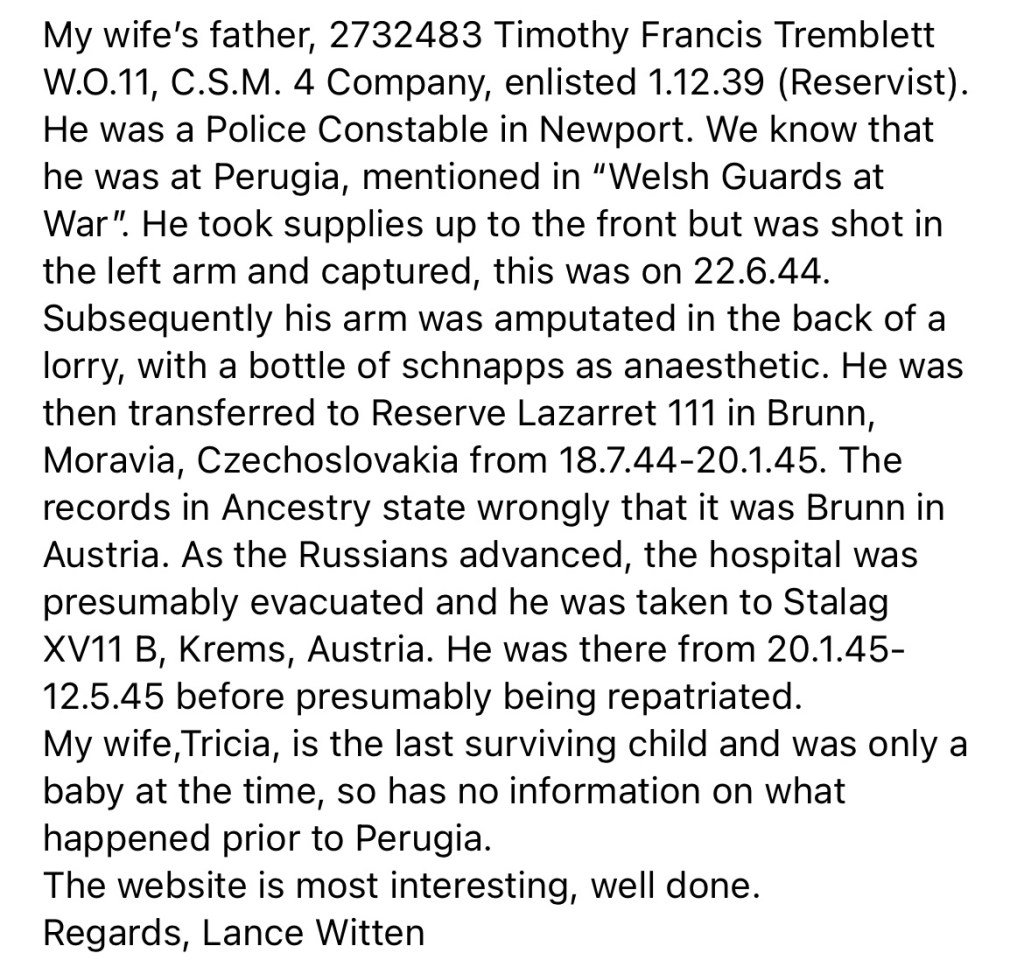
I recently told a story about Gdsm James Woodman by bringing these multiple sources and layers of information together. This post was read by Lance Witten, who left the below comment:
© Copyright Gareth Scanlon 2025.
Knowing I had a lot more information on CSM Tremblett, I asked Lance to drop me an email so that I could provide more information regarding his father-in-law.

Lance did email, to which I penned the below (verbatim) reply …
My reply:
Good Evening Lance,
Thank you for getting in touch. Just to give a little context to my interest in 3WG, I had two great-grandfathers who served in the battalion.
As you will likely have deduced from my blog I’m currently writing a book “The Forgotten Fighting Third: The Welsh Guards in Tunisia & Italy 1943-45” and have been amassing information for (on and off) 20 years, but more intensively for the last 5. I have also been building up a nominal roll of those who served with the battalion, and currently have details on c.1450 (of the c.2000) men. This has been gathered from multiple sources including casualty lists, war diaries, personal diaries, letters, books, archival research etc.
I am also in touch with several families of those who served and have been extremely fortunate and privileged to be able to copy/photograph what their relatives retained from the campaign. This significantly helps piece all of this information together as you will see.
In terms of Francis, you and Tricia are likely aware he enlisted in the Welsh Guards on 31/12/1927 aged 18 (4/12) at Cardiff. He was a painter prior to enlistment. He served a 3 year engagement with the regiment and was discharged to the reserves on 30/12/1930. At some point after his service he joined the Police in Newport and was subsequently ‘recalled to the colours’ for service in WW2. This was a well trodden pathway for many discharged Welsh Guardsmen after their service, and indeed, when the recall notices went out from the regiment there were significant concerns raised as it depleted Welsh Constabularies by some 300 Police Officers! Several of these pre-war now police guardsmen became the backbone of the service battalions with many, such as Francis, become senior sergeants and warrant officers.
Regarding his time in 3Bn he has not, so far, come up in any of my accounts of the fighting in Tunisia prior to Italy. That’s not to say he didn’t fight Tunisia – in fact I believe he did, and should I find anything relating to this period I shall immediately let you know.
What I do know, is that in late 1943 (after the hostilities had ended in Tunisia) he was the Company Sergeant Major (CSM) of the Welsh Guards ‘reserve Coy’ at the IRTD (Guards No.1 Infantry Reinforcement & Training Depot). He was deployed to Italy before the rest of the battalion when the IRTD moved from Philippeville, Tunisia (modern day Skikda) to Rotondi, Italy in early January 1944.
This advance party was subsequently attached to 2Bn Scots Guards, of 201 Guards Brigade in the Minturno sector in Italy, where it fought for a fortnight at the end of January 1944. In my last book I covered these ‘experiments’ of attaching one company of one guards regiment to another, however at that time all of the sources pointed to this happening with a company of Scots Guards attached to 2Bn Coldstream Guards first. I now know that this was not the case and this Welsh Guards IRTD Coy (referred to as ‘W Coy’) attachment to the Scots Guards was indeed the first instance. I know for certain he was with them as I have a roll featuring his name and number – he was W Coy’s CSM. I’ll cover this off in my book as thankfully the officer commanding W Coy kept a ‘semi-official’ diary.
After his W Coy attachment, I believe that Francis took over as CSM of 4 Coy as a consequence of CSM Welling (4 Coy) being wounded on 11 February 1944 at Monte Cerasola. Regrettably he was wounded by our own supporting 25pdr artillery (Ayrshire Yeomanry). CSM Welling was later evacuated home following severe damage to his hearing as a consequence. W Coy were left out of battle for Cerasola so I’m fairly confident Francis would not have fought there and replaced CSM Welling soon after the Bn was out of the line thereafter.
Following the engagements at Monte Purgatorio in March 1944, you will likely be aware that the Bn were deployed in Cassino in a holding role occupying the devastated remnants of the town itself. Once it had fallen, the 6th Armoured Division advanced northwards in pursuit of the Germans along Route 6 towards Rome. Following the bloody battle for the hills surrounding Coldragone near Arce, where 3WG sustained very heavy casualties, they swung east 5 miles from Rome and advanced towards Todi and Terni on the axis to Perugia. On reaching Perugia, they were ordered to capture objective ‘TULIP’ – the hamlet of San Marco. Here the Bn saw significant action and stiff opposition, inevitably as you know, Francis became a POW here.
I shall try and explain what happened to Francis through several accounts and information sources.
To start, the 3WG war diary for this period gives the following information for 21 June 1944 (See attachment titled War Diary):

© Copyright Gareth Scanlon 2025.
“O.C. 1 Coy [Officer Commanding 1 Company] (Major W.T.C. FOGG-ELLIOT) with a party went on a recce to pt [Point] 532 via left flank in order to try and get supplies up which had failed the night previous. Enemy were encountered at 652952 and casualties were suffered incl CSM TREMBLETT believed PW [Prisoner of War]) and 4 ORs [Other ranks].”
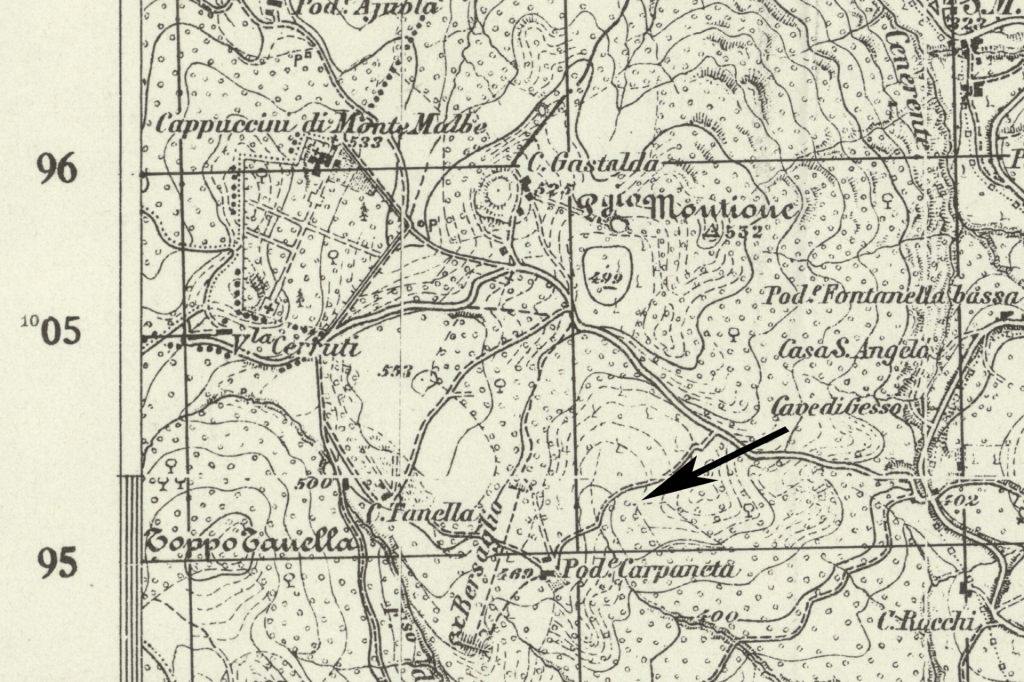
Please see an excerpt from a contemporary map from my collection illustrating the exact map reference quoted in the war diary should you wish to visit there. This is inevitably were Francis was taken prisoner. You will note that point 532 is above and to the right of where I have marked the reference contained in the war diary. I will cover off this engagement in my book – a number of gallantry medals were won on or around pt 532. (see attachment titled Map – Pode Carpaneta).
© Copyright Gareth Scanlon 2025.
There are three other accounts of the events of the 21 June 1944 (you will see how they all appear to use the primary ‘first source’ as a reference). The first (primary source) below is an excerpt from an account found within a three-page document written at the time titled ‘Some Gains Were Made’. This covers 3WG’s fight at San Marco – I have handled 3 copies of this document, two in the custody of families of 3WG officers and a third at the WG Archive at Wellington Barracks:
“Next morning Major W.T.C. Fogg-Elliot accompanied by Capt. Roberts, the AY FOO [Ayrshire Yeomanry {ARTILLERY} Forward Observation Officer] and a party including CSM Tremblett and Sit Essex made a further attempt to contact 4 Company. Determined not to repeat the error of the night, this party went left handed. About half way up the hill they came upon a German soldier at the back of a farmhouse. Having taken him prisoner they were investigating further when a number of Germans appeared; shots were exchanged and then fire was opened from the windows of the house and from the direction of the garden. We suffered some casualties including Capt. Roberts, who was hit in the leg but got away, and CSM Tremblett and Sit Essex who who were also wounded. Major Fogg-Elliot collected his party as best he could and continue to engage the enemy. However it became obvious that they were too small a force to take the house and he withdrew leaving the wounded who could not be moved owing to small arms fire.
On reaching Bn HQ he immediately organised a second party and set out again followed by a carrier fitted with stretchers. A very gallant attempt was made to reach the farmhouse but the enemy were now well prepared and opened fire with machine-guns and mortars. During the engagement in Major Fogg-Elliot and Lt. J.D.S. Nichol-Carne more killed. In the meantime, no it transpired, the enemy had recovered our wounded.”
The regimental history Welsh Guards at War (p.158-161) makes this account:
“With Perugia behind it the Battalion faced north-west. The hills on either hand lay back some distance from the central ridge which they had cleared, but those on the left stretched out a long arm across their front, ending in a hill called Montione (Point 532 on the map). It is about a mile from San Marco, and the road from Perugia continuing northwards runs at its foot. Italians reported that the Germans had withdrawn from it and Lieutenant-Colonel Gurney ordered No. 4 Company to occupy the hill …
… as soon as darkness fell the sound of enemy movement was heard on three sides of No. 4 Company’s position, so Egerton ordered the sections to slip away quietly, one at a time, and to reassemble at the foot of the hill, and the manoeuvre was so well carried out that all were away before the enemy fired a shot.
They were back in their old headquarters, a house behind San Marco, by soon after midnight. It was a large house with plenty of room for the whole company. They had a hot meal before turning in and all this acted as a great tonic to the men, who were very exhausted by the end of the operation. “We ate off plates and table cloths again and I had a wonderfully comfortable bed with linen sheets.’ ” It was only when they rejoined the Battalion that they learned what had happened in their absence.
Captain Egerton had only taken a skeleton Company Headquarters on to Montione: he had left behind Company Sergeant-Major F. Tremblett and others who could be spared, and during the night Tremblett organised a party to take rations up to the company. Major the Baron de Rutzen led them and they reached the crest of the hill without finding any of No. 4 Company. They heard voices and called to them quietly, but got no answer. So de Rutzen stood up just below the crest and shouted loudly. He was answered promptly by the unmistakable fire of spandaus and realised then that the voices he had heard were German. (Doubtless they came from the force which subsequently attacked No. 4 Company.) There was nothing for the lightly armed and heavily loaded ration-party to do but but de Rutzen ordered them to dump the rations they had brought up and this wise decision explains the company’s mysterious find.
But it was realised at headquarters that in the morning supplies must be got up to the company; Major Fogg-Eiliot, accompanied by Captain J. R. Roberts (observing for the guns of the Ayrshire Yeomanry), and a party which included Company Sergeant-Major F. Tremblett and Sergeant John Essex, set out to make contact with No. 4 Company. To avoid the enemy post which de Rutzen had encountered in the night they chose a wide left-handed approach, and they had reached the foot of the hill when they came upon a German soldier at the back of a farm building and quickly made him prisoner. They were about to question him when others appeared and fire was opened by both sides. This attracted heavier fire from a nearby house and garden. Captain Roberts was wounded but was able to get away. Tremblett and Essex were both too badly wounded to move and there were other casualties.
The force which remained was too small to take the position, so Fogg-Elliot withdrew, getting away with difficulty over open ground. As soon as he got back to his company he detailed Lieutenant J. D. S. Nicholl-Carne and his platoon to return with him, and at once they set out to capture the post and bring in the wounded. But when they approached the scene of action the enemy were well prepared; they were greeted by mortar and machine-gun fire; Fogg-Elliot and Nicholl-Carne were both killed and after a vain effort to subdue the enemy’s fire the remainder of the platoon withdrew. No. 4 Company were therefore still cut off from the Battalion and the Commanding Officer decided on the withdrawal recorded above.”
Phil Brutton’s in his book An Ensign in Italy (p.84) states:
“Major Fogg-Elliot, accompanied by Captain J. R. Roberts (observing for the guns of the Ayrshire Yeomanry), and a party which included Company Sergeant-Major F. Tremblett and Sergeant John Essex, set out to make contact with No. 4 Company. To avoid the enemy post which de Rutzen had encountered in the night they chose a wide left-handed approach, and they had reached the foot of the hill when they came upon a German soldier at the back of a farm building and quickly made him prisoner. They were about to question him when others appeared and fire was opened by both sides. This attracted heavier fire from a nearby house and garden. Captain Roberts was (hit in the leg) wounded but was able to get away. Tremblett and Essex were both too badly wounded to move and there were other casualties.”
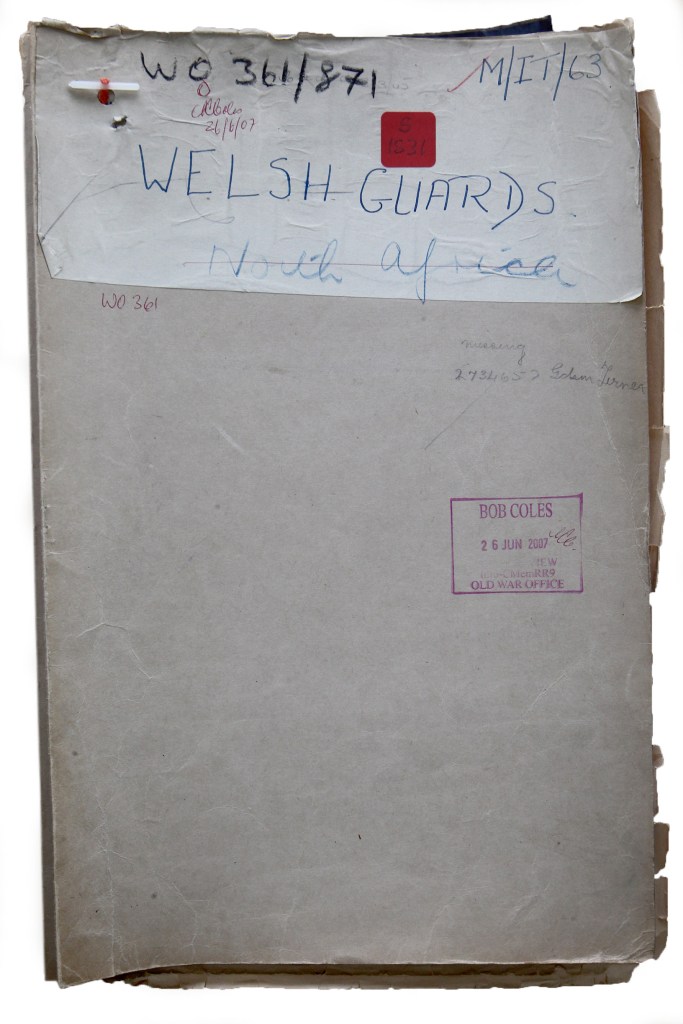
Also, all missing personnel were investigated with any witnesses etc. interviewed. A separate Missing Personnel War Diary at The National Archives documents all of these missing person investigations.
© Copyright Gareth Scanlon 2025.
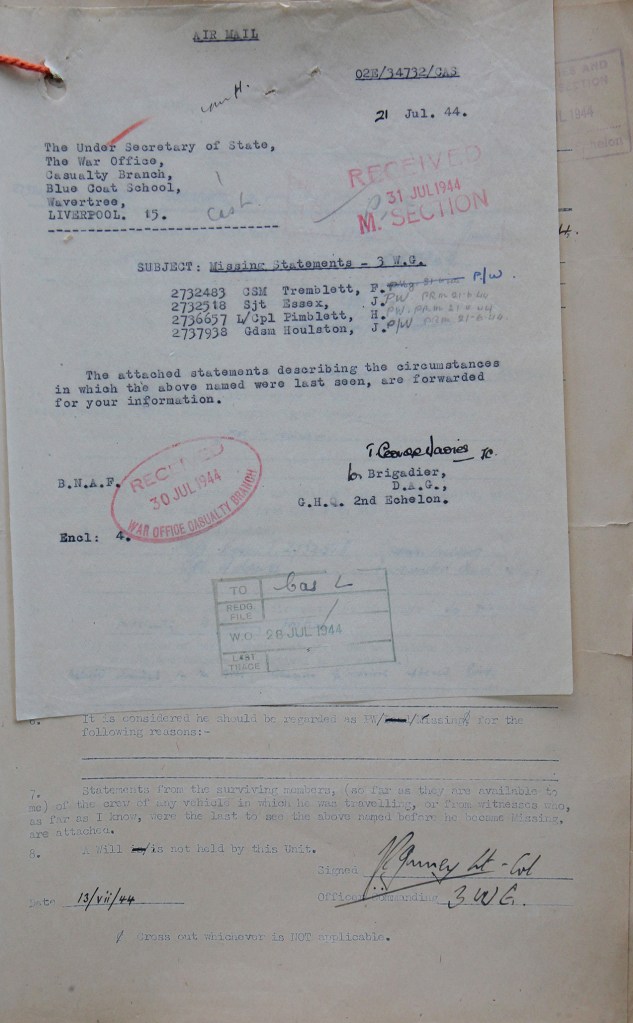
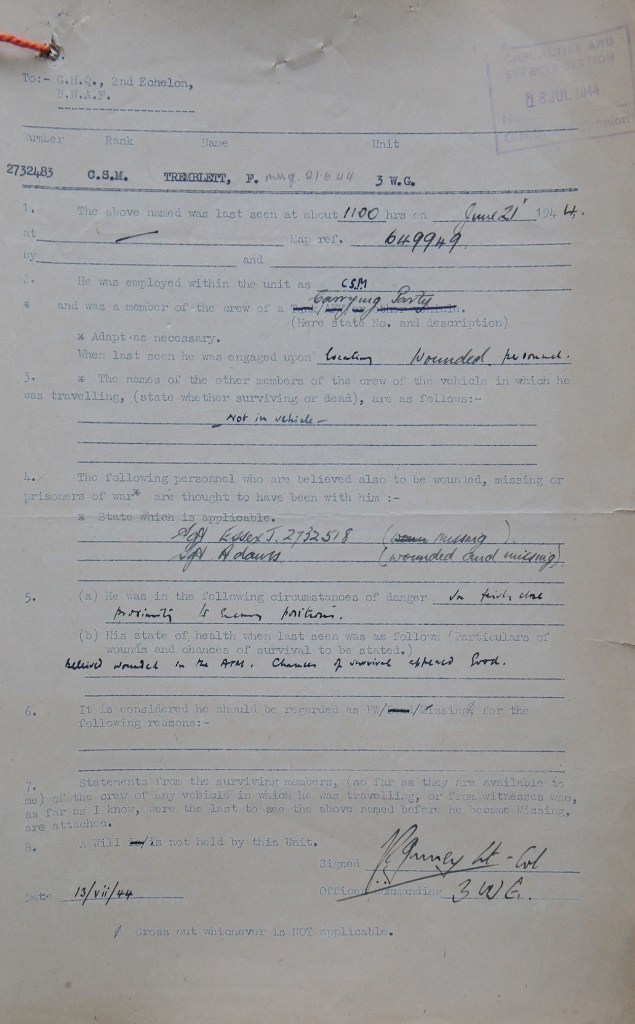
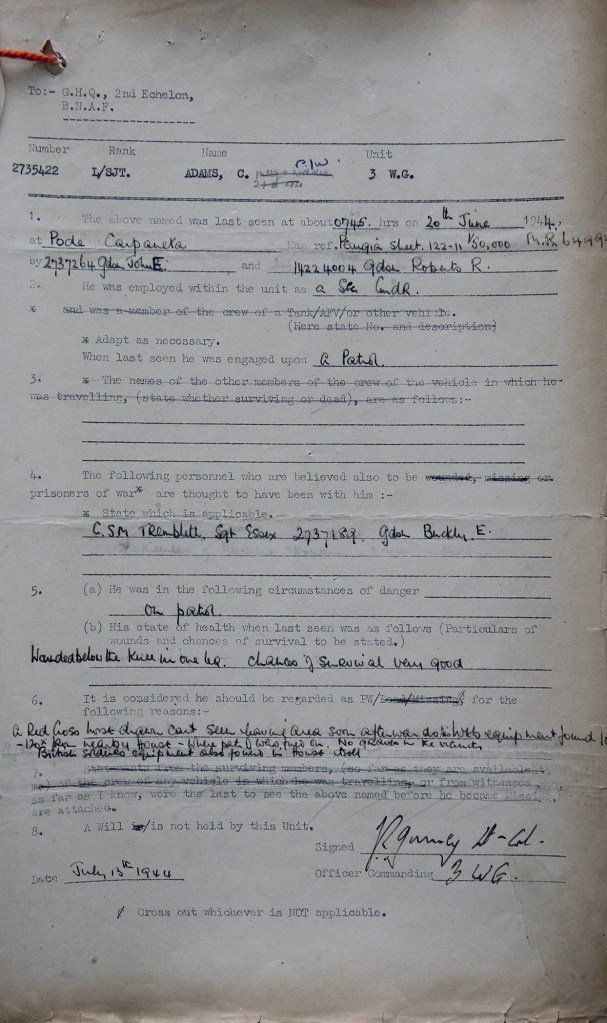
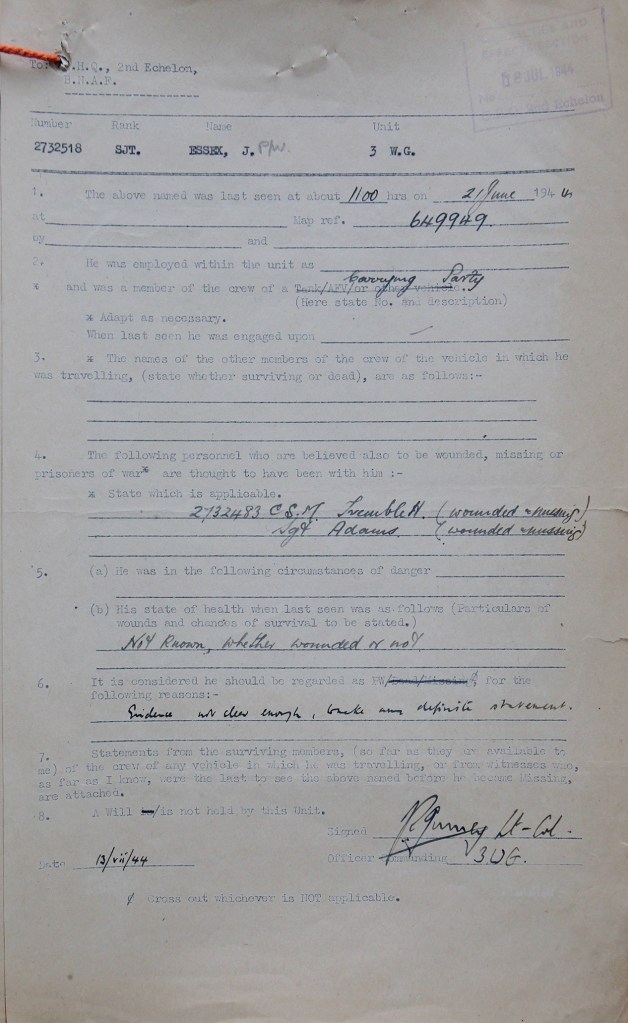
Documents within this War Diary (attached titled Missing Personnel Diary) state that Francis, Sjt. Essex, L/Sjt Adams and Gdsm ‘Big Buck’ Buckley were all together when they became ‘missing’. They were last seen at PODE CARPANETA (which is the house to the below left of the arrow on the attached map). The farm building and house mentioned in the accounts is without doubt PODE CARPANETA (the ‘White House’) and I believe the scene of the attack mentioned in all of the above narratives. PODE CARPANETA is here (you can juxtapose it against the excerpt of the contemporary map):
Francis, Sjt Essex (himself also a Policeman in Bristol – he retuned to policing after the war) and L/Sjt Adams (he was wounded below the knee in one leg) were all wounded. Gdsm ‘Big Buck’ Buckley was a Bren Gunner, and stayed behind to protect the wounded men until they could be rescued (he died of wounds presumably as a result of action where the Germans rounded up Francis, Essex and Adams – I believe he must have been wounded in defending them).
© Copyright Gareth Scanlon 2025.
© Copyright Gareth Scanlon 2025.
© Copyright Gareth Scanlon 2025.
© Copyright Gareth Scanlon 2025.
The family of Lt.Col. Jocelyn Gurney, who was the 3WG Commanding Officer at that time (he also is the signatory on the documents in the missing personnel diary), have a substantial archive that their family retained. His personal diary mentions on 21 June 1944 that:
“CSM and 2 others wounded and had to be left behind (later we saw horses with Red X flag going away from this white house).”
This account is without doubt how Francis was likely taken away by the Germans .
Recently, the family also found and forwarded this amazing newspaper clipping that they shared with me (see attachment Newspaper Clipping) which is an interview with Francis about what happened, unfortunately I don’t know when or who published it:
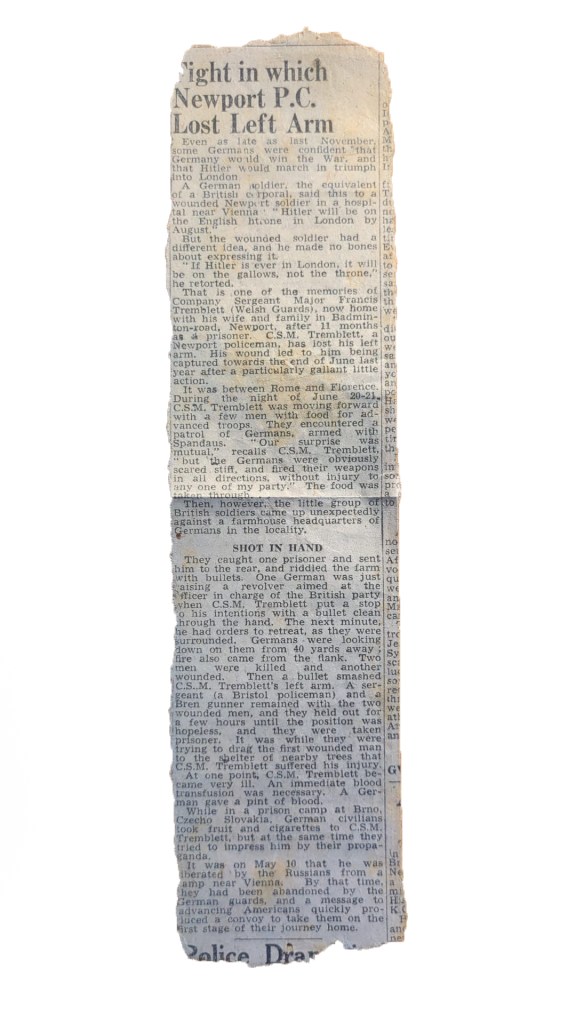
© Copyright Gareth Scanlon 2025.
Fight in which Newport P.C. Lost Left Arm
Even as late as last November some Germans were confident that Germany would win the War, and that Hitler would march in triumph into London.
A German soldier, the equivalent of a British corporal, said this to a wounded Newport soldier in a hospital near Vienna “Hitler will be on the English throne in London by August.”
But the wounded soldier had a different idea, and he made no bones about expressing it.
“If Hitler is ever in London, it will be on the gallows, not the throne,” he retorted.
That is one of the memories of Company Sergeant Major Francis Tremblett (Welsh Guards), now home with his wife and family in Badminton-road, Newport, after 11 months as a prisoner. C.S.M. Tremblett, a Newport policeman, has lost his left arm. His wound led to him being captured towards the end of June last year after a particularly gallant little action.
It was between Rome and Florence. During the night of June 20-21, C.S.M. Tremblett was moving forward with a few men with food for advanced troops. They encountered a patrol of Germans, armed with Spandaus. “Our surprise was mutual,” recalls C.S.M. Tremblett, “but the Germans were obviously scared stiff, and fired their weapons in all directions, without injury to any one of my party.” The food was taken though.
Then, however, the little group of British soldiers came up unexpectedly against a farmhouse headquarters of the Germans in the locality.
SHOT IN HAND
They caught one prisoner and sent him to the rear, and riddled the farm with bullets. One German was just raising a revolver aimed at the officer in charge of the British party when C.S.M Tremblett put a stop to his intention with a bullet clean through the hand. The next minute, he had orders to retreat, as they were surrounded. Germans were looking down on them from 40 yards away; fire also came from the flank. Two men were killed and another wounded. Then a bullet smashed C.S.M. Tremblett’s left arm. A sergeant (a Bristol policeman) and a Bren gunner remained with the two wounded men, and they held out for a few hours until the position was hopeless, and they were taken prisoner. It was while they were trying to drag the first wounded man to the shelter of nearby trees that C.S.M. Tremblett suffered his injury.
At one point, C.S.M. Tremblett became very ill. An immediate blood transfusion was necessary. A German gave a pint of blood.
While in a prison camp at Brno, Czecho Slovakia. German civilians took fruit and cigarettes to C.S.M. Tremblett, but at the same time they tried to impress him by their propaganda.
It was on May 10 that he was liberated by the Russians from a camp near Vienna. By that time, they had been abandoned by the German guards, and a message to advancing Americans quickly produced a convoy to take them on the first stage of their journey home.
So given your information about him having his arm amputated in a lorry following a bottle of schnapps being provided as anaesthetic, it appears that he also had a blood transfusion from a German soldier. It also gives an account of his continued resistance whilst at the Stalag.
You will note the incongruence in the casualty figures quoted between the sources, this is strangely quite normal.
I sincerely hope from a family perspective that this gives you a very complete understanding of what happened to Francis, where, when, how and why. I hope this is helpful to you.
As an aside, do you have any items or photographs from Francis’s service? I would very much like to see a photograph of him, or indeed to see any items he may have retained from the war.
I’m sorry about the length of this email, but I wanted to try and explain it as fully as I could. I feel it’s very important to give families as much information as I possibly can.
Sincerely hope this helps,
PS, as promised link to reading list:
Gareth Scanlon
Why I’m sharing this …
Firstly, I think Francis’s story is an extremely important one to tell to remind those of the sacrifice these men gave so that most of us have been able to enjoy decades of relative peace.
Secondly, I think this example perfectly illustrates how all of the sources I’ve been able to gather together can ‘work as whole’ to tell a story. This of course is how I’m going to bring the story of 3Bn’s war together by telling it through the detail of personal experiences. This inevitably chimes in on the overarching reason I’m writing the book, that is, so that these important stories of service and contribution are told.
Finally, it provides immense personal satisfaction to be able to share information with families regarding their loved one’s war. I’ve met countless families of those who served in 3Bn and I most enjoy the conversations and exchange of information which are, without doubt, mutually beneficial.
As a final note …
Since sending the email, there have been several emails sent back and forth. It’s such a fantastic feeling to get a response such as this:
© Copyright Gareth Scanlon 2025.
It makes everything all so worthwhile and spurs me on to get the book done! I’m confident it’ll help hundreds of other families too.
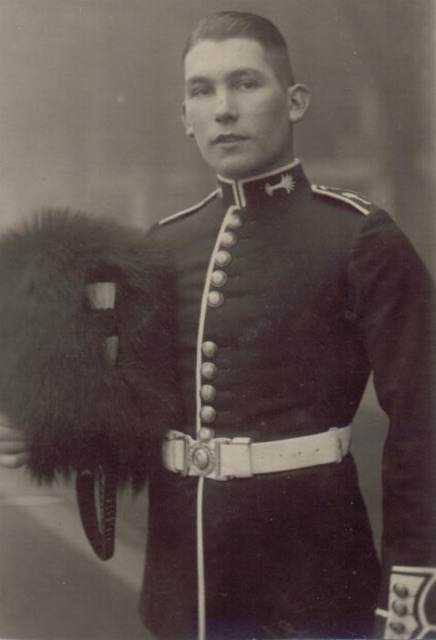
Within those subsequent exchanges, Lance and Tricia included several photographs of Francis which is always most delightful to put a face to a name I’ve read so much about. Here he is:
© Copyright Gareth Scanlon 2025.
Anyhow, I sincerely hope you’ve enjoyed it, thank you for ‘staying with me’ through this longer than normal read.
Diolch yn fawr iawn,
Gareth
 Camouflaged Fist
One thought on “2732483 CSM Francis Tremblett: Providing His Family With More Information”