
Those of you that regularly follow my posting here will be well aware that I am now deeply within the throes of writing my next book; The Forgotten Fighting Third. This will tell the story of the 3rd Battalion (3Bn) Welsh Guards throughout ‘their war’ during the campaigns in Tunisia and Italy between 1943-45.
Again, regular readers will also be well aware of ‘why’ I’m doing this; I had two great-grandfathers who served in this illustrious and combat-effective battalion. To that end, I have spent the last 20+ years ‘on-and-off’ researching the people, their history and exploits.
Some time ago I began writing biographies for each of the officers of 3Bn under the (incredible and selfless) help, support and guidance of master-military-genealogist Tracey Van Oeffelen.
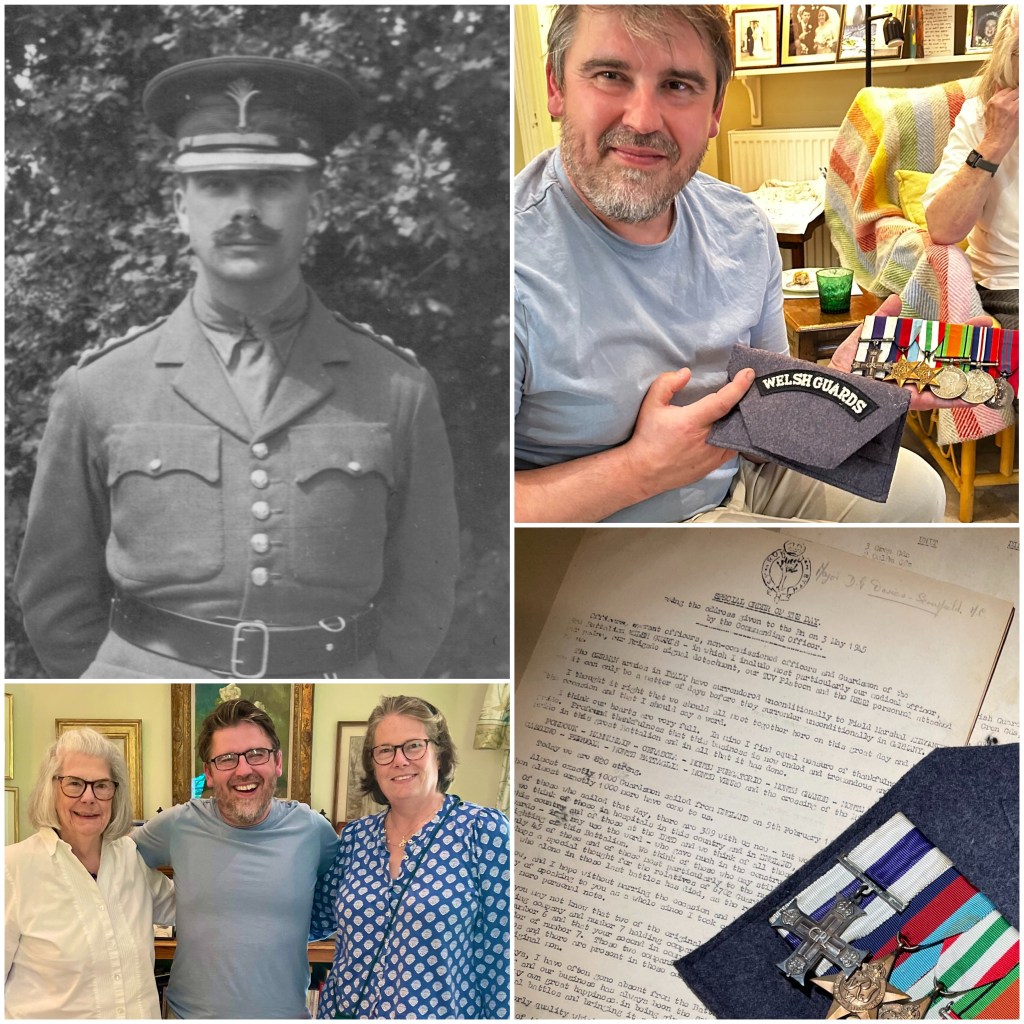
Now again, as regular readers will fully recognise, I am a self-confessed 3Bn Welsh Guards obsessor, but I have a very special, micro-niche, interest in the stories of No.1 Rifle Company, and particularly that of its No.1 Platoon. This is principally due to one of my Great-Grandfather 2733859 Glyn Spowart (Gdsm-L/Sjt [at various times]) spending his entire war within No.1 Platoon, No.1 Coy. As a consequence, anything No.1 Coy related always spikes my interest.
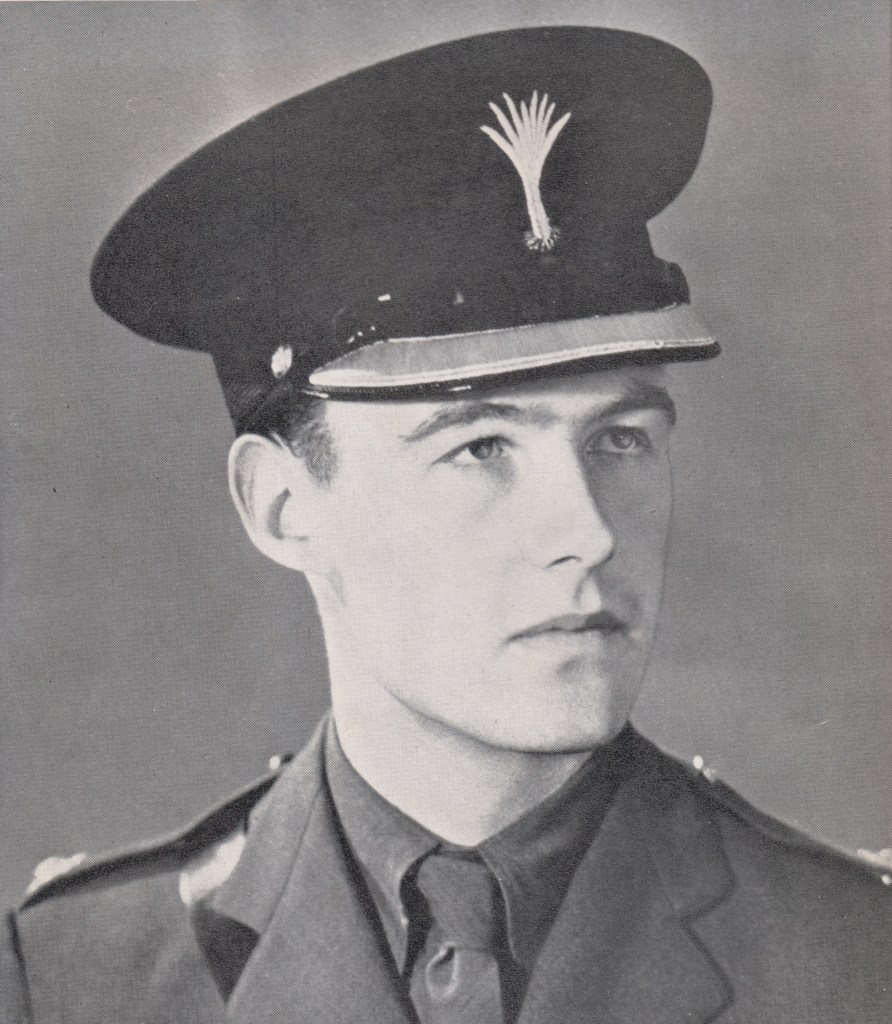
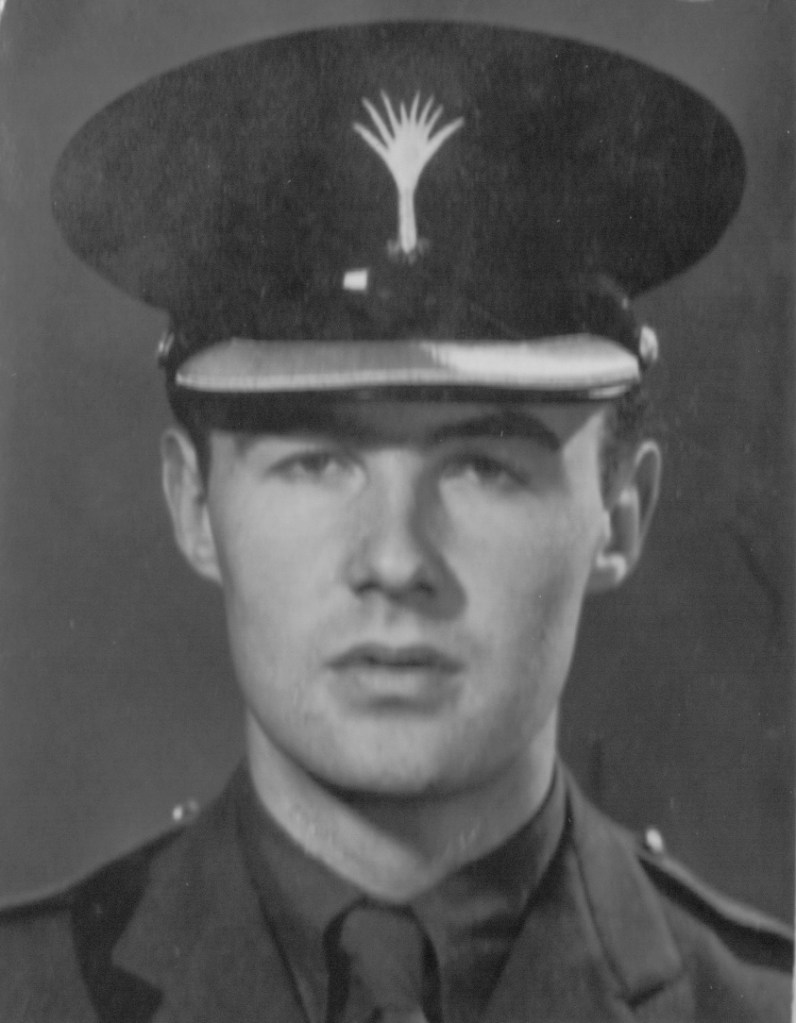
Going back to Tracey and the officer’s bio’s piece, I vividly recall reading various snippets of information about Anthony Schuster’s life.
He was an exceedingly bright young boy, who lost his mother whilst young. His early creative talents were both identified and recognised by national bodies. He was extremely well educated and a very young man when he joined the Welsh Guards in 1940. Moreover, he was the only son to a widowed father who had already suffered much during service in the First World War.
Whilst I was writing his biography, I delved a little deeper than normal wanting to know more. Through chance I became aware of a memoir book published by his father, following Anthony’s death, containing several of his son’s poems and letters. He intended it to serve as a memento of his son for others to ensure, perhaps so that he may live beyond death.
As my research intensified I acquired several documents covering his final days, but wasn’t able to ‘close the loop’ with the full story. Owing to having the utter privilege to have been able to meet, and be connected to ,over a hundred families of 3Bn officers and men, the archives they retained have been instrumental in building the story. Here and there I discovered more primary evidence regarding Anthony’s war which I have gradually pieced together over time.
Finally, my continuous attempts over several years to seek out a copy of his memoir book, to no avail, finally paid off in January 2026 as I struck gold and found a copy on ABE Books. I hurriedly snapped it up and couldn’t wait for it to land on the door mat. This book contained more that I had hoped for, and in many respects offered the final pieces of the jig-saw to the events that led to a talented young life being cut short in offering up the ultimate sacrifice.
The purpose of this article is tell Anthony’s story through the words of those who were there. Whilst it is a longer article than usual, I sincerely hope you enjoy it. Allied to that, I am currently writing the ever-growing book chapter covering 3Bn’s awful time holding Monte Cerasola in February 1944. It would be foolhardy to even try and give a full account of it ‘all’ here. Instead, I will provide a précis in order to tell Anthony’s story.
I had intended to publish this article on the 82nd anniversary of Anthony’s death (last Friday), but in order to give due diligence to providing a full account – it took a little longer.
I do hope you find it informative and that it serves to whet the appetite of what’s to come in my forthcoming book.
Anthony’s Memoire Book
As per the above, I am extremely grateful to own a copy of his book. Over several years of searching I have only found two copies for sale; the first I purchased, and literally days later another has been offered on ABE Books (link to the book on sale here **UPDATE 20 February 2026 ** this copy is no longer available, it was purchased by the Welsh Guards Regiment following this article).
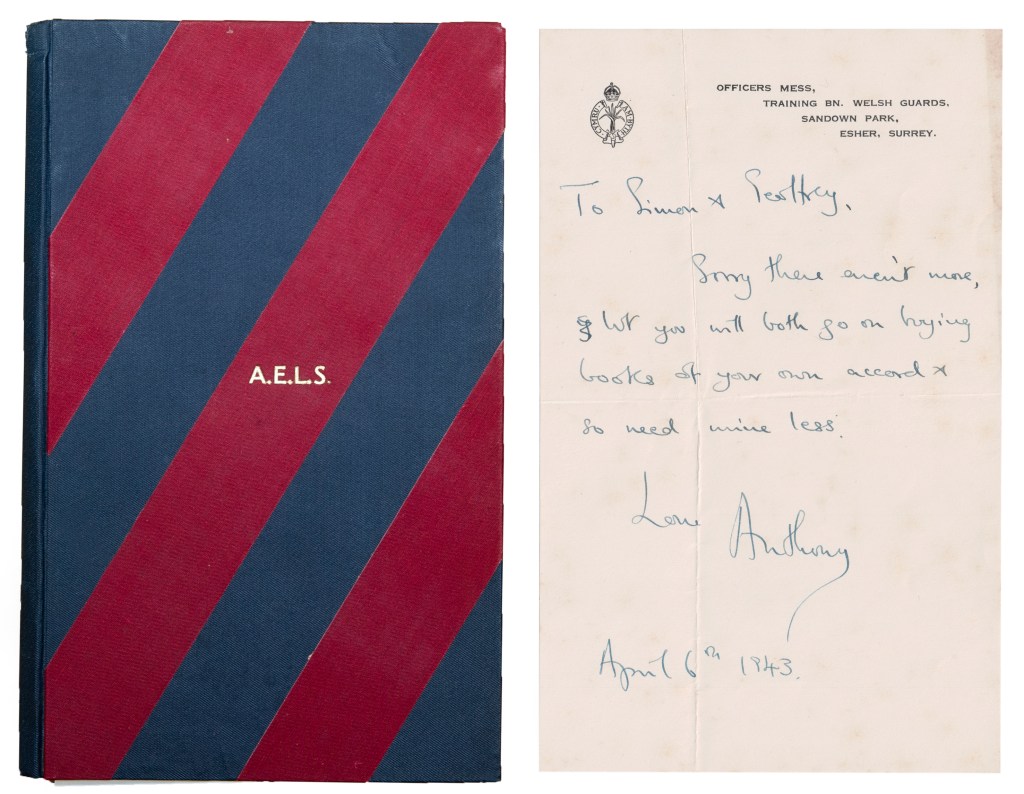
l was, again, extremely lucky to buy a copy which came with one of Anthony’s letters, presumably either Geoffrey or Simon (the recipients of the letter) had retained with the book. Inevitably the letter pre-dates the book. I’m ever so grateful to be able to own an item personal to him, and there is little else better than a letter.
As you can see, the book is emblazoned with the colours of the Brigade of Guards and is embossed with his initials. The poems inside, bar one, are all from his time in service with the Welsh Guards – mainly whilst a guardsman. They are just wonderful ! In addition, there are several excerpts of letters, documents and photographs contained within, a real 3Bn treasure trove.
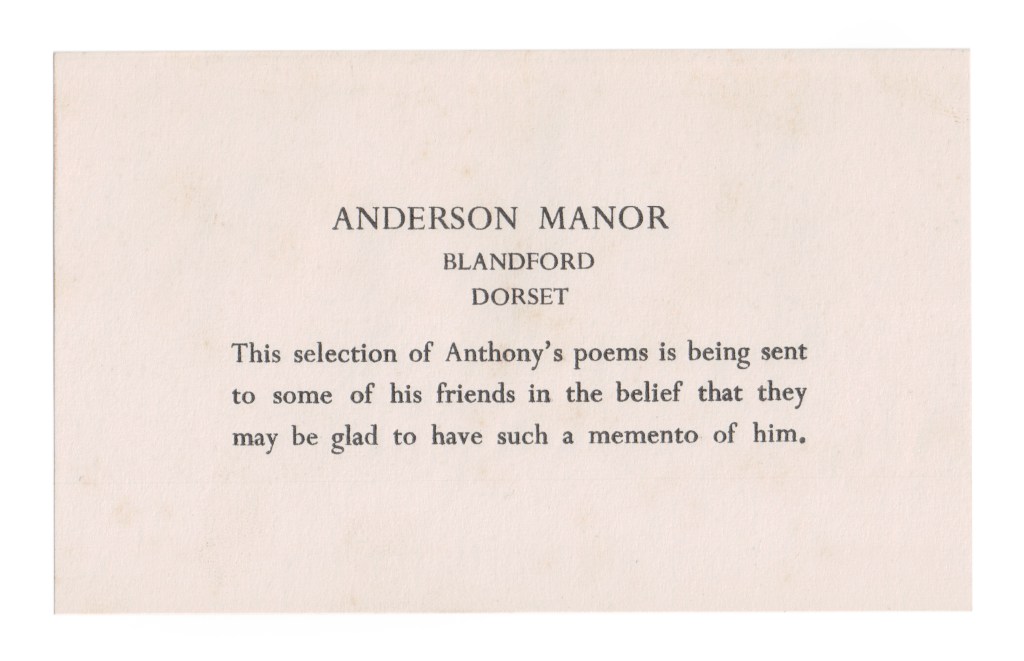
The book also came with a short message explaining the purpose of the book. Of note is that Anderson Manor in Blandford was the HQ for the Small Scale Raiding Force (SSRF), or No.62 Commando. Following its disbandment in 1943, it became a HQ for the Special Operations Executive (SOE).
Before I continue further, when Major Ellis wrote the (WW2) regimental history, Welsh Guards at War, he did an exemplary job of providing an extremely balanced and insightful account of terrifying ten days that ensued thereafter. My forthcoming book, The Forgotten Fighting Third, will pick up where Ellis inevetibly had to stop in order to be able to cover the rest of the war fought by all three Welsh Guards service battalions. I am now writing the substantial chapter covering Cerasola. As a result, it would be foolhardy to even try and give a full account here. Instead, I will provide a precis in order to tell Anthony’s story.
Early Life
Anthony Evelyn Loveday Shuster was born on 15 July 1921 at 68 Romney Street, Westminster to Lt. Leonard F Schuster and Edyth Shipton Schuster (née. Goodall). His father Leonard served with the 1/3rd County of London Yeomanry during the First World War and was wounded at Gallipoli on 2 September 1915. His mother Edyth Goodall was a well-known and successful actress who died in 1929 aged 47 following complications of surgery.
Of Anthony’s early years, his father writes:
“His earliest interest in the Arts was in drawing and to a lesser extent modelling. As soon as he could hold a pencil he drew anything that interested him and he surprised us with his facility for conveying the impression of cars or animals in motion. Three of his drawings made between the ages of two and four were bought by the Royal Drawing Society, and we thought that this was where his future lay.”
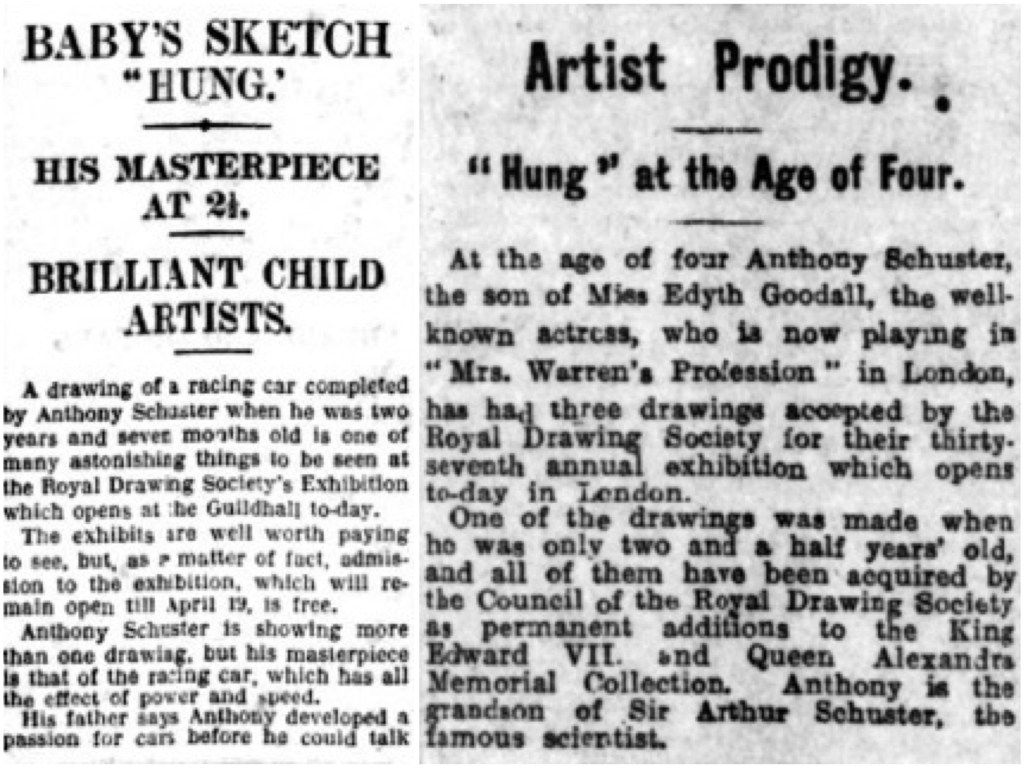
“My earliest recollection of his interest in writing is of his making letters out of twigs from the stick-box at our cottage at Tatsfield where he spent his early years! As this interest developed, drawing took second place and and he only made use of this facility to illustrate his writings.”
He was educated at Eton and later Cambridge, leaving the latter in June 1940. He worked the land for a couple of months before arriving at Caterham Barracks in September 1940 where he learned to become Guardsman 5829575 of the Welsh Guards. It should be noted that several 3Bn officers were offered a commission having initially joined or been drafted within the ranks. In Anthony’s case he got his commission in March 1941 as 2/Lt. 176789. He was later posted to 3Bn.
Following the destruction of 2 Hampshires at Terbourba in early December 1942, 3Bn was sent for to replace them in 1st Guards Brigade.
Likely being attuned to the prospect of an imminent deployment overseas, on 4 December 1942, The Reading Standard announced his engagement to Janet Mary Wallis of Goring. A short while later he was hospitalised with jaundice.
Upon the 3Bn’s mobilisation on 9 January 1943, all personnel under the hospital care were posted to ‘Home Details’. He was consequently posted from 3Bn to the Training Battalion on 11 January 1943 and would not initially go to Africa with the rest of the battalion.
Following his recovery, he spent some time in Canada supporting work with military mapping before arriving in Tunisia and re-joining 3Bn at Sidi Naceur on 28 April 1943. He was posted to No.2 Coy as a Platoon Commander on 30 April 1943, but was ‘left out of battle’ (L.O.B.) for 3Bn’s final major engagement in Tunisia at Hammam-Lif on 8 May 1943.
Italy 1944
Quoting from my last book:
“Following the defeat of Axis Forces in Tunisia on 14 May 1943 the 6th Armoured Division underwent a period of retraining and reorganisation in Tunisia and later Algeria. Elements of the division arrived in Italy in early January 1944 starting with the 16/5 Lancers. However, it was not the divisions’ armour that Alexander required but its infantry and artillery. On 5 February 1944, as a part of 1st Guards Brigade, 3Bn Welsh Guards disembarked from the Ville d’Oran at Naples harbour where it too became temporarily detached from the 6th Armoured Division.”
Upon arrival in Italy, the Welsh Guardsmen were immediately moved into the line under the command of 46th Infantry Division.
Following a last minute change of plan, on 10 February 1944 they were ordered to relieve the 2/4 Hampshires who had endured terrible casualties whilst holding Monte Cerasola in the Garigliano Salient. This was the southernmost element of the infamous Gustav Line.
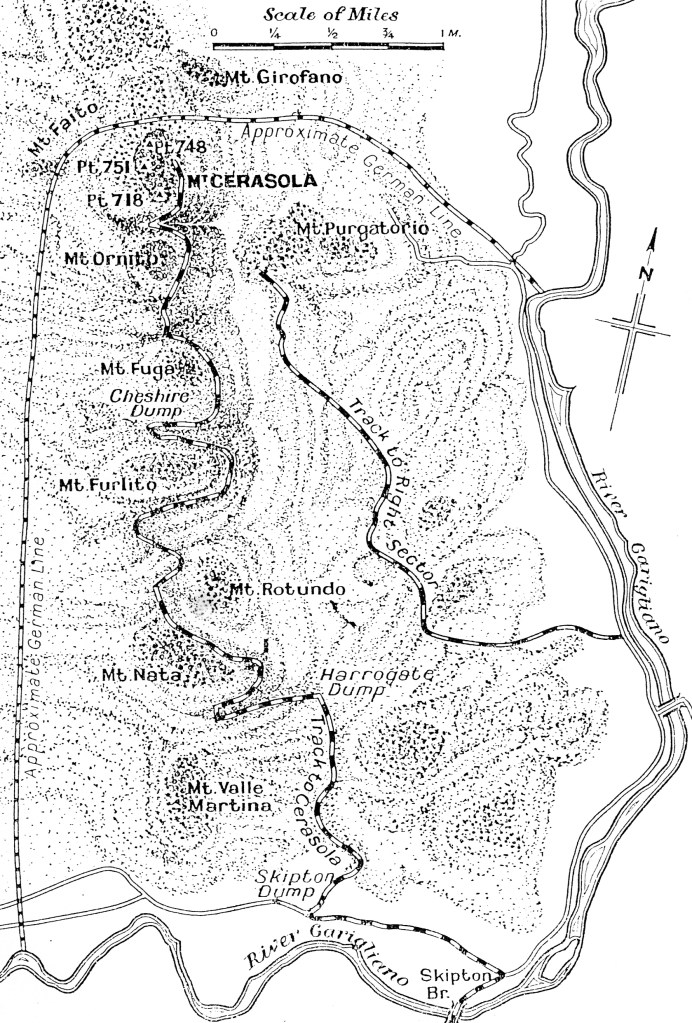
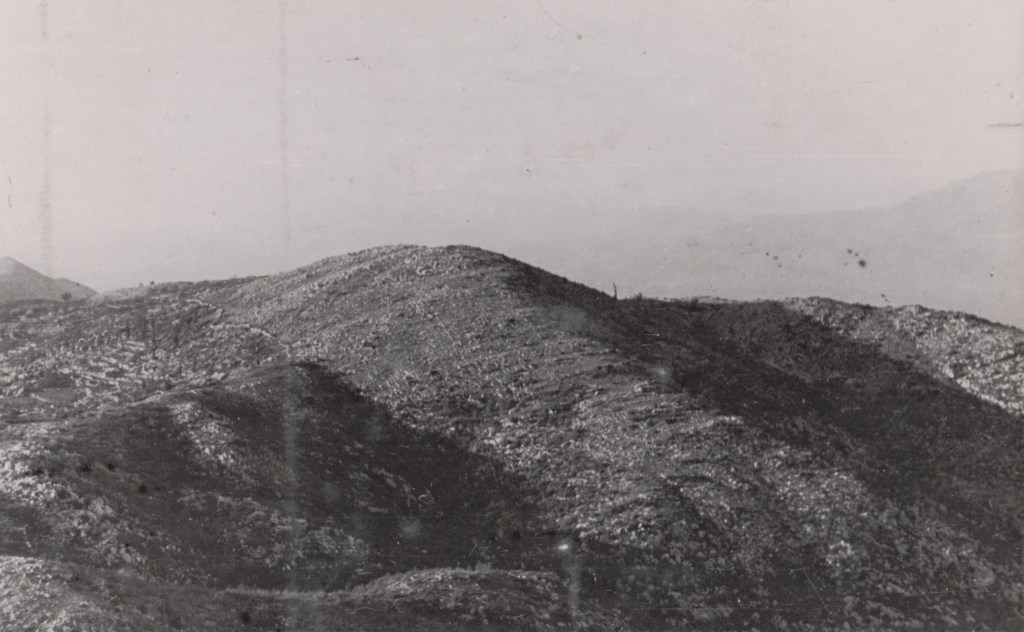
Monte Cerasola is a remote and desolate 748 metre peak. For Welsh readers: think Pen-Y-Fan in the Brecon Beacons (886 metres) altitude-wise, but it being surrounded by even larger peaks. The summit of the mountain is a mass of bare rocks, rising to crest line, 10 metres wide, bent in half circle towards the west (see the two maps and the photograph below). There and on the north side it falls steeply to the valleys which separate Cerasola from the heights of Faito and Girolfano, these being the main German held positions.
To get to Cerasola, 3Bn marched up the mountain tracks from their de-bussing point at Skipton Dump. This took several hours over two days. Ellis’s Welsh Guards at War recounts that on the 9 February “it started to rain as though the very flood gates of heaven were opened and to blow hard and cold”. On the morning of 10 February the men“tried with ill success to dry their sodden clothes and blankets in a wind which froze them stiff between showers that melted them into a soggy mess”.
Later that day they were led to Cerasola in a blizzard, and whilst nearly there, they could see the Hampshires in the midst of being attacked.
It was decided that the companies would occupy positions just below the crest line as follows; No.1 Coy at Pt.748, No.2 Coy at Pt.751 and No.3 Coy at Pt.718 (with No.4 Coy held in reserve). The Germans had outposts over the crest on the face of Cerasola which were overlooked from their main positions on Faito and Girofano.
I had surmised for some time that the German H.Q. where Anthony was buried was at the location marked in the map. It is located at the top end of the gulley that separated Cerasola from Ornito. It ‘had’ to be the place, indeed the ‘only’ house that fitted the multiple accounts.
On arrival, the men realised that Cerasola’s crest was of bare rock. This meant that there was no opportunity to ‘dig-in’ in the traditional sense. In lieu of this, they moved into the sangers (positions built of rock piles to offer protection) built by the Hampshires. As the Hamps had been heavily depleted, there were not enough sangers to house 3Bn’s four full-strength rifle companies. Those that were present needed significant modification to accept the physically larger guardsmen. The men set about building positions through the night in the snow, wind and rain. The Story of the 46th Division 1939-45 reinforces this in saying:
“In the eight days they spent on Ornito and Cerasola, before their relief by 3 Welsh Guards on 10th February, (the) Hampshires suffered nearly two hundred casualties from incessant mortaring and determined counter-attacks, the last and fiercest of which was driven off by a bayonet charge on the day of the relief. The Welsh Guards, with full strength companies and six-foot men, found it difficult to fit in the sangars”
Having just completed their sangers, at dawn on 11 February the German put in a concerted attack which centred on Pt.751 (see map below – then held by No.2 Coy). This was eventually repelled by two bayonet charges where on each occasion the officer leading the charge was killed.
Total casualties for the 10 and 11 February were 2 Officers and 18 ORs KIA, and 2 Officers and 60 ORs wounded. Only 38 men remained in No.2 Coy which was then withdrawn and replaced by No.4 Coy. For those so unfortunate to be wounded, they would endure a gruelling carry by stretcher down the slippery frozen tracks under constant mortar and shellfire – a journey that would take several painful hours, which many of them would not survive. In addition, the casualties mounted as a result of altitude sickness, exposure and frostbite in equal ratio to those caused by German artillery, mortars and bullets.
In his memoir, An Undistinguished Life, Lt. Andrew Gibson-Watt recounts that “Cerasola lived in everyone’s memories as the hardest and most unpleasant experience ever”.
No.1 Coy Patrol, 13/14 February 1944: Conflicting Accounts
Notwithstanding the attacks and losses of the previous days, (then) Lt.’Tim’ Bolton recalled that:
“active patrolling was essential, particularly when the enemy was close – and himself active. Night after night patrols had to go out, even if the result of them was frequently ‘nothing to report’, which of itself was valuable”.
As Ellis describes, the 3Bn War Diary for this period is “laconic“, with but a few words iterated for each day. The entire month of February is accounted for on one sheet of paper! This is hardly surprising given the situation they faced at that time.
Thankfully, the W3008 returns (which provide personnel rosters) show on 5 February 1944 that Anthony was the second in command of No.1 Coy, but retained the rank of Lieutenant. Regrettably, unlike later periods of the campaign (as above), there are no actual Patrol Report for Anthony’s action. There are however several accounts, with some conflicts, which I shall attempt to stitch together, chronologically, in order to tell his story.
Firstly, a Situation Report of the 1st Guards Brigade War Diary for the 14 February 1944 states:
“Last night 3WG sent a patrol of one offr and 16 other ranks fwd from No. 1 Coy to try and discover the enemy’s exact posns, and if possible to take a prisoner. The patrol left from No. 1 Coy and wheeled left until they were fired on by an M.G. 34 about 100 yds in advance of No. 4 Coys posn. Lt. Schuster threw grenades itno the M.G. post and rushed fwd. It is believed that he was wounded by his own grenade and is now missing“.
Extracts from letters (published within Anthony’s memorial book) sent by Lt.Col. ‘Willie’ Makins, who had already been evacuated from Cerasola with severe frostbite by this point, recalls that:
“Anthony commanded a fighting patrol that left our lines at 7.30 p.m. The object of the patrol was to knock out an enemy machine gun post which was established in front of our position but on the reverse slope of a crest. He led his patrol round the enemy’s left flank and bumped the M.G. post where expected.”
An after-action account retained within the family archive of Lt. Col. Davies-Scourfield states that:
“Of the patrols that were sent out, mention must be made of two in particular, the first was a fighting patrol of about 16 men under Anthony Schuster. His object was to clear the forward slopes of Cerasola ridge of the Bosche forward posts in order that we might establish our own forward Bren groups and thus control the ground in front of our positions. The patrol went out round our right flank and was encountered by an enemy M.G. post which the patrol leader attacked.“
No.1 Company Sergeant Major (CSM) 4034108 Bill ’08’ Davies in his account states:
“Sgt. Ben Garrison had a position on the extreme edge of the Company perimeter, a position fraught with danger and the first to be hit in an attack. After the first two attacks he had moved back a few yards and constructed a new line of sangers which blended with the rocks and was virtually undetectable from twenty feet away. It was through this position that Lt. Schuster took his patrol.”
Davies-Scourfield’s account then goes on to describe the action:
“The patrol went out round our right flank and was encountered by an enemy M.G. post which the patrol leader attacked. The patrol had got a bit split up in the dark when taking cover from the enemy fire, and Anthony Schuster decided to assault the post with himself and the only other Gdsm present. He was last heard rushing in throwing a grenade and calling upon the post to surrender, but he was apparently wounded and did not return“.
Makins’s letter continues to say:
Covered by the fire of part of his force, he led the assault on the enemy M.G. and was last seen running in throwing a grenade calling upon the enemy to put up their hands. The enemy post was too strong for the assault. When Anthony decided to go in, he had only one other guardsman with him who gave him fire support from a tommy gun – so that Anthony virtually assaulted the position alone. He must have thought it best to go straight for it in spite of only having himself and one guardmen there, rather than wait a few moments to collect the others who were only a few yards away, having taken cover when the enemy M.G. opened fire on them. It was a dark night and it was clear that in taking covert they allgot slightly out of touch and Anthony probably though that by throwing in a couple of grenades he would put out part of the post and get the others to surrender.
The remainder of the patrol waited some time in the hopes that Anthony would rejoin them but after a while, as he did not do so, they returned to their company, having inflicted several casualties on the enemy. It is quite impossible to get any more information as the night was very dark and one can only suppose he finished up in the Bosche post and was taken prisoner.”
The Daily Express on 26 January 1945 said of Schuster:
“On the 13 February 1944, with only one guardsman at his side, he led an assault on a German gun-post whilst the rest of his men took cover. A grenade exploded, stunning the guardsman, who recovered in time to see the Germans carrying somebody away to their lines. He assumed that they were carrying Schuster since he could find no trace of him. He further assumed that Schuster had been wounded or the Germans would not have taken him with them“.
Lt. Tim Bolton says of the patrol that:
“Lt. A E Schuster, went down into the valley beyond the ridge which 3WG held and was involved in a fight at a cottage”.
Other later (less reliable) reports quoted in newspapers all loosely conform to a similar story of the ‘patrol being sent out down the valley into no-mans-land by night to investigate a deserted cottage’. This will be covered later.
Patrol Summary

As can be seen, there are several conflicting accounts, particularly around the purpose of the patrol. From what is given, I feel that it is a fair to conclude that the 16 man patrol led by Anthony left the extreme right flank of No.1 Coy’s positon at 7.30 p.m. I believe that the purpose of the patrol is most likely an amalgam of all of three accounts given by Davies-Scourfield, the 1st Guards Brigade War Diary and Makins; namely to clear the forward slopes, obtain a prisoner and reconnoitre future forward positions.
Following the action Anthony was reported missing believed wounded. Strangely, there is no account of a missing person investigation, which was customary for all missing officers and men, within the specific missing person war diary. There are no reports of any other casualties from his patrol either.
Both Makins and Davies-Scourfield refer to Schuster’s gallant action and both say respectively:
Personal diary, Lt. Col, Davies-Scourfield:
“Quiet day in line. Spasmodic Shelling. Anthony Schuster takes out fighting patrol. Gallantly assaults M.G. post whilst alone and fails to return. Believed wounded“.
Extract from Makin’s letters:
“One thing is certain. He (Schuster) carried out a difficult job with the greatest courage and devotion to duty, and what amounted to a single-handed assault on the enemy post was an extremely brave action”
In terms of other participants of the patrol, I am able to identify two of the sixteen. After the action where Anthony became missing, another position was assualted and eight Germans were killed.
I have often wondered whether one of my own great-grandfathers, Glyn, participated in this patrol being that he stayed with No.1 Platoon, No.1 Coy throughout the campaigns in Tunisia and Italy. He was not wounded in Italy and was very lucky to leave Cerasola physically unscathed.
2737253 Guardsman Thomas James Llewellyn Arnold MM
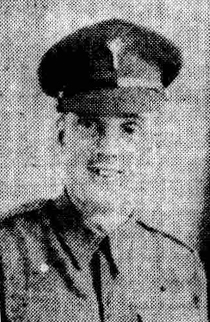
Gdsm. Arnold enlisted in the Welsh Guards on 25 July 1940. He was the only son of Mr. and Mrs. T. J. Arnold of 6 Richard Place, Swansea. Prior to the war he was a boiler scaler at Swansea Docks. In a letter Anthony sent to his father, he describes members of his Platoon, as the Platoon Commander. He says,“Arnold, another miner whose body has never been given enough food to develop, who is bitter with Socialism but gives me the most cheerful ‘Good Morning’ of the day”.
He won a periodic MM for his combined actions at Cerasola and the Bn’s first foray into the Cassino area during patrols into the southern part of the town from Monte Trocchio. Phil Brutton recounts in his book, Ensign in Italy, that he had twice took command of a section when his superiors were killed or wounded. The first at Cerasola and the second at Monte Piccolo in May 1944. He ended the war in Austria as a L/Sjt in No.1 Coy. He was discharged on 8 April 1946.
Gdsm. Arnold was the Tommy Gunner mentioned in the accounts who gave Anthony the covering fire as he assaulted the positions. His MM citation has been transcribed below:
1 January 1944 – 30 April 1944 (periodic), Military Medal, 6 Brit Armd Div. 13 Corps.
Period 1 Jan 44 – 30 Apr 44. This Gdsm. Has shown exemplary conduct both in action and during all periods out of the line. During this period he has been in action both in the GARIGLIANO sector on the RAPIDO, and in CASSINO. On all occasions he has been an example to all with whom he has come in contact. In particular, when a member of a fighting patrol on Mt. CERASOLA (Map ref 8604 Sheet 160. II SE 1/25,000) his exceptional courage and powers of leadership resulted in the killing of many Germans and the safe return of the patrol. When his offr who led the patrol decided to assault the position, Gdsm. ARNOLD who was the only member of the patrol nearby, unhesitatingly went in to the assault with his officer. He was temporarily stunned by a grenade and found his officer missing when he came to. He then went and collected other members of the patrol, returned to attack another enemy post inflicting casualties. Similarly on the RAPIDO HE WAS INSTRUMENTAL IN saving the lives of some wounded members of a patrol when he remained under fire in the area until all wounded had been evacuated and the patrol withdrawn.
770548 Guardsman Walter Jones MID
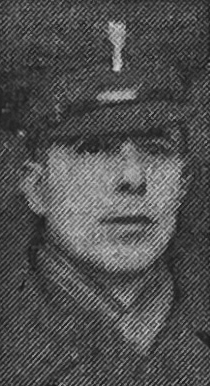
Gdsm. Jones enlisted in the Welsh Guards in the late 1920s. He was a miner and the son of Gomer and Keziah Jones of 3 Crown Road, Kenfig Hill, Glamorgan. He was one of one of four brothers serving in the forces, one of his brothers Sgt Thomas Jones was killed at Dunkirk in 1940. He was a good-all round sportsman and played rugby for the Guards and several London Clubs. He was also a walking champion.
He led Schuster patrol back to friendly lines having assualted another positon after Schuster became missing. Gdsm Jones was killed in action during the major (and final) German attack at Cerasola on 19 February 1944. He was 36 years old. He is buried at CWGC Cassino and remembered on the Pyle War Memorial. He was issued a MID for his actions at Cerasola, the citation miraculously survives:
This Guardsman was a member of a fighting patrol which came under heavy close range M.G. fire. When this post had been dealt with this Guardsman took command of a party from the patrol, who had now lost their officer, and led them to the attack on another enemy post which they destroyed. Gdsn. Jones’s courage and leadership were of a very high order and he was responsible for the safe return of his patrol after inflicting casualties on the enemy and searching unsuccessfully for the body of his officer who was missing, believed wounded. GDSN. JONES WAS SUBSEQUENTLY KILLED IN ACTION – POSTHUMOUS AWARD.
3 Coy Patrol, 16/17 February 1944: Relevance to Anthony
Another patrol was sent out on the night of the 16 February led by Lt. Bryan Pugh of No.3 Coy. He writes on 24 February that:
“After a certain amount of fighting in which L/C Beynon got wounded in both arms from an M.G. 34, we found ourselves together about 100yds in front of 4 Coy in the midst of a German position. As we had run out of ammunition and grenades, I decided to go over the ridge to get help from 4 Coy. When I left, L/C Paisley and L/C Beynon were together having taken cover in some rocks. L/C Paisley was unwounded.
A few minutes after I reached 4 Coy, the rest of my patrol followed with the exception of the above mentioned N.C.O.’s.. When 4 Coy did send out a patrol, these two could not be found.
In my opinion they were almost certainly taken prisoner, as the enemy was less than 50 yds away.”
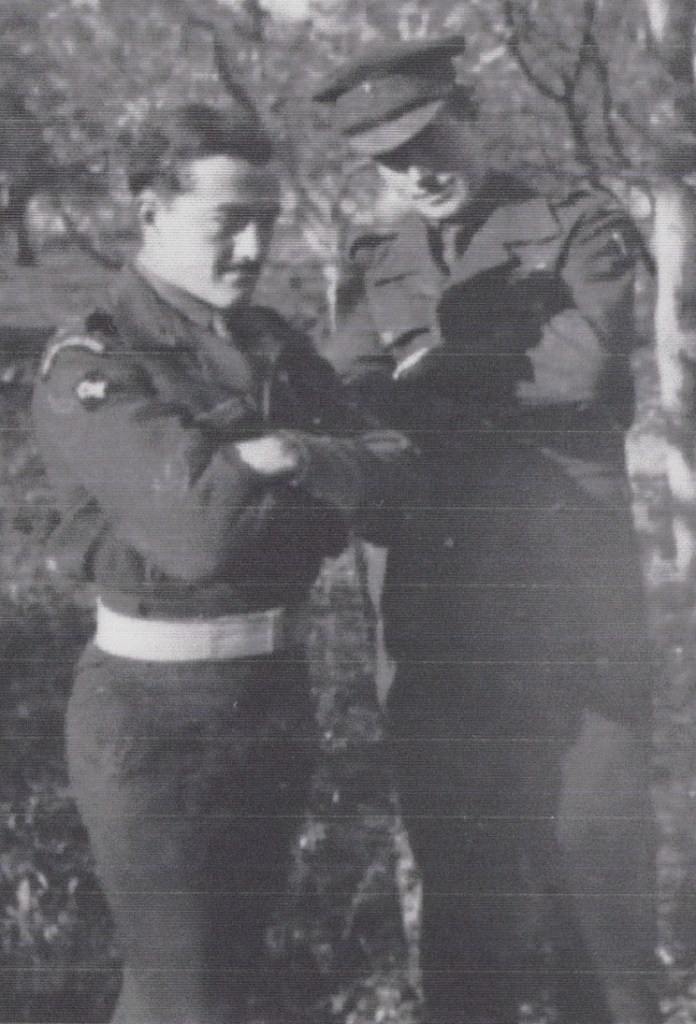
The two missing men were 2738029 L/Cpl Reginald Paisley and 2737129 L/Cpl David Beynon (wounded). Both were later confirmed as POWs.
As an aside, Lt. Pugh won the M.C. for his actions during this patrol.
February 1945
A year passed, with no further information regarding Anthony, and his status remained as ‘missing’. His father wrote in Anthony’s memorial book that:
“We heard no more till February 1945, when a notice in the Press enabled us to get in touch with a corporal in the Welsh Guards who was repatriated a few days earlier from a POW camp in Germany. He told us he had been wounded and taken prioner on a patrol two nights after Anthony had disappeared. When he was brought into the enemy post which was located in a farm house, the German officer pointed to a heap of stones near the entrance and said it was the grave of an officer of the Welsh Guards, ‘Herr Schuster’, who had died of wounds in the head two days earlier.
We got in touch with the Regiment and a patrol was sent up on to Monte Cerasola to look for the grave. It was found just where the Corporal had described it and Anthony’s remains were verified and transferred to the War Graves Cemetery at Minturno”
Aside from Anthony, there were only two others reported as missing from the Bn’s time holding Cerasola; they were L/Cpl’s Paisley and Beynon. Paisley was not released from captivity until April 1945 (see below), therefore it was unequivocally L/Cpl Beynon that responded to the appeal.
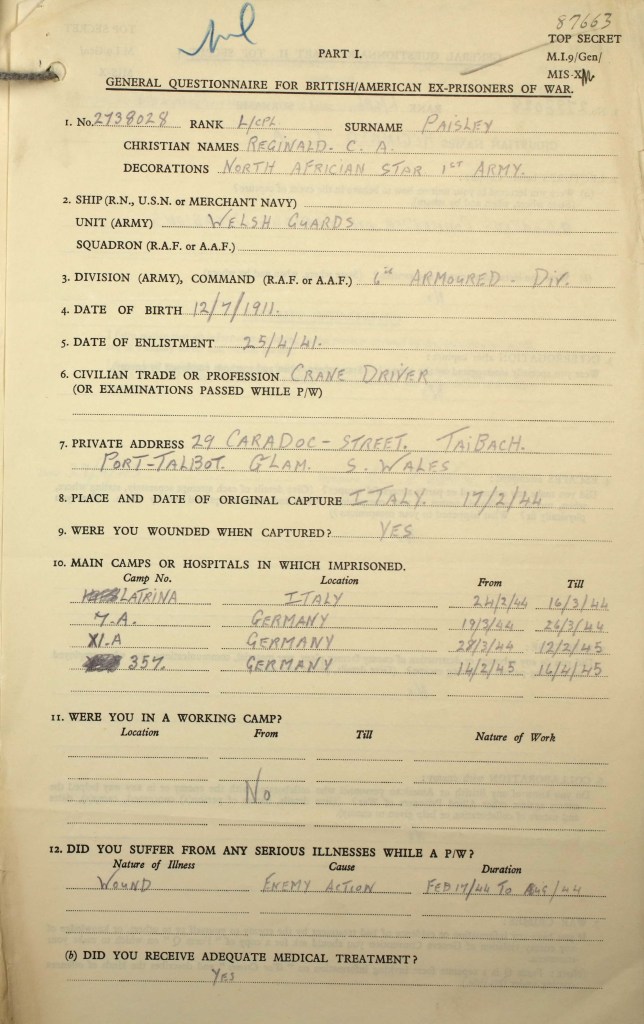
I am absolutely confident that both Anthony’s and Lt. Pugh’s patrols saw action at the same German strongpoint 100 yards ahead of No.4 Coys position on Pt.751.
The Expedition To Find Anthony
In March 1945, Lt. Ronnie Hedley-Dent was dispatched by Davies-Scourfield to locate Anthony’s remains. Extracts from a letter sent to Capt. Francis Egerton, 3Bn’s Adjutant, give an account of his finding:
“On reaching Cerasola 2733295 L/Sjt (Ronald) Williams … knew where Anthony’s patrol had gone had no difficulty in identifying the enemy position which the patrol had attacked, and the farm house which had been the German H.Q. Anthony’s grave was discovered on the right of the farm house by the side of two German graves. It consisterd of a pile of stones with a British steel helmet on top. The actual identification was comparatively easy, as the Brigade Stars, Welsh Guards Designations and finally Name Tapes on the Clothing.”
The letter goes on to describe his injuries with the author concurring that he would have “suffered very little”.
A photograph was seemingly taken by Lt. Hedley-Dent and passed to the family. Anthony’s father published it in his memorial book:
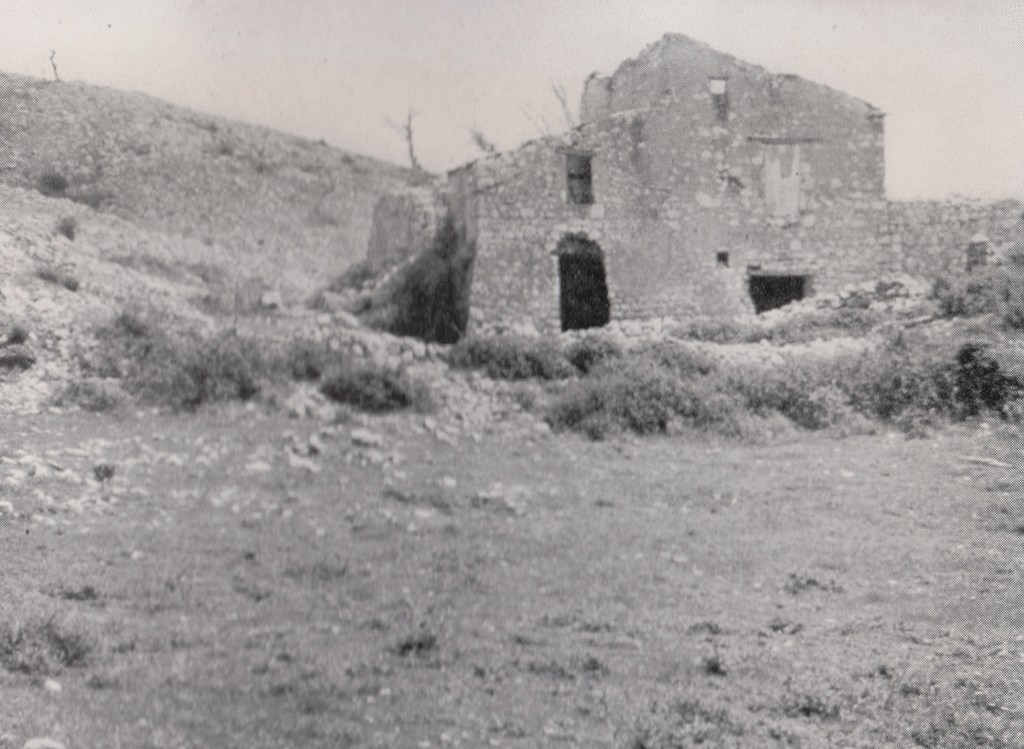
From the accounts, it is likely that Anthony was carried here by the Germans and passed away a short while after. It doesn’t appear that the patrol attacked this position from the account provided by L/Sjt Williams either.
The Final ‘Jig-Saw’ Piece
Enter Giuseppe Caucci of the Associazione Linea Gustav Fronte Garigliano. We had exchanged several messages to try and establish the location of the house pictured. Having scoured my original maps, I surmised it could only be in one specific area. Giuseppe, native to Castelforte and knows the area like the back of his hand, agreed with my theory of where the house was and was confident that the locations matched.
Yesterday, 18 February 2026, he dispatched his team to investigate – talk about impeccable timing!:
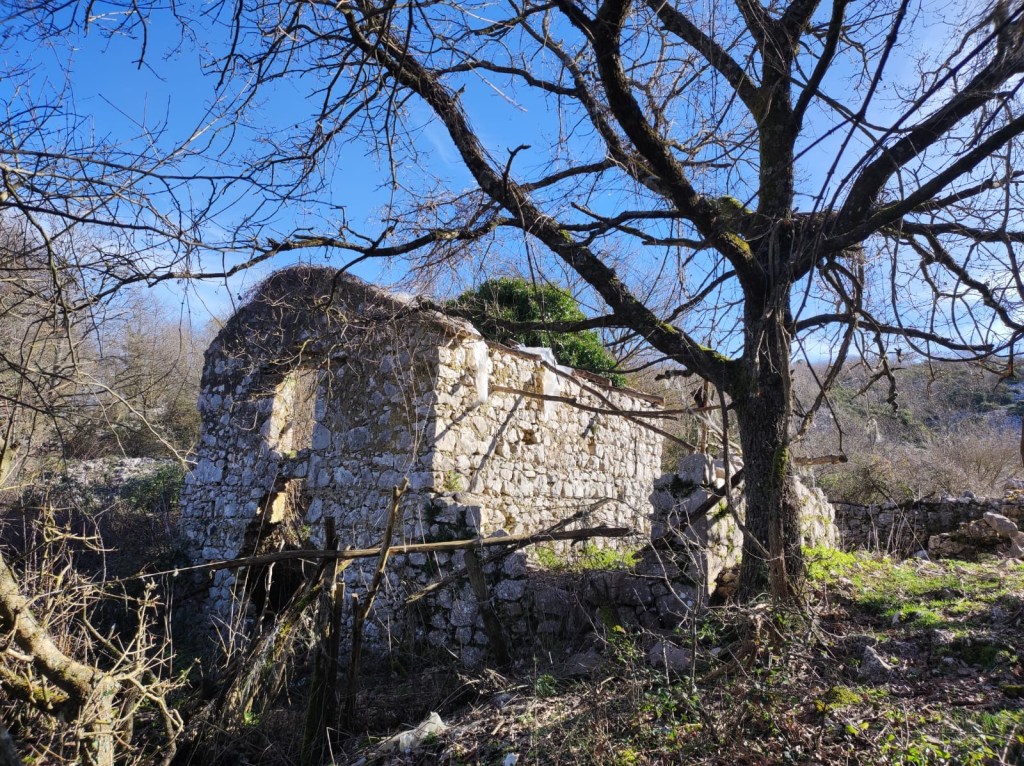
BINGO! This is undisputedly the same house – one can even match individual stones in the masonry work:
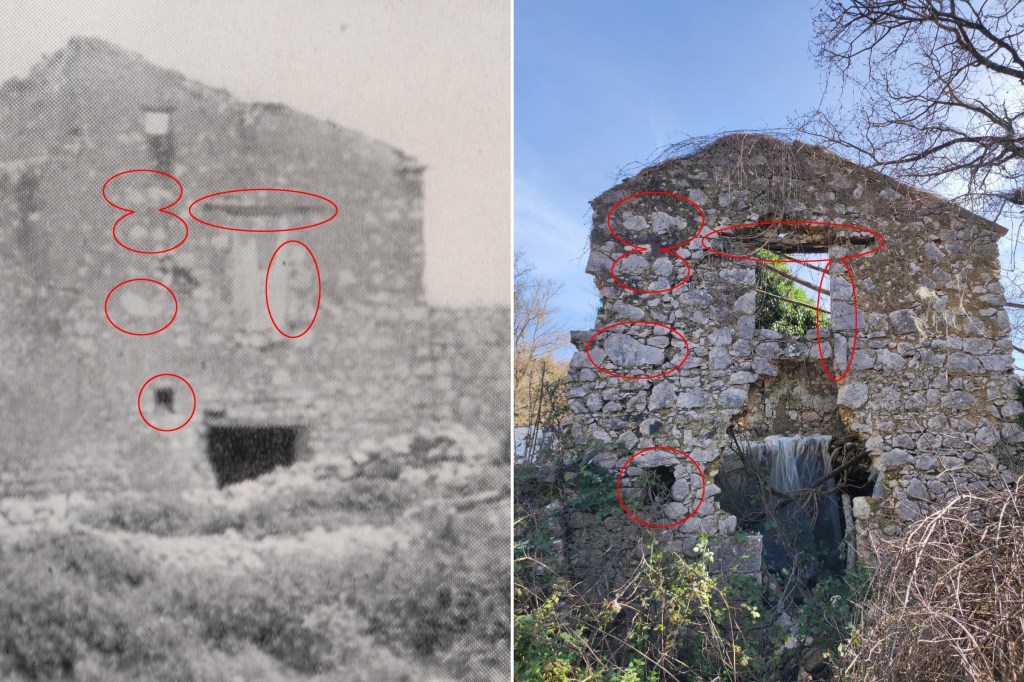
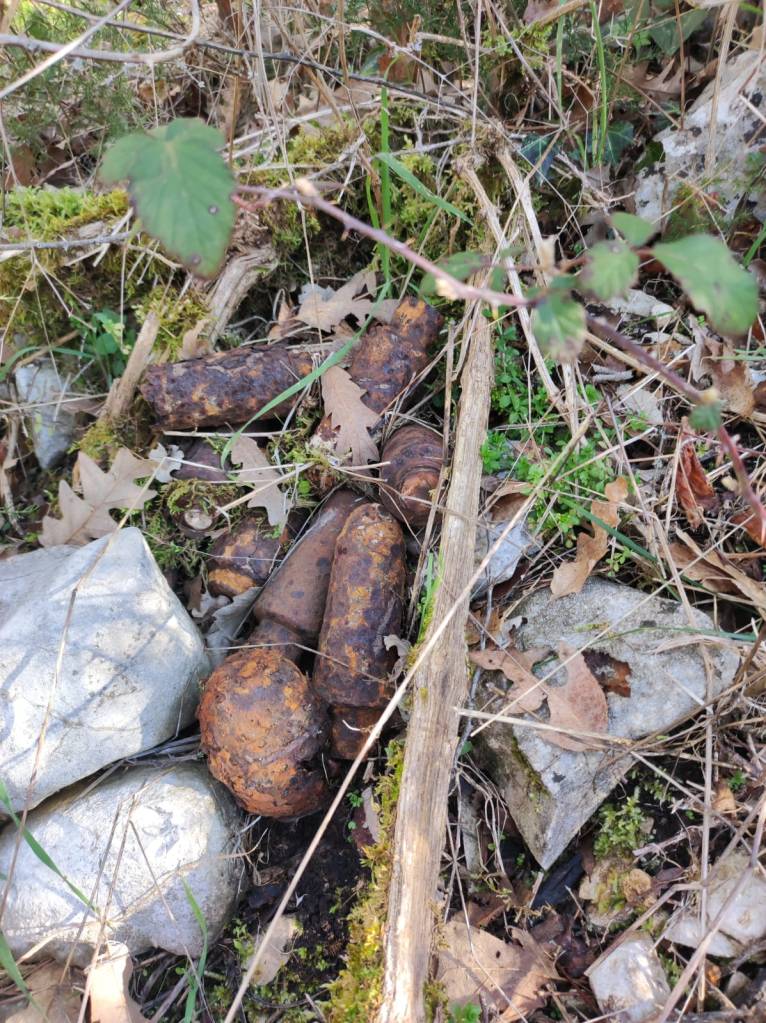
I sincerely hope that in the near future, God-willing, that I will be able to visit this area and identify the German positions that Anthony and Lt. Pugh attacked soon.
Conclusion
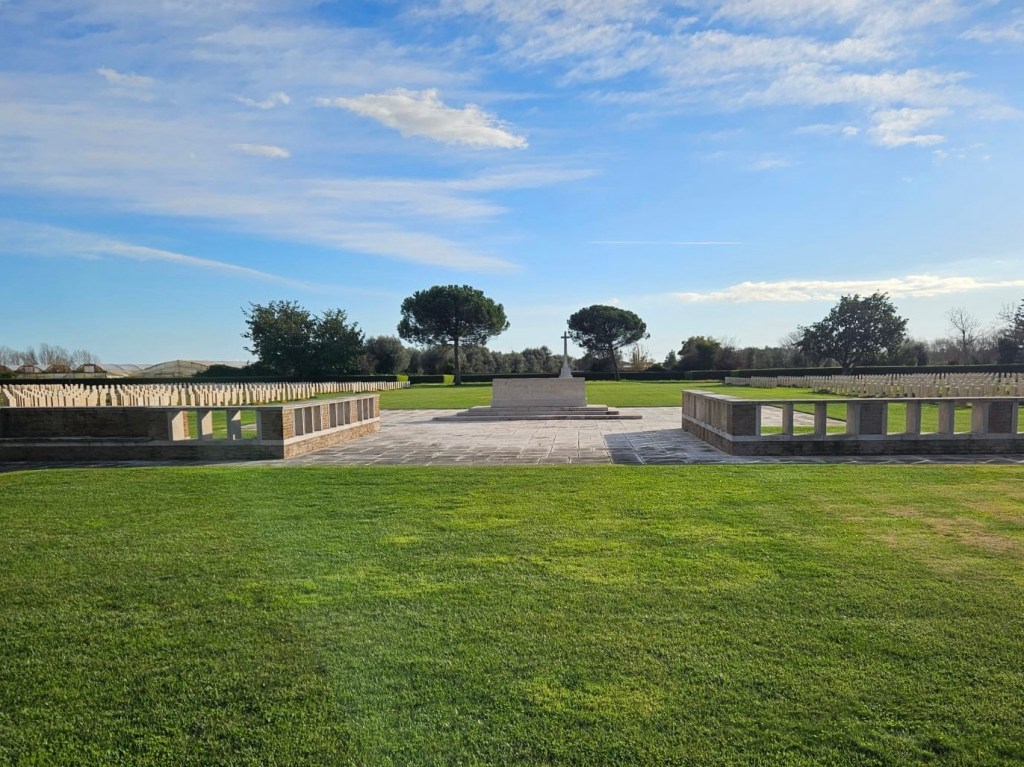
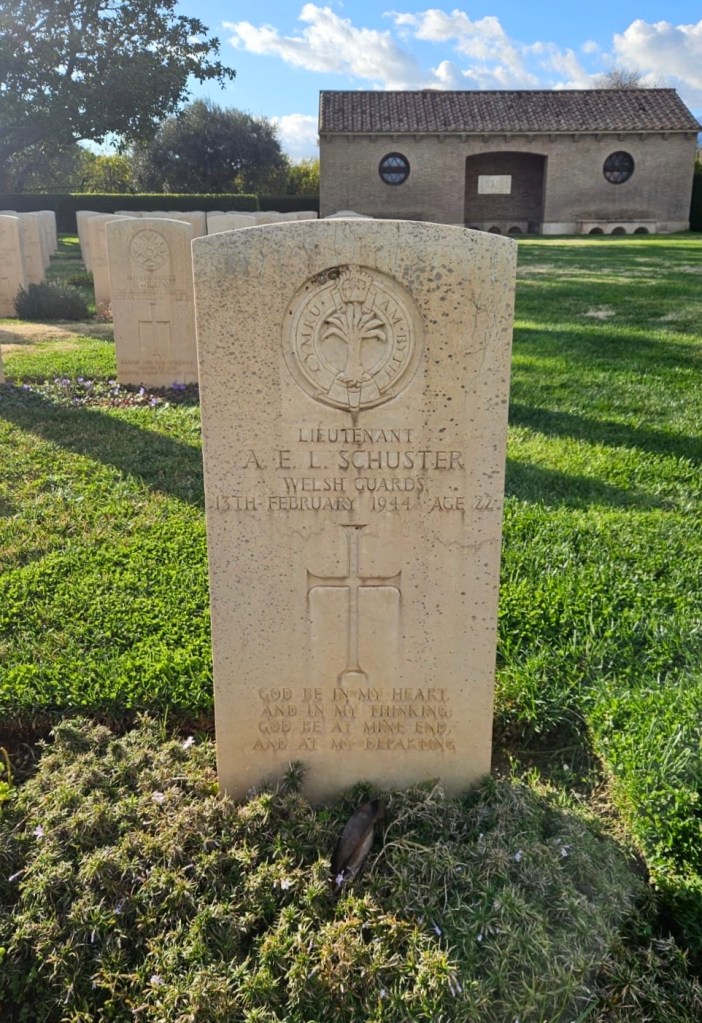
Anthony now rests at CWGC Minturno. He was 22 years old when he died. He was Mentioned in Despatches for his gallantry on this patrol, regrettably I have been unable to locate his citation.
His headstone is marked:
God be in my heart, and my thinking; God be at mine end, and my departing.
Upon learning of his death, Lt.Col. Makins wrote a letter to Anthony’s father:
“I shall always remember Anthony as I last saw him. I had sent him to contact our neighbours on the right rear of Cerasola (2Bn Coldstream Guards who were occupying Monte Ornito – a deep gulley separated Cerasola from Ornito), and later in the day the Brigadier ordered me to hand over to David (Davies-Scourfield) and go back to Bde. Hqrs. to rest ….
As I went back across the gulley I met Anthony coming back with his report. He pointed out to me all the positions the other Bn. were holding and I told him to go on to Bn. Hqrs and give David this information.
I was acutely aware of the fact that we were standing on the very exposed slope where we had been heavily shelled two days before on our way up to take over the position, and I was not at all anxious to linger in full view of the German O.P.
However Anthony had no such anxiety. He stood quite calmly, and went on with his report and even when he had given me a complete picture of the layout, and I had hobbled off as fast as I could go, I could see him still standing where he was – using his glasses (binoculars) for a further check up.
It was typical of his attitude to warfare. He knew just as well as I did the risk he was running but when he had a job to do he just ignored the possible results of doing it thoroughly”.
I sincerely thank you for staying with me through this 6000 word read – quite a bit longer than my usual posts. I sincerly hope you enjoyed reading about my journey of piecing together the facts regarding the tragic last day of a talented life taken, so young, in the most utterly selfless and courageous way.
Not least does it seek to honour Anthony, but all of those men who served with 3Bn.
I hope it also serves to illustrate the scale of the challenge I now face in bringing all of this micro-detail together.
I am currently engaged in writing the Cerasola chapter of my book which intends to build upon Ellis’s work to tell the story of The Forgotten Fighting Third.
I also hope you can see how I intend to use first hand accounts to tell their story blow-by-blow.
Diolch yn fawr iawn am aros a darllen,
Gareth
 Camouflaged Fist