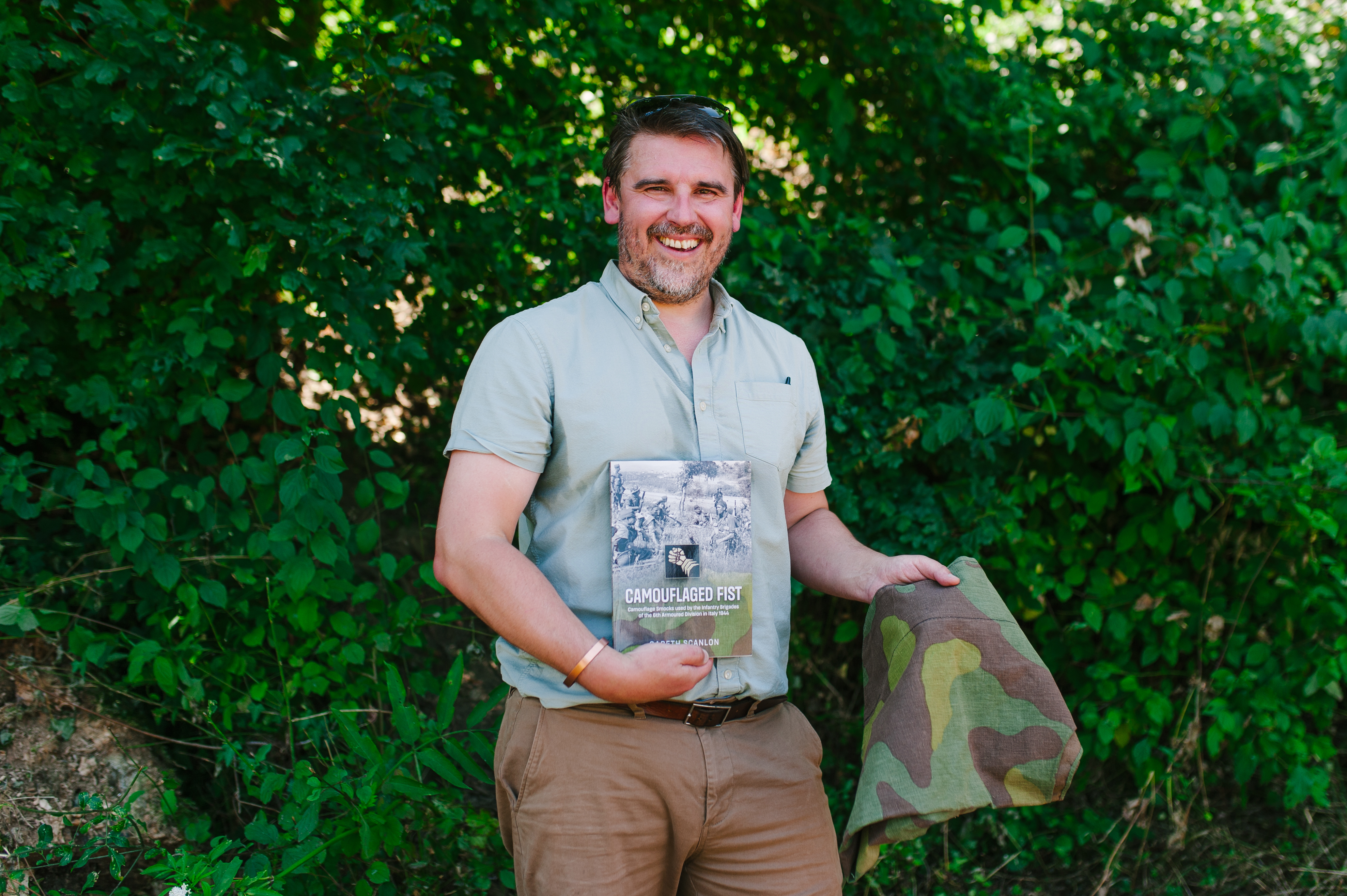

My first post, and as such I just wanted to say hello and tell you a little about me. I’m Gareth, a lay historian, with a strong interest in the Italian Campaign of 1943-45, particularly the 6th Armoured Division, 1st Guards Brigade and 3rd Battalion Welsh Guards.
This principally comes from the fact that I had two Great Grandfathers who served together in Italy with 3rd Battalion Welsh Guards. As many of us have done, over the last 20 years (on-and-off) I have tried to improve my understanding of this chapter of their lives and of their individual contributions to the collective defeat of fascism in Europe. One of my Great Grandfathers was 2733859 Glyn Spowart, a professional soldier who joined the regiment in 1934. He spent 552 days in active combat zones; three days at Boulogne in 1940, 97 days in Tunisia and 452 days in Italy.
Despite being dubbed the “soft underbelly of Europe” by Winston Churchill, the Italian campaign saw some of the hardest and most ferocious fighting of the war. The Allies were ill-prepared for Italy’s diverse climate and geography and they quickly discovered it did not play to their strengths as a highly mechanised and manoeuvrable modern army. Conversely, the Germans waged a war of denial and attrition, fighting a slow and tenacious retreat to prepared lines of defence using the mountainous terrain and multiple rivers to inflict maximum delay and destruction. General Mark Clark was certainly right in correcting Churchill’s comment in referring to Italy as “one tough gut”. The withdrawal of experienced Allied divisions in preparation for D-Day further exacerbated the challenges faced. This forced the Allied armies in Italy to continually develop, innovate and change to suit the situation and environment that presented.
During my research I stumbled across a high-resolution photograph, one that I had seen many times before, albeit poorly reproduced in other books. This image enabled me to positively identify Glyn in full battle order with his section (fourth from left, bare headed). Following the initial excitement of realising the incredible odds of uncovering an in the field photograph of him I became curious about the non-standard clothing he and his section were wearing. Readers will likely recognise the standard image of the Second World War Tommy neatly turned out in brown battledress and pack, however, in this photograph that was not the case; the men are wearing khaki US Army Enlisted Man’s shirts, denim battledress trousers, helmets covered in Indian pattern nets and most peculiarly enemy pattern M1929 Italian Telo Mimetico camouflage smocks. A blend of uniform from four countries.
3rd Battalion Welsh Guards, Route 71, L’Olmo, Arezzo, 16 July 1944

These smocks spiked my interest, but despite best efforts, it quickly became apparent that there was extremely limited information available regarding them. Being a tenacious type, I was unable to accept that there was ‘nothing out there’ and I commenced what would be over a year of intensive research of biographies, accounts, unit histories and War Diaries to battalion level. I have since visited the exact spot where the above photograph was taken exactly 80 years to the time and day, more on that soon!
The use of camouflage clothing by the British Army during the Second World War was predominantly confined to that issued to special forces troops including the Denison Smock used by the Paras and Commandos and to those operating in particular environments, for example in snow. This was later augmented by a more widespread issue of the Smock, Windproof, Camouflageto regular infantry units from 1943 onwards. For most infantrymen, personal concealment and camouflage equipment was limited to the use of a variety of helmet nets, blanco (a compound mixed with water used to colour webbing), blackening of skin and the personal net (face veil).
In the Mediterranean theatre there was substantial use of khaki drill tropical wear. Whilst being extremely comfortable and offering excellent camouflage in the desert of North Africa and the arid landscape of Southern Italy it was not suitable for the green and lushly grassed landscape of Umbria and Tuscany. Both wool and denim battledress would also have been too warm for the scorching Italian summer. Alex Bowlby of 2nd Battalion Rifle Brigade of 61st Infantry Brigade gives a personal view on the garment in July 1944:
“… everybody was issued with green camouflaged smocks. Our pale Khaki Drill, excellent camouflage in the Desert, now stuck out like a range target. German snipers had picked off so many men … that G.H.Q. (General Headquarters) ponderous ‘Think Machine’ had belatedly decided on a variation of the German camouflage suit, something the Germans have been wearing for years. The smock certainly gave us a sense of protection and in a curious way mine made me feel I had turned professional”1.
This loose and sleeveless one–size–fits–all camouflaged smock, repurposed from captured enemy pattern Italian M1929 TeloMimetico material, presented a perfect tactical solution to the climate and environment being faced. It was easily carried, light to wear over a shirt or battledress blouse and enabled the user to more effectively blend in with his surroundings. Their systematic in-theatre production exemplifies the problem solving through innovation approach that is seen throughout the Italian Campaign at strategic, tactical and operational levels.
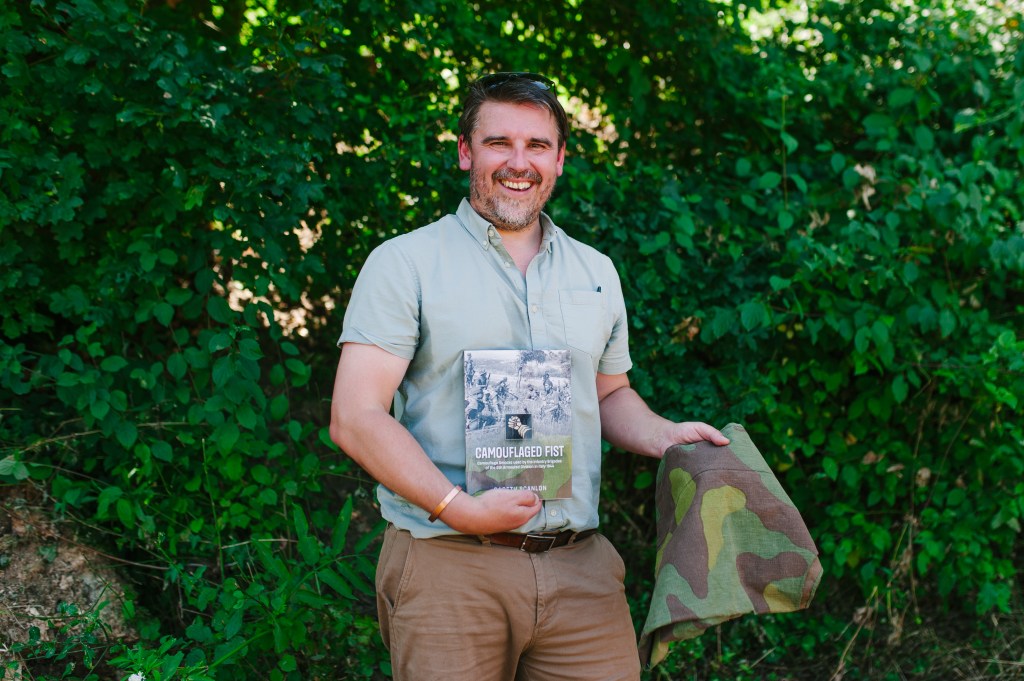
Authors Original Smock

I am confident that it fills a gap in the narrative about these garments and hope that it brings new attention and interest to the events and men that served in the Italian Campaign in redressing “what is often portrayed as a dull, unimaginative and colourless campaign”2
This research project (read obsession!) has culminated in Camouflaged Fist, my first book, which delivers an account to establish the who, what, why, where, when and how surrounding the use of these innovative garments through the lens of the infantry brigades of 6th Armoured Division. In doing so it uses a fully evidence based approach in featuring previously unpublished contemporary photographs and document to outline the drivers for change, set out when and where they were used, and how and by whom were they made.
Camouflaged Fist is available from Helion Publishing here.
I’m very much looking forward to sharing a lot more content regarding my interests in WW2 here soon.
Thank you !
Gareth
- Alex Bowlby, The Recollections of Rifleman Bowlby (London: Cassel Military Paperbacks, 1969, Reprint 2002), p.91. ↩︎
- Words of Nigel Warwick (Foreword), Scanlon Gareth, Camouflaged Fist – Camouflage Smocks used by the Infantry Brigades of the 6th Armoured Division in Italy 1944 (Warwick: Helion & Company Limited, 2024), p.x. ↩︎
 Camouflaged Fist
Well done!
LikeLiked by 1 person
Thank you Eddie 👍
LikeLike